
Transduction strategies in enzyme-free nanomaterial-based aptasensors for tetracycline antibiotics: A review

Q1 Engineering
Smart Materials in Medicine Pub Date : 2026-01-01 Epub Date: 2026-03-07 DOI:10.1016/j.smaim.2026.02.002
Minh Duc Luu , Mai Thi Tran , Son Hai Nguyen
{"title":"Transduction strategies in enzyme-free nanomaterial-based aptasensors for tetracycline antibiotics: A review","authors":"Minh Duc Luu ,&nbsp;Mai Thi Tran ,&nbsp;Son Hai Nguyen","doi":"10.1016/j.smaim.2026.02.002","DOIUrl":null,"url":null,"abstract":"<div><div>Enzyme-free aptamer-based biosensors have gained increasing attention for tetracycline monitoring, yet existing studies remain highly fragmented across materials and sensing formats. This review presents a mechanistic framework that systematically classifies optical and electrochemical aptasensors by their transduction pathways rather than by individual nanomaterials. Representative fluorescence, colorimetric, SERS, SPR, chemiluminescence, electrochemical impedance, voltammetric, photoelectrochemical, and electrochemiluminescent systems are critically compared to elucidate how aptamer conformational changes, interfacial interactions, and signal amplification mechanisms govern analytical performance. Beyond reporting detection limits, the review emphasizes real-sample applicability, discussing matrix effects, cross-selectivity among tetracycline analogues, and practical deployment constraints. Comparative analysis with conventional methods highlights biosensors as complementary tools for rapid, decentralized screening rather than direct replacements for laboratory-based quantification. Finally, emerging directions, including microfluidic integration, miniaturized readout systems, and intelligent data processing, are outlined as key strategies toward robust, portable, and field-deployable tetracycline-sensing platforms.</div></div>","PeriodicalId":22019,"journal":{"name":"Smart Materials in Medicine","volume":"7 ","pages":"Pages 93-115"},"PeriodicalIF":0.0000,"publicationDate":"2026-01-01","publicationTypes":"Journal Article","fieldsOfStudy":null,"isOpenAccess":false,"openAccessPdf":"","citationCount":"0","resultStr":null,"platform":"Semanticscholar","paperid":null,"PeriodicalName":"Smart Materials in Medicine","FirstCategoryId":"1085","ListUrlMain":"https://www.sciencedirect.com/science/article/pii/S2590183426000037","RegionNum":0,"RegionCategory":null,"ArticlePicture":[],"TitleCN":null,"AbstractTextCN":null,"PMCID":null,"EPubDate":"2026/3/7 0:00:00","PubModel":"Epub","JCR":"Q1","JCRName":"Engineering","Score":null,"Total":0}
引用次数: 0

Abstract

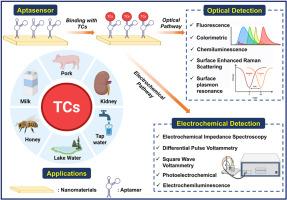
Enzyme-free aptamer-based biosensors have gained increasing attention for tetracycline monitoring, yet existing studies remain highly fragmented across materials and sensing formats. This review presents a mechanistic framework that systematically classifies optical and electrochemical aptasensors by their transduction pathways rather than by individual nanomaterials. Representative fluorescence, colorimetric, SERS, SPR, chemiluminescence, electrochemical impedance, voltammetric, photoelectrochemical, and electrochemiluminescent systems are critically compared to elucidate how aptamer conformational changes, interfacial interactions, and signal amplification mechanisms govern analytical performance. Beyond reporting detection limits, the review emphasizes real-sample applicability, discussing matrix effects, cross-selectivity among tetracycline analogues, and practical deployment constraints. Comparative analysis with conventional methods highlights biosensors as complementary tools for rapid, decentralized screening rather than direct replacements for laboratory-based quantification. Finally, emerging directions, including microfluidic integration, miniaturized readout systems, and intelligent data processing, are outlined as key strategies toward robust, portable, and field-deployable tetracycline-sensing platforms.
Abstract Image

基于纳米材料的无酶四环素类抗生素适体传感器的转导策略综述
基于无酶适配体的生物传感器在四环素监测中获得了越来越多的关注,但现有的研究在材料和传感格式方面仍然高度分散。这篇综述提出了一个机制框架,系统地分类光学和电化学感光传感器的转导途径,而不是单独的纳米材料。对代表性的荧光、比色、SERS、SPR、化学发光、电化学阻抗、伏安、光电化学和电化学发光系统进行了严格的比较,以阐明适体构象变化、界面相互作用和信号放大机制如何影响分析性能。除了报告检测限外,该综述还强调了实际样本的适用性,讨论了矩阵效应、四环素类似物之间的交叉选择性以及实际部署限制。与传统方法的比较分析强调,生物传感器是快速、分散筛选的补充工具,而不是实验室定量的直接替代品。最后,概述了新兴方向,包括微流控集成、小型化读出系统和智能数据处理,作为实现强大、便携和可现场部署的四环素传感平台的关键策略。
本文章由计算机程序翻译,如有差异,请以英文原文为准。
求助全文
约1分钟内获得全文 求助全文
来源期刊
Smart Materials in Medicine
Smart Materials in Medicine Engineering-Biomedical Engineering
CiteScore
14.00
自引率
0.00%
发文量
41
审稿时长
48 days

×
引用
GB/T 7714-2015
复制
MLA
复制
APA
复制
导出至
BibTeX EndNote RefMan NoteFirst NoteExpress
×
提示
您的信息不完整,为了账户安全,请先补充。
现在去补充
×
提示
您因"违规操作"
具体请查看互助需知
我知道了
×
提示
确定
请完成安全验证×
copy
已复制链接
快去分享给好友吧!
我知道了
右上角分享
点击右上角分享
0
联系我们:info@booksci.cn Book学术提供免费学术资源搜索服务,方便国内外学者检索中英文文献。致力于提供最便捷和优质的服务体验。 Copyright © 2023 布克学术 All rights reserved.
京ICP备2023020795号-1
ghs 京公网安备 11010802042870号
Book学术文献互助
Book学术文献互助群
群 号:604180095
Book学术官方微信
小红书


