
Influence of enzyme type and hydrolysis duration on the metabolite profiles of red sorghum (Sorghum bicolor L.): Untargeted metabolomic combined with chemometrics approach
IF 3.7
2区 农林科学
Q2 FOOD SCIENCE & TECHNOLOGY
引用次数: 0
Abstract
Red sorghum (Sorghum bicolor L. Moench) is a nutrient-rich cereal containing starch, proteins, lipids, non-starch polysaccharides, and health-promoting antioxidant phenolics. This study investigated the influence of enzyme type and hydrolysis duration on the metabolite profiles of sorghum hydrolysates to identify key bioactive constituents and determine optimal hydrolysis conditions.Hydrolysis was conducted using bromelain and papain at 60 °C, pH 7.6, across five time points (0–4 h), with an enzyme-to-substrate ratio of 1:10 (w/w). Metabolomic profiling was performed via High-Performance Liquid Chromatography-Orbitrap High-Resolution Mass Spectrometer (HPLC-Orbitrap-HRMS). Chemometric techniques, including Principal Component Analysis (PCA), partial least square-discriminant analysis (PLS-DA) and variable importance in projection (VIP) scoring, were applied to evaluate treatment effects on metabolite variations. Chemometric analysis revealed enzyme- and time-dependent alterations in red sorghum metabolites, with bromelain promoting greater diversity, particularly enriched in amino acids (L-phenylalanine), dipeptides (Leu-Leu), and flavonoids (taxifolin), especially with prolonged incubation. Chemometrics analyses demonstrated distinct metabolite patterns influenced by enzyme type and hydrolysis time, with amino acids serving as key discriminants.
These findings underscore the critical role of enzyme selection and incubation period in enhancing the functional profile of sorghum hydrolysates, positioning bromelain as a promising enzyme for generating bioactive-rich extracts.
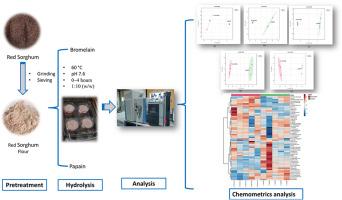
酶类型和水解时间对红高粱代谢产物谱的影响:非靶向代谢组学与化学计量学相结合的方法
红高粱(sorghum bicolor L. Moench)是一种营养丰富的谷物,含有淀粉、蛋白质、脂质、非淀粉多糖和促进健康的抗氧化剂酚类物质。本研究研究了酶类型和水解时间对高粱水解产物代谢谱的影响,以确定关键生物活性成分并确定最佳水解条件。用菠萝蛋白酶和木瓜蛋白酶在60 °C, pH 7.6, 5个时间点(0-4 h)进行水解,酶底比为1:10 (w/w)。代谢组学分析通过高效液相色谱-轨道阱高分辨率质谱仪(HPLC-Orbitrap-HRMS)进行。化学计量学技术,包括主成分分析(PCA)、偏最小二乘判别分析(PLS-DA)和投影变量重要性(VIP)评分,被用于评估治疗对代谢物变化的影响。化学测量分析揭示了红高粱代谢产物的酶和时间依赖性变化,菠萝蛋白酶促进了更大的多样性,特别是在长时间孵育下,氨基酸(l -苯丙氨酸)、二肽(亮氨酸)和类黄酮(杉木素)含量丰富。化学计量学分析表明,受酶类型和水解时间影响的代谢产物模式不同,氨基酸是关键的判别因子。这些发现强调了酶的选择和孵育时间在增强高粱水解物的功能方面的关键作用,将菠萝蛋白酶定位为一种有前途的酶,可以产生富含生物活性的提取物。
本文章由计算机程序翻译,如有差异,请以英文原文为准。
求助全文
约1分钟内获得全文
求助全文
来源期刊
Journal of Cereal Science
工程技术-食品科技
CiteScore
7.80
自引率
2.60%
发文量
163
审稿时长
38 days
期刊介绍:
The Journal of Cereal Science was established in 1983 to provide an International forum for the publication of original research papers of high standing covering all aspects of cereal science related to the functional and nutritional quality of cereal grains (true cereals - members of the Poaceae family and starchy pseudocereals - members of the Amaranthaceae, Chenopodiaceae and Polygonaceae families) and their products, in relation to the cereals used. The journal also publishes concise and critical review articles appraising the status and future directions of specific areas of cereal science and short communications that present news of important advances in research. The journal aims at topicality and at providing comprehensive coverage of progress in the field.
 求助内容:
求助内容: 应助结果提醒方式:

 京公网安备 11010802042870号


