
How germination conditions modulate the enzymatic activities, antioxidant potential and phenolic profile of chickpeas
IF 3.8
Q2 BIOTECHNOLOGY & APPLIED MICROBIOLOGY
Biocatalysis and agricultural biotechnology
Pub Date : 2026-02-01
Epub Date: 2026-01-29
DOI:10.1016/j.bcab.2026.103946
引用次数: 0
Abstract
This study investigated the impact of germination conditions, including different photoperiods (dark, light, and alternating dark/light) and incubation times (12–96 h), on the germination rate, enzyme activities, phenolic compounds, and antioxidant properties of chickpeas. Germination consistently enhanced the activity of antioxidant enzymes (catalase, peroxidase, ascorbate peroxidase, superoxide dismutase) and hydrolytic enzymes (α-amylase, protease, lipase) as incubation progressed. Germination rates varied significantly (p ≤ 0.05) with conditions, ranging from 40 to 63 % under dark, 13–50 % under light, and 23–63 % under alternating regimes. Total phenolic content (TPC) increased across all treatments, from 2.31 mg GAE/g in non-germinated grains to 4.24 mg GAE/g (72 h, dark), 4.16 mg GAE/g (96 h, light), and 4.21 mg GAE/g (96 h, alternating). Antioxidant properties increased during germination compared to the control (non-germinated grains). For ABTS, DPPH, and FRAP, the increases were 48 %, 203 %, and 152 % in the dark; 59 %, 161 %, and 170 % in the light; and 56 %, 116 %, and 163 % under alternating dark/light conditions. HPLC analysis revealed gallic acid and catechin as the compounds with the highest increases during germination. These findings highlight germination as an effective strategy to enhance the antioxidant potential of chickpeas, with direct implications for the development of functional foods that align nutrition, health, and consumer demands. Overall, optimizing germination parameters and understanding the underlying biochemical mechanisms are crucial for tailoring the bioactive compound profile in legumes.
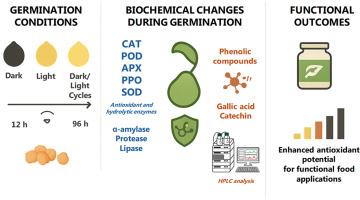
发芽条件如何调节鹰嘴豆的酶活性、抗氧化潜能和酚类成分
研究了不同光周期(暗、光、暗/光交替)和孵育时间(12-96 h)对鹰嘴豆发芽率、酶活性、酚类化合物和抗氧化性能的影响。随着培养的进行,萌发持续提高抗氧化酶(过氧化氢酶、过氧化物酶、抗坏血酸过氧化物酶、超氧化物歧化酶)和水解酶(α-淀粉酶、蛋白酶、脂肪酶)的活性。发芽率在不同条件下变化显著(p≤0.05),在黑暗条件下为40% ~ 63%,在光照条件下为13 ~ 50%,在交替条件下为23 ~ 63%。总酚含量(TPC)在所有处理中均有所增加,从未发芽籽粒的2.31 mg GAE/g增加到4.24 mg GAE/g (72 h,暗处理)、4.16 mg GAE/g (96 h,光处理)和4.21 mg GAE/g (96 h,交替处理)。与对照(未发芽谷物)相比,发芽期间抗氧化性能有所提高。ABTS、DPPH和FRAP在黑暗中分别增加48%、203%和152%;59%, 161%和170%的光;在暗/光交替条件下分别为56%、116%和163%。高效液相色谱分析显示,未食子酸和儿茶素是萌发过程中增加最多的化合物。这些发现强调发芽是提高鹰嘴豆抗氧化潜力的有效策略,对开发符合营养、健康和消费者需求的功能性食品具有直接意义。总的来说,优化发芽参数和了解潜在的生化机制对于调整豆科植物的生物活性化合物特征至关重要。
本文章由计算机程序翻译,如有差异,请以英文原文为准。
求助全文
约1分钟内获得全文
求助全文
来源期刊
Biocatalysis and agricultural biotechnology
Agricultural and Biological Sciences-Agronomy and Crop Science
CiteScore
7.70
自引率
2.50%
发文量
308
审稿时长
48 days
期刊介绍:
Biocatalysis and Agricultural Biotechnology is the official journal of the International Society of Biocatalysis and Agricultural Biotechnology (ISBAB). The journal publishes high quality articles especially in the science and technology of biocatalysis, bioprocesses, agricultural biotechnology, biomedical biotechnology, and, if appropriate, from other related areas of biotechnology. The journal will publish peer-reviewed basic and applied research papers, authoritative reviews, and feature articles. The scope of the journal encompasses the research, industrial, and commercial aspects of biotechnology, including the areas of: biocatalysis; bioprocesses; food and agriculture; genetic engineering; molecular biology; healthcare and pharmaceuticals; biofuels; genomics; nanotechnology; environment and biodiversity; and bioremediation.
 求助内容:
求助内容: 应助结果提醒方式:

 京公网安备 11010802042870号


