
Development of hydrolytically stable γ-cyclodextrin-based microparticles derived from MOFs for sustained pulmonary drug delivery
IF 5.2
3区 医学
Q1 PHARMACOLOGY & PHARMACY
Journal of Drug Delivery Science and Technology
Pub Date : 2026-03-01
Epub Date: 2026-01-28
DOI:10.1016/j.jddst.2026.108064
引用次数: 0
Abstract
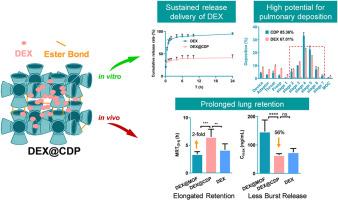
Chronic lung diseases remain challenging to treat due to inefficient drug delivery and rapid clearance from the respiratory tract. In this study, covalently crosslinked γ-cyclodextrin particles (CDPs) were synthesized from γ-cyclodextrin metal–organic frameworks (MOFs) via esterification with diphenyl carbonate. The obtained CDPs exhibited a uniform particle size (D50 = 1.19 μm) and a crosslinking degree of approximately 4. Structural and physicochemical characterizations indicated the successful covalent transformation, preserved internal cavities, and enhanced aqueous stability. Dexamethasone (DEX) was encapsulated within CDPs to form DEX@CDP complexes. Next generation impactor testing revealed superior aerosolization with fine particle fractions of 85.36 % (CDP) and 67.01 % (DEX), ensuring efficient deposition in the deep lung region. In vitro release studies showed sustained release, with less than 31 % of DEX released over 24 h. In vivo pharmacokinetic analysis demonstrated that DEX@CDP doubled mean residence time (MRT) and elimination half-life (t1/2) compared to inhaled DEX@MOF and intragastric DEX. Furthermore, CDPs exhibited excellent cytocompatibility toward A549 and J774A.1 cells (20–500 μg/mL) and favorable in vivo biocompatibility. These results indicate that the hydrolytically stable, cavity-retaining CDPs derived from MOFs are promising inhalable carriers for efficient and sustained pulmonary drug delivery.
开发水解稳定的基于γ-环糊精的mof微颗粒,用于持续肺给药
慢性肺部疾病仍然具有挑战性的治疗,由于低效的药物输送和快速清除从呼吸道。以γ-环糊精金属有机骨架(MOFs)为原料,与碳酸二苯酯酯化合成共价交联的γ-环糊精颗粒(CDPs)。所制得的CDPs粒径均匀(D50 = 1.19 μm),交联度约为4。结构和物理化学表征表明共价转化成功,保留了内部空腔,并增强了水稳定性。地塞米松(DEX)被包裹在CDPs内形成DEX@CDP复合物。新一代冲击器测试显示,其雾化效果较好,细颗粒含量为85.36 % (CDP)和67.01 % (DEX),确保了在深肺区域的有效沉积。体外释放研究显示,DEX的释放持续,在24 h内释放量小于31% %。体内药代动力学分析表明DEX@CDP与吸入DEX@MOF和胃内DEX相比,平均停留时间(MRT)和消除半衰期(t1/2)增加了一倍。此外,CDPs对A549和J774A.1 细胞具有良好的细胞相容性(20-500 μg/mL)和良好的体内生物相容性。这些结果表明,从mof衍生的水解稳定、保留腔体的CDPs是有效和持续的肺部药物输送的有前途的可吸入载体。
本文章由计算机程序翻译,如有差异,请以英文原文为准。
求助全文
约1分钟内获得全文
求助全文
来源期刊
CiteScore
8.00
自引率
8.00%
发文量
879
审稿时长
94 days
期刊介绍:
The Journal of Drug Delivery Science and Technology is an international journal devoted to drug delivery and pharmaceutical technology. The journal covers all innovative aspects of all pharmaceutical dosage forms and the most advanced research on controlled release, bioavailability and drug absorption, nanomedicines, gene delivery, tissue engineering, etc. Hot topics, related to manufacturing processes and quality control, are also welcomed.
 求助内容:
求助内容: 应助结果提醒方式:

 京公网安备 11010802042870号


