
Diagnostic and genomic characterization of an imported chikungunya virus case in Ningxia Hui Autonomous Region, China, September 2025

Infectious Medicine Pub Date : 2026-03-01 Epub Date: 2026-03-03 DOI:10.1016/j.imj.2026.100242
Jianxin Pei , Jingting Wang , Ling Niu , Ting Mu , Ziyang Luo , Shanshan Du , Huiqin Wang , Yuefen Zhang , Jiandong Li , Zhonglan Wu
{"title":"Diagnostic and genomic characterization of an imported chikungunya virus case in Ningxia Hui Autonomous Region, China, September 2025","authors":"Jianxin Pei ,&nbsp;Jingting Wang ,&nbsp;Ling Niu ,&nbsp;Ting Mu ,&nbsp;Ziyang Luo ,&nbsp;Shanshan Du ,&nbsp;Huiqin Wang ,&nbsp;Yuefen Zhang ,&nbsp;Jiandong Li ,&nbsp;Zhonglan Wu","doi":"10.1016/j.imj.2026.100242","DOIUrl":null,"url":null,"abstract":"<div><div>To analyze the first imported case of chikungunya virus (CHIKV) in Ningxia Hui Autonomous Region (Ningxia), China, and to provide insights for the prevention and control of emerging infectious diseases. An epidemiological investigation and viral detection was performed via quantitative reverse transcription polymerase chain reaction (qRT-PCR). The virus was further characterized using whole-genome sequencing and phylogenetic analysis. A 26-year-old female was confirmed to be infected with CHIKV. Genotypic analysis identified the East/Central/South African (ECSA) Indian Ocean Lineage (IOL), specifically the ECSA2 sub-lineage. A key mutation (E1-A226V), known to enhance viral adaptability to <em>Aedes albopictus</em>, was identified. Phylogenetic analysis revealed 99.21% nucleotide similarity to a CHIKV strain isolated in Foshan City, Guangdong Province, in 2025. No <em>Ae. aegypti</em> or <em>Ae. albopictus</em> were found in Ningxia. This imported case of CHIKV in Ningxia, genetically linked to the ECSA-IOL lineage carrying the E1-A226V mutation, underscores the risk of introduction and potential local transmission of arboviruses via domestic travel. Enhanced surveillance, timely diagnosis, and effective management of imported cases are essential for preventing outbreaks.</div></div>","PeriodicalId":100667,"journal":{"name":"Infectious Medicine","volume":"5 1","pages":"Article 100242"},"PeriodicalIF":0.0000,"publicationDate":"2026-03-01","publicationTypes":"Journal Article","fieldsOfStudy":null,"isOpenAccess":false,"openAccessPdf":"","citationCount":"0","resultStr":null,"platform":"Semanticscholar","paperid":null,"PeriodicalName":"Infectious Medicine","FirstCategoryId":"1085","ListUrlMain":"https://www.sciencedirect.com/science/article/pii/S2772431X26000080","RegionNum":0,"RegionCategory":null,"ArticlePicture":[],"TitleCN":null,"AbstractTextCN":null,"PMCID":null,"EPubDate":"2026/3/3 0:00:00","PubModel":"Epub","JCR":"","JCRName":"","Score":null,"Total":0}
引用次数: 0

Abstract

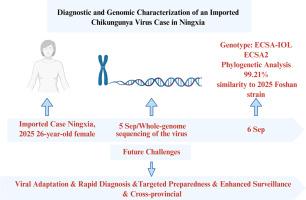
To analyze the first imported case of chikungunya virus (CHIKV) in Ningxia Hui Autonomous Region (Ningxia), China, and to provide insights for the prevention and control of emerging infectious diseases. An epidemiological investigation and viral detection was performed via quantitative reverse transcription polymerase chain reaction (qRT-PCR). The virus was further characterized using whole-genome sequencing and phylogenetic analysis. A 26-year-old female was confirmed to be infected with CHIKV. Genotypic analysis identified the East/Central/South African (ECSA) Indian Ocean Lineage (IOL), specifically the ECSA2 sub-lineage. A key mutation (E1-A226V), known to enhance viral adaptability to Aedes albopictus, was identified. Phylogenetic analysis revealed 99.21% nucleotide similarity to a CHIKV strain isolated in Foshan City, Guangdong Province, in 2025. No Ae. aegypti or Ae. albopictus were found in Ningxia. This imported case of CHIKV in Ningxia, genetically linked to the ECSA-IOL lineage carrying the E1-A226V mutation, underscores the risk of introduction and potential local transmission of arboviruses via domestic travel. Enhanced surveillance, timely diagnosis, and effective management of imported cases are essential for preventing outbreaks.
Abstract Image

2025年9月宁夏一例输入性基孔肯雅病毒病例的诊断和基因组特征分析
目的分析宁夏回族自治区首例输入性基孔肯雅病毒(CHIKV)病例,为新发传染病防控提供依据。采用定量反转录聚合酶链反应(qRT-PCR)进行流行病学调查和病毒检测。利用全基因组测序和系统发育分析进一步鉴定了该病毒。一名26岁女性被证实感染了CHIKV病毒。基因型分析确定了东/中/南非(ECSA)印度洋谱系(IOL),特别是ECSA2亚谱系。发现了一种关键突变(E1-A226V),已知可增强病毒对白纹伊蚊的适应性。系统发育分析显示,该病毒与2025年从广东省佛山市分离的一株CHIKV病毒具有99.21%的核苷酸相似性。没有Ae。埃及伊蚊宁夏有白纹伊蚊。宁夏的这一输入性CHIKV病例在遗传上与携带E1-A226V突变的ECSA-IOL谱系相关,强调了虫媒病毒通过国内旅行传入和可能在当地传播的风险。加强监测、及时诊断和有效管理输入病例对于预防疫情至关重要。
本文章由计算机程序翻译,如有差异,请以英文原文为准。
求助全文
约1分钟内获得全文 求助全文
来源期刊
CiteScore
1.40
自引率
0.00%
发文量
0
×
引用
GB/T 7714-2015
复制
MLA
复制
APA
复制
导出至
BibTeX EndNote RefMan NoteFirst NoteExpress
×
提示
您的信息不完整,为了账户安全,请先补充。
现在去补充
×
提示
您因"违规操作"
具体请查看互助需知
我知道了
×
提示
确定
请完成安全验证×
copy
已复制链接
快去分享给好友吧!
我知道了
右上角分享
点击右上角分享
0
联系我们:info@booksci.cn Book学术提供免费学术资源搜索服务,方便国内外学者检索中英文文献。致力于提供最便捷和优质的服务体验。 Copyright © 2023 布克学术 All rights reserved.
京ICP备2023020795号-1
ghs 京公网安备 11010802042870号
Book学术文献互助
Book学术文献互助群
群 号:604180095
Book学术官方微信
小红书



