{"title":"Threshold dynamics of mass extinctions and human famine risk","authors":"Kunio Kaiho","doi":"10.1016/j.eve.2026.100114","DOIUrl":null,"url":null,"abstract":"<div><div>Large-scale continental volcanism, meteoroid impacts, and nuclear war can inject massive amounts of sulfur dioxide or soot into the stratosphere, causing solar dimming, global cooling, reduced rainfall, and—at extremes—global famine and mass extinction. Using Phanerozoic data, this study quantifies animal extinction magnitudes and human famine risk under such scenarios. We find a nonlinear threshold: species loss surges from a few percent to 20–40% when soot exceeds 100–120 Tg or volcanic ejecta surpasses 500,000–700,000 km<sup>3</sup>. Human population loss from food shortages increases more gradually, reaching 50–80% beyond these thresholds. These tipping points may be exceeded by massive eruptions, large asteroid impacts, or full-scale nuclear war. Our results offer a unified model for extinction mechanisms and underscore the grave risks these events pose to biodiversity and human survival.</div></div>","PeriodicalId":100516,"journal":{"name":"Evolving Earth","volume":"4 ","pages":"Article 100114"},"PeriodicalIF":0.0000,"publicationDate":"2026-01-01","publicationTypes":"Journal Article","fieldsOfStudy":null,"isOpenAccess":false,"openAccessPdf":"","citationCount":"0","resultStr":null,"platform":"Semanticscholar","paperid":null,"PeriodicalName":"Evolving Earth","FirstCategoryId":"1085","ListUrlMain":"https://www.sciencedirect.com/science/article/pii/S2950117226000105","RegionNum":0,"RegionCategory":null,"ArticlePicture":[],"TitleCN":null,"AbstractTextCN":null,"PMCID":null,"EPubDate":"2026/2/18 0:00:00","PubModel":"Epub","JCR":"","JCRName":"","Score":null,"Total":0}
引用次数: 0
Abstract
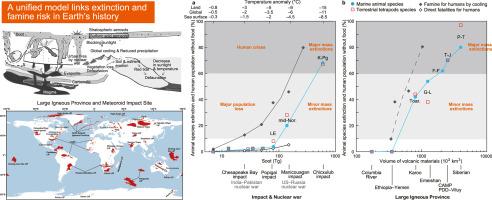
Large-scale continental volcanism, meteoroid impacts, and nuclear war can inject massive amounts of sulfur dioxide or soot into the stratosphere, causing solar dimming, global cooling, reduced rainfall, and—at extremes—global famine and mass extinction. Using Phanerozoic data, this study quantifies animal extinction magnitudes and human famine risk under such scenarios. We find a nonlinear threshold: species loss surges from a few percent to 20–40% when soot exceeds 100–120 Tg or volcanic ejecta surpasses 500,000–700,000 km3. Human population loss from food shortages increases more gradually, reaching 50–80% beyond these thresholds. These tipping points may be exceeded by massive eruptions, large asteroid impacts, or full-scale nuclear war. Our results offer a unified model for extinction mechanisms and underscore the grave risks these events pose to biodiversity and human survival.


 求助内容:
求助内容: 应助结果提醒方式:

 京公网安备 11010802042870号


