
Is there a three-instar pathway in the development of the Japanese pine sawyer? A revised hypothesis for the life cycle
IF 1.3
3区 农林科学
Q3 ENTOMOLOGY
Journal of Asia-pacific Entomology
Pub Date : 2026-03-01
Epub Date: 2026-02-21
DOI:10.1016/j.aspen.2026.102537
引用次数: 0
Abstract
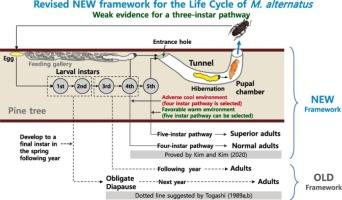
The Japanese pine sawyer (JPS), Monochamus alternatus, is the primary vector of the pine wood nematode, the causal agent of pine wilt disease. Despite more than five decades of intensive research, its complete life cycle—particularly the developmental pathways defined by larval instar number prior to pupation—remains incompletely resolved. This study reexamines JPS’s life cycle from the perspective of instar-pathway (IP) selection. While four- and five-instar pathways (4-IP and 5-IP) have been documented, empirical support for a three-instar pathway (3-IP) has remained inconclusive. We tracked the full developmental trajectories of individually marked larvae from egg hatch to pupal chamber construction under near-natural field conditions. Special attention was given to tunnel-digging behavior, a characteristic sequence of boring and entrance-hole plugging that precedes overwintering. Our observations indicate that the initiation of tunnel-digging behavior coincides with the completion of IP selection. All individuals committed to an IP only after reaching at least the fourth instar, most frequently during the mid- to late fourth instar stage. No explicit evidence was found for pupation or adult emergence following a 3-IP. Reanalysis of previously published datasets likewise failed to provide convincing support for a 3-IP. These results suggest that the fourth instar represents a critical developmental threshold for progression toward pupation and adult emergence. Variation beyond this threshold allows some individuals to continue growth into a fifth instar, resulting in alternative 5-IP. The present study redefines JPS’s developmental framework and provides an improved foundation for future modeling of its phenology and population dynamics.
日本松柏的发展是否存在三期路径?生命周期的修正假设
松材线虫是松材线虫的主要传播媒介,而松材线虫是松材枯萎病的致病因子。尽管经过了50多年的深入研究,但其完整的生命周期,特别是由蛹化前的幼虫龄数所定义的发育途径,仍未完全解决。本研究从instar-pathway (IP)选择的角度重新审视了JPS的生命周期。虽然已有文献记载了4-IP和5-IP信号通路,但3-IP信号通路的实证支持仍然没有定论。我们在接近自然的野外条件下,追踪了个体标记幼虫从卵孵化到蛹室形成的完整发育轨迹。特别关注隧道开挖行为,即在越冬之前的钻孔和入口孔堵塞的特征序列。我们的观察表明,隧道掘进行为的开始与IP选择的完成是一致的。所有的个人都是在达到至少第4个阶段之后才开始投入IP,最常见的是在第4个阶段的中后期。没有明确的证据表明3-IP后会出现化蛹或成虫羽化。对先前发布的数据集的重新分析同样未能为3-IP提供令人信服的支持。这些结果表明,四龄代表了向化蛹和成虫羽化发展的关键发育门槛。超过这个阈值的变异允许一些个体继续生长到第五阶段,从而产生替代的5-IP。本研究重新定义了JPS的发育框架,并为其物候和种群动态的未来建模提供了改进的基础。
本文章由计算机程序翻译,如有差异,请以英文原文为准。
求助全文
约1分钟内获得全文
求助全文
来源期刊
Journal of Asia-pacific Entomology
Agricultural and Biological Sciences-Insect Science
CiteScore
2.70
自引率
6.70%
发文量
152
审稿时长
69 days
期刊介绍:
The journal publishes original research papers, review articles and short communications in the basic and applied area concerning insects, mites or other arthropods and nematodes of economic importance in agriculture, forestry, industry, human and animal health, and natural resource and environment management, and is the official journal of the Korean Society of Applied Entomology and the Taiwan Entomological Society.
 求助内容:
求助内容: 应助结果提醒方式:

 京公网安备 11010802042870号


