
Long-term ship trajectory prediction using a transformer with inverted attention and feature augmentation
IF 3.9
3区 工程技术
Q2 ENGINEERING, MARINE
International Journal of Naval Architecture and Ocean Engineering
Pub Date : 2026-01-01
Epub Date: 2026-01-16
DOI:10.1016/j.ijnaoe.2026.100744
引用次数: 0
Abstract
Maritime transportation is essential for global trade, with the increasing ship traffic necessitating accurate trajectory prediction for enhanced safety and efficiency. In this study, a transformer-based architecture is proposed for long-term ship trajectory prediction. Feature augmentation is performed by deriving kinematic and directional variables from raw AIS data, and trajectory clustering is applied using dynamic time warping. An inverted attention mechanism is employed, to compute the attention across variables rather than temporal positions, thereby enhancing scalability in high-dimensional settings and enabling explicit modeling of variable dependencies. The encoded representations are mapped to the prediction horizon through a multilayer perceptron decoder. Comprehensive experiments on AIS trajectory datasets demonstrated that the proposed framework attains higher accuracy in both short- and long-term prediction tasks. The results indicate that the integration of feature augmentation and inverted attention enhances predictive accuracy, robustness, and generalization for maritime trajectory prediction.
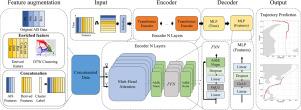
利用反向注意力和特征增强的变压器进行长期船舶轨迹预测
海上运输对全球贸易至关重要,随着船舶交通量的增加,需要准确的轨迹预测以提高安全性和效率。本文提出了一种基于变压器的船舶长期轨迹预测体系结构。通过从原始AIS数据中提取运动学和方向变量来进行特征增强,并使用动态时间规整应用轨迹聚类。采用了一种反向注意力机制来计算跨变量而不是时间位置的注意力,从而增强了高维设置中的可扩展性,并实现了变量依赖关系的显式建模。编码后的表示通过多层感知器解码器映射到预测视界。在AIS轨迹数据集上的综合实验表明,该框架在短期和长期预测任务中都具有较高的精度。结果表明,特征增强和反向注意的结合提高了海上弹道预测的预测精度、鲁棒性和泛化能力。
本文章由计算机程序翻译,如有差异,请以英文原文为准。
求助全文
约1分钟内获得全文
求助全文
来源期刊
International Journal of Naval Architecture and Ocean Engineering
ENGINEERING, MARINE-
CiteScore
4.90
自引率
4.50%
发文量
62
审稿时长
12 months
期刊介绍:
International Journal of Naval Architecture and Ocean Engineering provides a forum for engineers and scientists from a wide range of disciplines to present and discuss various phenomena in the utilization and preservation of ocean environment. Without being limited by the traditional categorization, it is encouraged to present advanced technology development and scientific research, as long as they are aimed for more and better human engagement with ocean environment. Topics include, but not limited to: marine hydrodynamics; structural mechanics; marine propulsion system; design methodology & practice; production technology; system dynamics & control; marine equipment technology; materials science; underwater acoustics; ocean remote sensing; and information technology related to ship and marine systems; ocean energy systems; marine environmental engineering; maritime safety engineering; polar & arctic engineering; coastal & port engineering; subsea engineering; and specialized watercraft engineering.
 求助内容:
求助内容: 应助结果提醒方式:

 京公网安备 11010802042870号


