
Hybrid biodegradation of petroleum drill waste through vermitechnology integrated with hydrocarbon degrading microbial consortia: Promoting enhanced vermicomposting and waste valorization

Q1 Environmental Science
Bioresource Technology Reports Pub Date : 2026-02-01 Epub Date: 2026-02-03 DOI:10.1016/j.biteb.2026.102616
Bikash Dhadumia, Biswajit Paul
{"title":"Hybrid biodegradation of petroleum drill waste through vermitechnology integrated with hydrocarbon degrading microbial consortia: Promoting enhanced vermicomposting and waste valorization","authors":"Bikash Dhadumia,&nbsp;Biswajit Paul","doi":"10.1016/j.biteb.2026.102616","DOIUrl":null,"url":null,"abstract":"<div><div>The potential for valorizing petroleum drill waste (PW) through enhanced vermicomposting process has yet to be investigated. This research investigated the efficacy of PW waste valorization using enhanced vermicomposting with the earthworm species <em>Eisenia fetida</em>, in conjunction with hydrocarbon-degrading microbial consortia (HDM) across five different mixtures of PW and cow dung (CD), compared to vermicomposting without added HDM, referred to as standard vermicomposting. Metal concentrations (Cd, Cr, Cu, Pb, Ni, and As) decreased up to 92% through bioaccumulation and biotransformation. Notably, hydrocarbon concentrations decreased significantly by up to 98%. The worms experienced a decline in both their fertility and growth in the CD + PW (0:100) substrate mixture initially but demonstrated progress at a later stage. The pH, electrical conductivity, and carbon concentrations were stabilized. The levels of macronutrients, namely nitrogen, phosphorus, and potassium (NPK), have shown a rise of as much as 59% through enhanced vermicomposting. Furthermore, the vermicompost produced was subjected to seed germination tests to validate the findings. The analysis reveals that the end product compositions of CD + PW in ratios of 70:30, 50:50, and 30:70 from enhanced vermicomposting exhibited exceptional germination results compared to all five standard vermicomposts. As a result, these findings shed new light on the potential of enhanced vermicomposting as a hybrid method for biodegrading PW into nutrient-rich fertilizer, thereby promoting green hybrid waste valorization.</div></div>","PeriodicalId":8947,"journal":{"name":"Bioresource Technology Reports","volume":"33 ","pages":"Article 102616"},"PeriodicalIF":0.0000,"publicationDate":"2026-02-01","publicationTypes":"Journal Article","fieldsOfStudy":null,"isOpenAccess":false,"openAccessPdf":"","citationCount":"0","resultStr":null,"platform":"Semanticscholar","paperid":null,"PeriodicalName":"Bioresource Technology Reports","FirstCategoryId":"1085","ListUrlMain":"https://www.sciencedirect.com/science/article/pii/S2589014X26000745","RegionNum":0,"RegionCategory":null,"ArticlePicture":[],"TitleCN":null,"AbstractTextCN":null,"PMCID":null,"EPubDate":"2026/2/3 0:00:00","PubModel":"Epub","JCR":"Q1","JCRName":"Environmental Science","Score":null,"Total":0}
引用次数: 0

Abstract

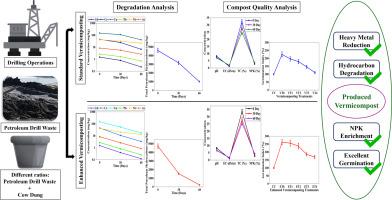
The potential for valorizing petroleum drill waste (PW) through enhanced vermicomposting process has yet to be investigated. This research investigated the efficacy of PW waste valorization using enhanced vermicomposting with the earthworm species Eisenia fetida, in conjunction with hydrocarbon-degrading microbial consortia (HDM) across five different mixtures of PW and cow dung (CD), compared to vermicomposting without added HDM, referred to as standard vermicomposting. Metal concentrations (Cd, Cr, Cu, Pb, Ni, and As) decreased up to 92% through bioaccumulation and biotransformation. Notably, hydrocarbon concentrations decreased significantly by up to 98%. The worms experienced a decline in both their fertility and growth in the CD + PW (0:100) substrate mixture initially but demonstrated progress at a later stage. The pH, electrical conductivity, and carbon concentrations were stabilized. The levels of macronutrients, namely nitrogen, phosphorus, and potassium (NPK), have shown a rise of as much as 59% through enhanced vermicomposting. Furthermore, the vermicompost produced was subjected to seed germination tests to validate the findings. The analysis reveals that the end product compositions of CD + PW in ratios of 70:30, 50:50, and 30:70 from enhanced vermicomposting exhibited exceptional germination results compared to all five standard vermicomposts. As a result, these findings shed new light on the potential of enhanced vermicomposting as a hybrid method for biodegrading PW into nutrient-rich fertilizer, thereby promoting green hybrid waste valorization.
Abstract Image

结合碳氢化合物降解微生物群落的蚯蚓技术对石油钻井废弃物的混合生物降解:促进蚯蚓堆肥和废弃物增值
通过增强蚯蚓堆肥工艺对石油钻井废弃物(PW)进行增值的潜力尚未进行研究。本研究考察了在五种不同的蚯蚓和牛粪(CD)混合物中添加Eisenia fetida蚯蚓和碳氢化合物降解微生物联合体(HDM)的强化蚯蚓堆肥与不添加HDM的蚯蚓堆肥(称为标准蚯蚓堆肥)相比,对PW废物进行价值化的效果。金属(Cd, Cr, Cu, Pb, Ni和As)浓度通过生物积累和生物转化降低了92%。值得注意的是,碳氢化合物浓度显著降低了98%。在CD + PW(0:100)基质混合物中,蠕虫的繁殖力和生长最初都有所下降,但在后期表现出进步。pH、电导率和碳浓度稳定。大量营养物质,即氮、磷和钾(NPK)的水平通过增强蚯蚓堆肥显示出高达59%的上升。此外,所产生的蚯蚓堆肥进行了种子发芽试验,以验证研究结果。结果表明,在CD + PW比例为70:30、50:50和30:70的条件下,强化蚯蚓堆肥的最终产物萌发效果优于5种标准蚯蚓堆肥。因此,这些发现揭示了增强蚯蚓堆肥作为一种混合方法的潜力,可以将PW生物降解为富含营养的肥料,从而促进绿色混合废物的增值。
本文章由计算机程序翻译,如有差异,请以英文原文为准。
求助全文
约1分钟内获得全文 求助全文
来源期刊
Bioresource Technology Reports
Bioresource Technology Reports Environmental Science-Environmental Engineering
CiteScore
7.20
自引率
0.00%
发文量
390
审稿时长
28 days

×
引用
GB/T 7714-2015
复制
MLA
复制
APA
复制
导出至
BibTeX EndNote RefMan NoteFirst NoteExpress
×
提示
您的信息不完整,为了账户安全,请先补充。
现在去补充
×
提示
您因"违规操作"
具体请查看互助需知
我知道了
×
提示
确定
请完成安全验证×
copy
已复制链接
快去分享给好友吧!
我知道了
右上角分享
点击右上角分享
0
联系我们:info@booksci.cn Book学术提供免费学术资源搜索服务,方便国内外学者检索中英文文献。致力于提供最便捷和优质的服务体验。 Copyright © 2023 布克学术 All rights reserved.
京ICP备2023020795号-1
ghs 京公网安备 11010802042870号
Book学术文献互助
Book学术文献互助群
群 号:604180095
Book学术官方微信
小红书


