
Enhancing bioethanol production: Synergistic effects of nano-Fe3O4, inoculum, large language model-assisted additive optimization and economic implications

Q1 Environmental Science
Bioresource Technology Reports Pub Date : 2026-02-01 Epub Date: 2026-01-29 DOI:10.1016/j.biteb.2026.102600
Sinenhlanhla L. Mweli, Isaac A. Sanusi, Lorika S. Beukes, Gueguim E.B. Kana
{"title":"Enhancing bioethanol production: Synergistic effects of nano-Fe3O4, inoculum, large language model-assisted additive optimization and economic implications","authors":"Sinenhlanhla L. Mweli,&nbsp;Isaac A. Sanusi,&nbsp;Lorika S. Beukes,&nbsp;Gueguim E.B. Kana","doi":"10.1016/j.biteb.2026.102600","DOIUrl":null,"url":null,"abstract":"<div><div>This study presents a novel approach that enhanced bioethanol production through nano-based <em>S. cerevisiae</em> inoculum development, antioxidant (ascorbic acid) and surfactant (Tween-80) incorporation. Response Surface Methodology (RSM) was initially used to model Fe<sub>3</sub>O<sub>4</sub> NPs (0–0.1 wt%), temperature (28–30 °C), and exposure time (12–18 h) towards high <em>S. cerevisiae</em> specific growth rate and biomass concentration for improved bioethanol production. Experimental validation yielded 0.234 ± 0.019 h<sup>−1</sup> and 3.395 ± 0.102 g/L respectively, corresponding to a 13% and 8% enhancement over the control. The fermentation performance of the optimized inoculum on pretreated potato residues was enhanced (&gt;55%). Moreover, the use of context-driven retrieval-augmented generation (CD-RAG) large language model (LLM) assisted the optimization of Tween-80 and ascorbic acid inclusion for improved specific growth rate (1.16-fold) and biomass concentration (1.11-fold). Economic assessment of the inoculum development strategy points to a potential profitable approach for producing bioethanol with shorter payback time (&lt;10 years) at higher processing capacity. These findings have provided valuable insights to improve bioethanol yield using Fe<sub>3</sub>O<sub>4</sub> NPs and CD-RAG LLM in inoculum development.</div></div>","PeriodicalId":8947,"journal":{"name":"Bioresource Technology Reports","volume":"33 ","pages":"Article 102600"},"PeriodicalIF":0.0000,"publicationDate":"2026-02-01","publicationTypes":"Journal Article","fieldsOfStudy":null,"isOpenAccess":false,"openAccessPdf":"","citationCount":"0","resultStr":null,"platform":"Semanticscholar","paperid":null,"PeriodicalName":"Bioresource Technology Reports","FirstCategoryId":"1085","ListUrlMain":"https://www.sciencedirect.com/science/article/pii/S2589014X26000587","RegionNum":0,"RegionCategory":null,"ArticlePicture":[],"TitleCN":null,"AbstractTextCN":null,"PMCID":null,"EPubDate":"2026/1/29 0:00:00","PubModel":"Epub","JCR":"Q1","JCRName":"Environmental Science","Score":null,"Total":0}
引用次数: 0

Abstract

This study presents a novel approach that enhanced bioethanol production through nano-based S. cerevisiae inoculum development, antioxidant (ascorbic acid) and surfactant (Tween-80) incorporation. Response Surface Methodology (RSM) was initially used to model Fe3O4 NPs (0–0.1 wt%), temperature (28–30 °C), and exposure time (12–18 h) towards high S. cerevisiae specific growth rate and biomass concentration for improved bioethanol production. Experimental validation yielded 0.234 ± 0.019 h−1 and 3.395 ± 0.102 g/L respectively, corresponding to a 13% and 8% enhancement over the control. The fermentation performance of the optimized inoculum on pretreated potato residues was enhanced (>55%). Moreover, the use of context-driven retrieval-augmented generation (CD-RAG) large language model (LLM) assisted the optimization of Tween-80 and ascorbic acid inclusion for improved specific growth rate (1.16-fold) and biomass concentration (1.11-fold). Economic assessment of the inoculum development strategy points to a potential profitable approach for producing bioethanol with shorter payback time (<10 years) at higher processing capacity. These findings have provided valuable insights to improve bioethanol yield using Fe3O4 NPs and CD-RAG LLM in inoculum development.
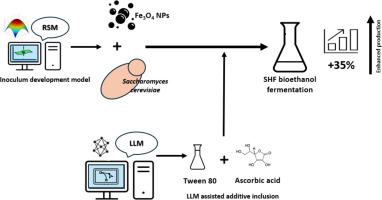
Abstract Image

提高生物乙醇生产:纳米fe3o4的协同效应,接种量,大语言模型辅助添加剂优化和经济意义
本研究提出了一种通过纳米基酿酒酵母接种、抗氧化剂(抗坏血酸)和表面活性剂(吐温-80)掺入来提高生物乙醇产量的新方法。响应面法(RSM)最初用于模拟Fe3O4 NPs (0-0.1 wt%)、温度(28-30°C)和暴露时间(12-18 h)对提高酿酒酵母特定生长速率和生物量浓度的影响,以提高生物乙醇产量。实验验证的结果分别为0.234±0.019 h - 1和3.395±0.102 g/L,分别比对照组提高13%和8%。优化后的接种物在预处理马铃薯渣上的发酵性能提高了55%。此外,使用上下文驱动的检索增强生成(CD-RAG)大语言模型(LLM)有助于优化吐温-80和抗坏血酸包合物,提高特定生长率(1.16倍)和生物量浓度(1.11倍)。接种物发展战略的经济评估指出了一种潜在的有利可图的方法,以更短的投资回收期(10年)和更高的加工能力生产生物乙醇。这些发现为利用Fe3O4 NPs和CD-RAG LLM在接种体发育中提高生物乙醇产量提供了有价值的见解。
本文章由计算机程序翻译,如有差异,请以英文原文为准。
求助全文
约1分钟内获得全文 求助全文
来源期刊
Bioresource Technology Reports
Bioresource Technology Reports Environmental Science-Environmental Engineering
CiteScore
7.20
自引率
0.00%
发文量
390
审稿时长
28 days

×
引用
GB/T 7714-2015
复制
MLA
复制
APA
复制
导出至
BibTeX EndNote RefMan NoteFirst NoteExpress
×
提示
您的信息不完整,为了账户安全,请先补充。
现在去补充
×
提示
您因"违规操作"
具体请查看互助需知
我知道了
×
提示
确定
请完成安全验证×
copy
已复制链接
快去分享给好友吧!
我知道了
右上角分享
点击右上角分享
0
联系我们:info@booksci.cn Book学术提供免费学术资源搜索服务,方便国内外学者检索中英文文献。致力于提供最便捷和优质的服务体验。 Copyright © 2023 布克学术 All rights reserved.
京ICP备2023020795号-1
ghs 京公网安备 11010802042870号
Book学术文献互助
Book学术文献互助群
群 号:604180095
Book学术官方微信
小红书


