
Evaluation of satellite precipitation products across climatic and topographic gradients in a basin in Northern South America
Q2 Environmental Science
引用次数: 0
Abstract
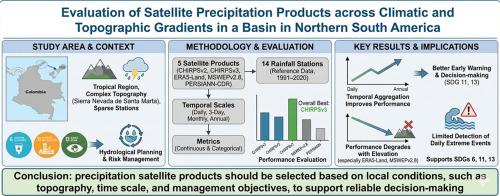
Reliably estimating precipitation remains a challenge, especially in tropical regions characterized by high climate variability, complex topography, and sparse rainfall station coverage. In these contexts, gridded precipitation satellite products (GPPs) are an important alternative for hydrological analysis, climate assessment, and risk management, which aligns with the Sustainable Development Goals, particularly SDG 6 (clean water and sanitation), SDG 11 (resilient cities and communities), and SDG 13 (climate action). This study evaluates the performance of five GPPs: CHIRPSv2, CHIRPSv3, ERA5-Land, MSWEPv2.8, and PERSIANN![]() CDR, in the Ranchería river basin in northern Colombia. The evaluation covered the period 1991–2020 and used continuous and categorical metrics on daily, 3-day, monthly, and annual time scales. Fourteen rainfall stations from the national monitoring network were used as a reference. The study area is a complex hydroclimatic environment ranging from semi-arid lowlands to mountainous terrain influenced by the Sierra Nevada de Santa Marta (the world’s highest coastal mountain range). This configuration allows analysis of the sensitivity of satellite algorithms to topographic gradients and varying precipitation intensities. The results indicate that CHIRPSv3 has the best overall performance and the highest inter-scale consistency, followed by CHIRPSv2 and PERSIANN
CDR, in the Ranchería river basin in northern Colombia. The evaluation covered the period 1991–2020 and used continuous and categorical metrics on daily, 3-day, monthly, and annual time scales. Fourteen rainfall stations from the national monitoring network were used as a reference. The study area is a complex hydroclimatic environment ranging from semi-arid lowlands to mountainous terrain influenced by the Sierra Nevada de Santa Marta (the world’s highest coastal mountain range). This configuration allows analysis of the sensitivity of satellite algorithms to topographic gradients and varying precipitation intensities. The results indicate that CHIRPSv3 has the best overall performance and the highest inter-scale consistency, followed by CHIRPSv2 and PERSIANN![]() CDR. In general, all products improve with temporal aggregation; however, their performance degrades with increasing elevation, especially in ERA5-Land and MSWEPv2.8. The detection of daily extreme events remains limited, with moderate improvements when considering 3-day accumulations. As a general recommendation, satellite products should be selected based on local conditions, such as topography, time scale, and management objectives, to support reliable decision-making.
CDR. In general, all products improve with temporal aggregation; however, their performance degrades with increasing elevation, especially in ERA5-Land and MSWEPv2.8. The detection of daily extreme events remains limited, with moderate improvements when considering 3-day accumulations. As a general recommendation, satellite products should be selected based on local conditions, such as topography, time scale, and management objectives, to support reliable decision-making.
南美洲北部盆地跨气候和地形梯度的卫星降水产品评估
可靠地估计降水量仍然是一个挑战,特别是在气候变率高、地形复杂和雨量站覆盖稀疏的热带地区。在这种情况下,网格化降水卫星产品(gpp)是水文分析、气候评估和风险管理的重要替代方案,符合可持续发展目标,特别是可持续发展目标6(清洁水和卫生设施)、可持续发展目标11(抗灾城市和社区)和可持续发展目标13(气候行动)。本研究评估了哥伦比亚北部Ranchería河流域五个gpp的性能:CHIRPSv2、CHIRPSv3、ERA5-Land、MSWEPv2.8和PERSIANNCDR。评估涵盖1991-2020年期间,并使用每日、3天、每月和每年时间尺度的连续和分类指标。以全国监测网的14个雨量站为参考。研究区是一个复杂的水文气候环境,从半干旱的低地到受圣玛尔塔内华达山脉(世界上最高的沿海山脉)影响的山地地形。这种配置允许分析卫星算法对地形梯度和降水强度变化的敏感性。结果表明,CHIRPSv3综合性能最好,尺度间一致性最高,其次是CHIRPSv2和PERSIANNCDR。总的来说,所有产品都随着时间聚集而提高;然而,它们的性能随着海拔的增加而下降,特别是在ERA5-Land和MSWEPv2.8中。每日极端事件的检测仍然有限,考虑到3天的累积,有适度的改善。一般建议,应根据当地的地形、时间尺度和管理目标等条件选择卫星产品,以支持可靠的决策。
本文章由计算机程序翻译,如有差异,请以英文原文为准。
求助全文
约1分钟内获得全文
求助全文
来源期刊
Environmental Challenges
Environmental Science-Environmental Engineering
CiteScore
8.00
自引率
0.00%
发文量
249
审稿时长
8 weeks
 求助内容:
求助内容: 应助结果提醒方式:

 京公网安备 11010802042870号


