Masaru Tateno, Takaki Shimode, Koki Ono, Ryotaro Shimomura, Eri Shiraishi, Kotaro Nanba, Yukie Tateno, Ayumi Takano
{"title":"Parent-child discrepancies in screening for Internet Gaming Disorder: Evidence from a clinical sample of Japanese adolescents.","authors":"Masaru Tateno, Takaki Shimode, Koki Ono, Ryotaro Shimomura, Eri Shiraishi, Kotaro Nanba, Yukie Tateno, Ayumi Takano","doi":"10.1002/pcn5.70314","DOIUrl":null,"url":null,"abstract":"<p><strong>Aim: </strong>Questionnaire-based screening tools for Internet Gaming Disorder (IGD) are widely used in clinical and epidemiological research. However, discrepancies between child self-reports and parent reports may complicate the interpretation of screening results, particularly when cutoff-based classifications are applied.</p><p><strong>Methods: </strong>Participants were 58 adolescents (aged 10-18 years) attending child and adolescent psychiatry outpatient clinics and their parents. Gaming-related problems were assessed using parallel screening instruments: the Internet Gaming Disorder Scale for Children (IGDS-C) and the Parental version of the Internet Gaming Disorder Scale (PIGDS). Parent-child agreement was examined using dimensional analyses (Pearson's correlation), paired comparisons (paired <i>t</i>-test with Wilcoxon signed-rank test as a sensitivity analysis), and categorical agreement indices (concordance rate, Cohen's <i>κ</i>, and McNemar's test) based on the conventional cutoff score.</p><p><strong>Results: </strong>Parent- and child-reported IGDS scores were moderately correlated (<i>r</i> = 0.61, <i>p</i> < 0.001), indicating substantial dimensional concordance. However, parents reported significantly higher IGDS scores than children (mean difference = -1.09, <i>p</i> < 0.001), a finding confirmed by the Wilcoxon signed-rank test. Categorical agreement based on cutoff-based screening classifications was low (<i>κ</i> = 0.16), with most discordant cases reflecting parent-positive and child-negative classifications. McNemar's test demonstrated a significant asymmetry in these discrepancies.</p><p><strong>Conclusion: </strong>Although parent and child IGDS scores demonstrate meaningful dimensional concordance, the application of fixed cutoff-based screening classifications substantially reduces agreement, a pattern that may reflect differences in evaluative thresholds between informants. These findings highlight limitations of relying solely on self-reported cutoff-based measures and underscore the need for multi-informant, dimensional approaches when interpreting IGD screening results in youth.</p>","PeriodicalId":74405,"journal":{"name":"PCN reports : psychiatry and clinical neurosciences","volume":"5 1","pages":"e70314"},"PeriodicalIF":0.9000,"publicationDate":"2026-03-08","publicationTypes":"Journal Article","fieldsOfStudy":null,"isOpenAccess":false,"openAccessPdf":"https://www.ncbi.nlm.nih.gov/pmc/articles/PMC12967513/pdf/","citationCount":"0","resultStr":null,"platform":"Semanticscholar","paperid":null,"PeriodicalName":"PCN reports : psychiatry and clinical neurosciences","FirstCategoryId":"1085","ListUrlMain":"https://doi.org/10.1002/pcn5.70314","RegionNum":0,"RegionCategory":null,"ArticlePicture":[],"TitleCN":null,"AbstractTextCN":null,"PMCID":null,"EPubDate":"2026/3/1 0:00:00","PubModel":"eCollection","JCR":"","JCRName":"","Score":null,"Total":0}
引用次数: 0
Abstract
Aim: Questionnaire-based screening tools for Internet Gaming Disorder (IGD) are widely used in clinical and epidemiological research. However, discrepancies between child self-reports and parent reports may complicate the interpretation of screening results, particularly when cutoff-based classifications are applied.
Methods: Participants were 58 adolescents (aged 10-18 years) attending child and adolescent psychiatry outpatient clinics and their parents. Gaming-related problems were assessed using parallel screening instruments: the Internet Gaming Disorder Scale for Children (IGDS-C) and the Parental version of the Internet Gaming Disorder Scale (PIGDS). Parent-child agreement was examined using dimensional analyses (Pearson's correlation), paired comparisons (paired t-test with Wilcoxon signed-rank test as a sensitivity analysis), and categorical agreement indices (concordance rate, Cohen's κ, and McNemar's test) based on the conventional cutoff score.
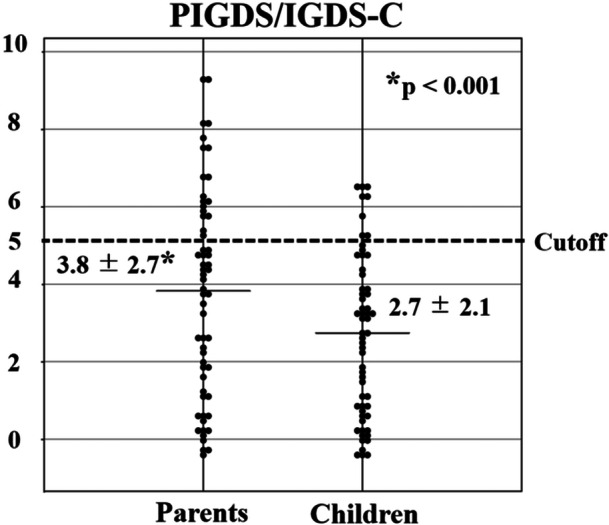
Results: Parent- and child-reported IGDS scores were moderately correlated (r = 0.61, p < 0.001), indicating substantial dimensional concordance. However, parents reported significantly higher IGDS scores than children (mean difference = -1.09, p < 0.001), a finding confirmed by the Wilcoxon signed-rank test. Categorical agreement based on cutoff-based screening classifications was low (κ = 0.16), with most discordant cases reflecting parent-positive and child-negative classifications. McNemar's test demonstrated a significant asymmetry in these discrepancies.
Conclusion: Although parent and child IGDS scores demonstrate meaningful dimensional concordance, the application of fixed cutoff-based screening classifications substantially reduces agreement, a pattern that may reflect differences in evaluative thresholds between informants. These findings highlight limitations of relying solely on self-reported cutoff-based measures and underscore the need for multi-informant, dimensional approaches when interpreting IGD screening results in youth.
目的:基于问卷的网络游戏障碍(IGD)筛查工具广泛应用于临床和流行病学研究。然而,儿童自我报告和家长报告之间的差异可能会使对筛查结果的解释复杂化,特别是在应用基于截止点的分类时。方法:研究对象为58名在儿童和青少年精神病学门诊就诊的青少年(10-18岁)及其父母。使用平行筛选工具评估游戏相关问题:儿童网络游戏障碍量表(IGDS-C)和家长版网络游戏障碍量表(PIGDS)。采用维度分析(Pearson’s相关性)、配对比较(配对t检验与Wilcoxon符号秩检验作为敏感性分析)和基于常规截断分数的分类协议指数(一致性率、Cohen’s κ和McNemar’s检验)来检验亲子协议。结果:父母和孩子报告的IGDS评分有中度相关性(r = 0.61, p p κ = 0.16),大多数不一致的病例反映了父母阳性和孩子阴性的分类。McNemar的实验证明了这些差异的显著不对称性。结论:尽管父母和儿童的IGDS得分表现出有意义的维度一致性,但基于固定下限的筛选分类的应用大大降低了一致性,这种模式可能反映了举报人之间评估阈值的差异。这些发现强调了仅仅依靠自我报告的截止点测量的局限性,并强调了在解释青少年IGD筛查结果时需要多信息者、多维方法。


 求助内容:
求助内容: 应助结果提醒方式:

 京公网安备 11010802042870号


