Exploring the length and time related concepts for scenario-based multiple-choice questions through perspectives of medical education experts: a mixed-method approach.
{"title":"Exploring the length and time related concepts for scenario-based multiple-choice questions through perspectives of medical education experts: a mixed-method approach.","authors":"Rahul Ramesh Bogam, Harish Chennuri, Girish Manohar Chavan","doi":"10.3946/kjme.2025.128","DOIUrl":null,"url":null,"abstract":"<p><strong>Purpose: </strong>There is a substantial gap in the scientific literature about specific, evidence-based guidelines for optimal word count (length) in multiple-choice question (MCQ) \"stems\" and \"options\" and validated time management strategies for MCQ test-takers. This dearth of research indicates a potential need for more studies to develop and validate these significant aspects of MCQ assessment and strategy. This was the first study which formulated guidelines for the word count of scenario-based MCQ (SB-MCQ) \"stems\" and \"options,\" along with justifications, from the perspective of medical education experts. The present research also developed specific, validated time management guidelines to assist test-takers effectively navigate MCQ examination.</p><p><strong>Methods: </strong>A mixed-methods design was implemented where quantitative data from a validated structured questionnaire and qualitative (focus group discussion) data were collected from 76 medical education professionals across multiple Indian provinces, and then analyzed using SPSS and NVivo software.</p><p><strong>Results: </strong>A recommended best practice for writing SB-MCQs was reported to have question stems between 35-50 words followed by 20-35 words, with three-option formats being preferred over four and five options. Nearly 92.73% of participants reported that, during 1-minute timeframe, maximum time must be spent on \"analyzing question stem\" followed by on \"eliminating options.\" The study developed succinct, \"eight-step guide\" to empower test-takers complete MCQ tests proficiently.</p><p><strong>Conclusion: </strong>Scenario based MCQs with stems between 35-50 words and options between 1-10 words can improve item quality. Three-option MCQs can be preferred over four- or five-option formats. An emerged \"eight-step structured guide\" can assist test takers to tackle multiple-choice tests more efficiently and effectively.</p>","PeriodicalId":37737,"journal":{"name":"Korean journal of medical education","volume":"38 1","pages":"30-43"},"PeriodicalIF":0.0000,"publicationDate":"2026-03-01","publicationTypes":"Journal Article","fieldsOfStudy":null,"isOpenAccess":false,"openAccessPdf":"https://www.ncbi.nlm.nih.gov/pmc/articles/PMC12971134/pdf/","citationCount":"0","resultStr":null,"platform":"Semanticscholar","paperid":null,"PeriodicalName":"Korean journal of medical education","FirstCategoryId":"1085","ListUrlMain":"https://doi.org/10.3946/kjme.2025.128","RegionNum":0,"RegionCategory":null,"ArticlePicture":[],"TitleCN":null,"AbstractTextCN":null,"PMCID":null,"EPubDate":"2026/2/23 0:00:00","PubModel":"Epub","JCR":"","JCRName":"","Score":null,"Total":0}
引用次数: 0
Abstract
Purpose: There is a substantial gap in the scientific literature about specific, evidence-based guidelines for optimal word count (length) in multiple-choice question (MCQ) "stems" and "options" and validated time management strategies for MCQ test-takers. This dearth of research indicates a potential need for more studies to develop and validate these significant aspects of MCQ assessment and strategy. This was the first study which formulated guidelines for the word count of scenario-based MCQ (SB-MCQ) "stems" and "options," along with justifications, from the perspective of medical education experts. The present research also developed specific, validated time management guidelines to assist test-takers effectively navigate MCQ examination.
Methods: A mixed-methods design was implemented where quantitative data from a validated structured questionnaire and qualitative (focus group discussion) data were collected from 76 medical education professionals across multiple Indian provinces, and then analyzed using SPSS and NVivo software.
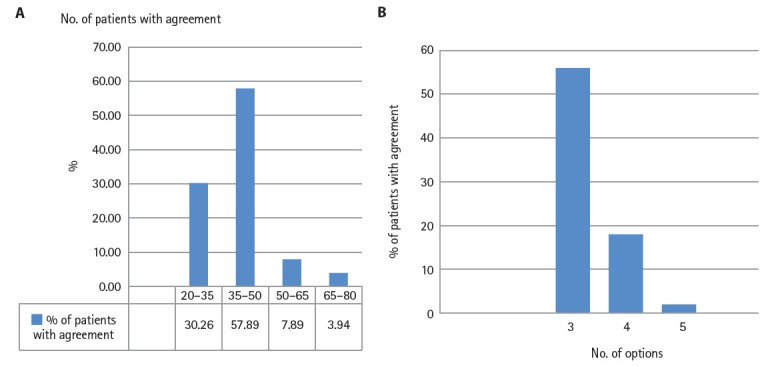
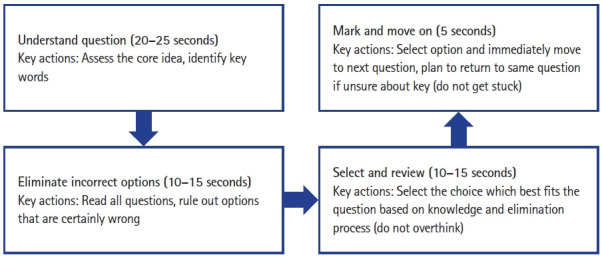
Results: A recommended best practice for writing SB-MCQs was reported to have question stems between 35-50 words followed by 20-35 words, with three-option formats being preferred over four and five options. Nearly 92.73% of participants reported that, during 1-minute timeframe, maximum time must be spent on "analyzing question stem" followed by on "eliminating options." The study developed succinct, "eight-step guide" to empower test-takers complete MCQ tests proficiently.
Conclusion: Scenario based MCQs with stems between 35-50 words and options between 1-10 words can improve item quality. Three-option MCQs can be preferred over four- or five-option formats. An emerged "eight-step structured guide" can assist test takers to tackle multiple-choice tests more efficiently and effectively.
期刊介绍:
The journal seeks to provide theoretical foundations, practical analysis, and up-to-date developments in health professional education: Curriculum development Teaching and learning Student assessment Educational evaluation Educational management and policy The journal welcomes high-quality papers on all levels of health professional education, including: Undergraduate education Postgraduate training Continuous professional development Interprofessional education.



 求助内容:
求助内容: 应助结果提醒方式:

 京公网安备 11010802042870号


