Magdalena Winklhofer, Göran Erik Nilsson, Sjannie Lefevre
{"title":"Long non-coding RNA transcripts in crucian carp brain - annotation and expression patterns in anoxia and reoxygenation.","authors":"Magdalena Winklhofer, Göran Erik Nilsson, Sjannie Lefevre","doi":"10.1080/15476286.2026.2643366","DOIUrl":null,"url":null,"abstract":"<p><p>Long non-coding RNAs (lncRNAs) regulate diverse cellular processes, yet their role in anoxia-induced transcriptomic changes in crucian carp (<i>Carassius carassius</i>) - a species that endures months without oxygen at low temperatures - remains unclear. Because existing genome annotations focus on protein-coding genes, we aimed to annotate lncRNAs in crucian carp, assess their potential for involvement in mRNA regulation during anoxia and reoxygenation, and characterize differentially regulated lncRNAs and nearby putative interaction partners (IPs). Using next-generation RNA sequencing of the brain across normoxia, anoxia, and reoxygenation (<i>n</i> = 10 per group), we assembled 145,264 transcripts with a reference-guided approach. With CPC2, CNCI, CPAT, and FEELnc, we identified 6072 lncRNAs. Anoxia elicited a robust transcriptomic response: 56,440 transcripts were differentially expressed (adjusted <i>p</i>-value < 0.05; |log2(fold change)| > 0.38), including 1321 lncRNAs. FEELnc classification highlighted proximal RNA transcripts suggestive of cis-acting lncRNA functions. Most (60%) DElncRNA - IP interaction sites were intergenic, predominantly on the same strand within intergenic subtypes, with many features nested within genic contexts. Notably, log2-fold changes in RNA abundance of predicted DE IPs positively correlated with those of their corresponding DElncRNAs. These results provide a comprehensive lncRNA annotation for crucian carp and reveal extensive lncRNA co-expression with nearby genes during anoxia and reoxygenation, supporting a potential cis-regulatory role in the adaptive transcriptomic response to oxygen deprivation.</p>","PeriodicalId":21351,"journal":{"name":"RNA Biology","volume":" ","pages":"1-21"},"PeriodicalIF":3.4000,"publicationDate":"2026-12-31","publicationTypes":"Journal Article","fieldsOfStudy":null,"isOpenAccess":false,"openAccessPdf":"https://www.ncbi.nlm.nih.gov/pmc/articles/PMC13023002/pdf/","citationCount":"0","resultStr":null,"platform":"Semanticscholar","paperid":null,"PeriodicalName":"RNA Biology","FirstCategoryId":"99","ListUrlMain":"https://doi.org/10.1080/15476286.2026.2643366","RegionNum":3,"RegionCategory":"生物学","ArticlePicture":[],"TitleCN":null,"AbstractTextCN":null,"PMCID":null,"EPubDate":"2026/3/25 0:00:00","PubModel":"Epub","JCR":"Q2","JCRName":"BIOCHEMISTRY & MOLECULAR BIOLOGY","Score":null,"Total":0}
引用次数: 0
Abstract
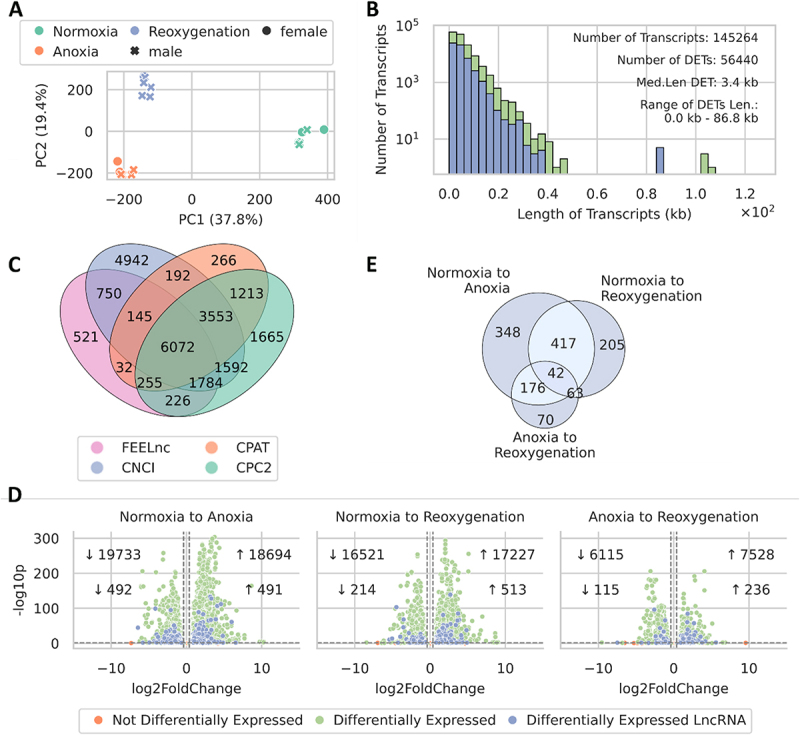
Long non-coding RNAs (lncRNAs) regulate diverse cellular processes, yet their role in anoxia-induced transcriptomic changes in crucian carp (Carassius carassius) - a species that endures months without oxygen at low temperatures - remains unclear. Because existing genome annotations focus on protein-coding genes, we aimed to annotate lncRNAs in crucian carp, assess their potential for involvement in mRNA regulation during anoxia and reoxygenation, and characterize differentially regulated lncRNAs and nearby putative interaction partners (IPs). Using next-generation RNA sequencing of the brain across normoxia, anoxia, and reoxygenation (n = 10 per group), we assembled 145,264 transcripts with a reference-guided approach. With CPC2, CNCI, CPAT, and FEELnc, we identified 6072 lncRNAs. Anoxia elicited a robust transcriptomic response: 56,440 transcripts were differentially expressed (adjusted p-value < 0.05; |log2(fold change)| > 0.38), including 1321 lncRNAs. FEELnc classification highlighted proximal RNA transcripts suggestive of cis-acting lncRNA functions. Most (60%) DElncRNA - IP interaction sites were intergenic, predominantly on the same strand within intergenic subtypes, with many features nested within genic contexts. Notably, log2-fold changes in RNA abundance of predicted DE IPs positively correlated with those of their corresponding DElncRNAs. These results provide a comprehensive lncRNA annotation for crucian carp and reveal extensive lncRNA co-expression with nearby genes during anoxia and reoxygenation, supporting a potential cis-regulatory role in the adaptive transcriptomic response to oxygen deprivation.
期刊介绍:
RNA has played a central role in all cellular processes since the beginning of life: decoding the genome, regulating gene expression, mediating molecular interactions, catalyzing chemical reactions. RNA Biology, as a leading journal in the field, provides a platform for presenting and discussing cutting-edge RNA research.
RNA Biology brings together a multidisciplinary community of scientists working in the areas of:
Transcription and splicing
Post-transcriptional regulation of gene expression
Non-coding RNAs
RNA localization
Translation and catalysis by RNA
Structural biology
Bioinformatics
RNA in disease and therapy



 求助内容:
求助内容: 应助结果提醒方式:

 京公网安备 11010802042870号


