
3-D printed ultrastrong heat-resistant aluminum alloy achieved by bioinspired nanoscale amorphous confinement
IF 24.1
1区 材料科学
Q1 MATERIALS SCIENCE, MULTIDISCIPLINARY
引用次数: 0
Abstract
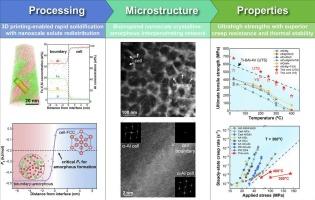
The high-temperature applications of aluminum alloys are constrained by their poor thermal stability, high creep susceptibility, and limited strength at elevated temperatures. Traditional dispersion strengthening has encountered inherent limitations in overcoming these challenges. Here, we introduce a bioinspired nanoscale confinement strategy realized by engineering a continuous three-dimensional crystalline-amorphous interpenetrating network structure, reminiscent of those found in natural biological materials. This strategy is implemented in an additively manufactured aluminum alloy, providing stringent spatial confinement that effectively impedes dislocation motion, grain-boundary migration, and atomic diffusion. In addition to good printability, the as-printed alloy achieves ultrahigh strength at room temperature to elevated temperatures, superior creep resistance, and outstanding thermal stability – a synergistic combination of properties that markedly outperforms previously reported materials. This work demonstrates the concept of strengthening materials by utilizing a continuous nanoscale amorphous network, rather than dispersed particles, through harnessing the nanoscale confinement effect inspired by Nature.
生物启发纳米级非晶约束实现的3d打印超强耐热铝合金
铝合金的高温应用受到其热稳定性差、高蠕变敏感性和高温强度有限的限制。传统的分散加强在克服这些挑战时遇到了固有的限制。在这里,我们介绍了一种生物启发的纳米级约束策略,通过工程设计一个连续的三维晶体-非晶互穿网络结构来实现,让人想起天然生物材料中的结构。该策略在增材制造的铝合金中实现,提供严格的空间限制,有效地阻碍位错运动,晶界迁移和原子扩散。除了良好的可打印性外,打印合金在室温到高温下都具有超高强度,具有优异的抗蠕变性能和出色的热稳定性,这些性能的协同组合明显优于先前报道的材料。这项工作展示了通过利用受大自然启发的纳米级约束效应,利用连续的纳米级非晶网络而不是分散的颗粒来增强材料的概念。
本文章由计算机程序翻译,如有差异,请以英文原文为准。
求助全文
约1分钟内获得全文
求助全文
来源期刊
Materials Today
工程技术-材料科学:综合
CiteScore
36.30
自引率
1.20%
发文量
237
审稿时长
23 days
期刊介绍:
Materials Today is the leading journal in the Materials Today family, focusing on the latest and most impactful work in the materials science community. With a reputation for excellence in news and reviews, the journal has now expanded its coverage to include original research and aims to be at the forefront of the field.
We welcome comprehensive articles, short communications, and review articles from established leaders in the rapidly evolving fields of materials science and related disciplines. We strive to provide authors with rigorous peer review, fast publication, and maximum exposure for their work. While we only accept the most significant manuscripts, our speedy evaluation process ensures that there are no unnecessary publication delays.
 求助内容:
求助内容: 应助结果提醒方式:

 京公网安备 11010802042870号


