
Anthraquinone disulfonate as a stable redox mediator for efficient air-cathodes at neutral pH in dual-chamber microbial fuel cells
IF 4.9
2区 化学
Q1 BIOCHEMISTRY & MOLECULAR BIOLOGY
Bioelectrochemistry
Pub Date : 2026-10-01
Epub Date: 2026-03-09
DOI:10.1016/j.bioelechem.2026.109279
引用次数: 0
Abstract
Microbial Fuel Cells (MFCs) are commonly developed as organic-matter oxidizing bioanodes with abiotic air cathodes. However, O2 reduction requires active aeration and/or the use of expensive catalysts using noble metals. In this study, 2,7-anthraquinone disulfonate (2,7-AQDS), an organic redox mediator commonly used in aqueous redox flow battery systems (AORFBs), served as a redox-stable intermediate for oxygen reduction. Dual-chamber MFC pilots were developed with 2,7-AQDS in the catholyte under both anoxic and aerobic conditions and compared to pilots with ferricyanide catholytes. In both conditions, cyclic voltammetry studies confirmed similar and efficient electroactivity despite the proximity AQDS formal redox potential to that of acetate oxidation. Mediated air-cathodes achieved open-circuit voltage (OCV) of 510 mV and current densities of 140 μA/cm2, nearly double those of air-only cathodes (72 μA/cm2), while delivering a 33% higher power density (12 mW/m2 vs. 8 mW/m2). Passive catholyte aeration enabled continuous reoxidation of reduced 2,7-AQDS at 8.8 × 10⁻⁸ mol/s, exceeding the AQDS reduction rate by the bioanode (2.5 × 10⁻¹⁰ mol/s), thus ensuring effective self-regeneration and stable AQDS concentration. These results demonstrate that AQDS coupled with passive oxygen supply sustains biofilm activity with enhances current and power, and allow long-term / low-maintenance MFC operation and organic-matter oxidation.
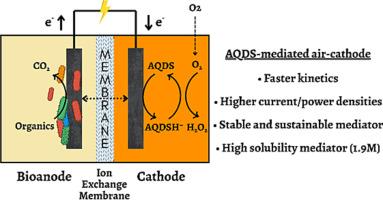
二磺酸蒽醌作为双室微生物燃料电池中性pH下高效空气阴极的氧化还原介质
微生物燃料电池(mfc)通常被开发为有机物氧化生物阳极和非生物空气阴极。然而,O2还原需要主动曝气和/或使用昂贵的贵金属催化剂。在本研究中,2,7-蒽醌二磺酸盐(2,7- aqds)作为水氧化还原液流电池系统(AORFBs)中常用的有机氧化还原介质,作为氧还原的氧化还原稳定中间体。在缺氧和有氧条件下培养具有2,7- aqds的双室MFC飞行员,并与具有铁氰化阴极的飞行员进行比较。在这两种情况下,循环伏安法研究证实,尽管AQDS形式氧化还原电位与醋酸氧化电位接近,但电活性相似且有效。介质空气阴极的开路电压(OCV)为510 mV,电流密度为140 μA/cm2,几乎是纯空气阴极(72 μA/cm2)的两倍,而功率密度(12 mW/m2 vs. 8 mW/m2)提高了33%。被动阴极曝气使还原的2,7-AQDS以8.8 × 10−8 mol/s的速度连续再氧化,超过了生物阳极对AQDS的还原速率(2.5 × 10−10 mol/s),从而保证了有效的自再生和稳定的AQDS浓度。这些结果表明,AQDS与被动供氧相结合,可以在增强电流和功率的情况下维持生物膜的活性,并允许长期/低维护的MFC运行和有机物氧化。
本文章由计算机程序翻译,如有差异,请以英文原文为准。
求助全文
约1分钟内获得全文
求助全文
来源期刊
Bioelectrochemistry
生物-电化学
CiteScore
9.10
自引率
6.00%
发文量
238
审稿时长
38 days
期刊介绍:
An International Journal Devoted to Electrochemical Aspects of Biology and Biological Aspects of Electrochemistry
Bioelectrochemistry is an international journal devoted to electrochemical principles in biology and biological aspects of electrochemistry. It publishes experimental and theoretical papers dealing with the electrochemical aspects of:
• Electrified interfaces (electric double layers, adsorption, electron transfer, protein electrochemistry, basic principles of biosensors, biosensor interfaces and bio-nanosensor design and construction.
• Electric and magnetic field effects (field-dependent processes, field interactions with molecules, intramolecular field effects, sensory systems for electric and magnetic fields, molecular and cellular mechanisms)
• Bioenergetics and signal transduction (energy conversion, photosynthetic and visual membranes)
• Biomembranes and model membranes (thermodynamics and mechanics, membrane transport, electroporation, fusion and insertion)
• Electrochemical applications in medicine and biotechnology (drug delivery and gene transfer to cells and tissues, iontophoresis, skin electroporation, injury and repair).
• Organization and use of arrays in-vitro and in-vivo, including as part of feedback control.
• Electrochemical interrogation of biofilms as generated by microorganisms and tissue reaction associated with medical implants.
 求助内容:
求助内容: 应助结果提醒方式:

 京公网安备 11010802042870号


