
Influence of double-beam design on nuclear waste transmutation performance for CiADS-like reactor
IF 2.9
3区 工程技术
Q1 NUCLEAR SCIENCE & TECHNOLOGY
Nuclear Engineering and Technology
Pub Date : 2026-07-01
Epub Date: 2026-03-05
DOI:10.1016/j.net.2026.104246
引用次数: 0
Abstract
This study establishes neutronics models of both single-beam and double-beam driven ADS subcritical reactors based on the CiADS core geometry using the OpenMC code, systematically comparing their performance in terms of power distribution, neutron flux, transmutation of long-lived fission products (LLFPs), and breeding of plutonium. Comparison shows that the discrepancy in the effective neutron multiplication factor between the model and reference results is within 0.003, and the neutron energy spectra agree well in the range of to 10 MeV. The results indicate that the double-beam design significantly improves the axial power distribution uniformity, with the full width at half maximum increasing from 58.8 cm in the single-beam system to 60.5 cm in the double-beam system, along with a general increase in neutron flux within fuel assemblies. Regarding transmutation performance, the double-beam system enhances the transmutation rate of 135Cs in LLFP assemblies by 58% and significantly promotes the breeding of 239Pu. These findings demonstrate that the double-beam design offers clear advantages in improving power flattening, enhancing transmutation efficiency, and promoting actinide conversion in ADS systems, providing neutronic insights for future engineering conceptual design of multi-beam ADS configurations.
双束设计对类ciads反应堆核废料嬗变性能的影响
本研究基于CiADS堆芯几何形状,利用OpenMC代码建立了单束和双束驱动ADS亚临界堆的中子模型,系统比较了它们在功率分布、中子通量、长寿命裂变产物嬗变和钚增殖等方面的性能。结果表明,模型与参考结果的有效中子倍增因子差异在±0.003以内,在10−4MeV ~ 10 MeV范围内中子能谱吻合良好。结果表明,双束设计显著改善了轴向功率分布的均匀性,半最大全宽度从单束系统的58.8 cm增加到双束系统的60.5 cm,同时燃料组件内的中子通量普遍增加。在嬗变性能方面,双光束系统使LLFP组件中135Cs的嬗变率提高了58%,并显著促进了239Pu的繁殖。这些研究结果表明,双光束设计在改善ADS系统的功率平坦化、提高嬗变效率和促进锕系元素转换方面具有明显的优势,为未来多光束ADS配置的工程概念设计提供了中子见解。
本文章由计算机程序翻译,如有差异,请以英文原文为准。
求助全文
约1分钟内获得全文
求助全文
来源期刊
Nuclear Engineering and Technology
工程技术-核科学技术
CiteScore
4.80
自引率
7.40%
发文量
431
审稿时长
3.5 months
期刊介绍:
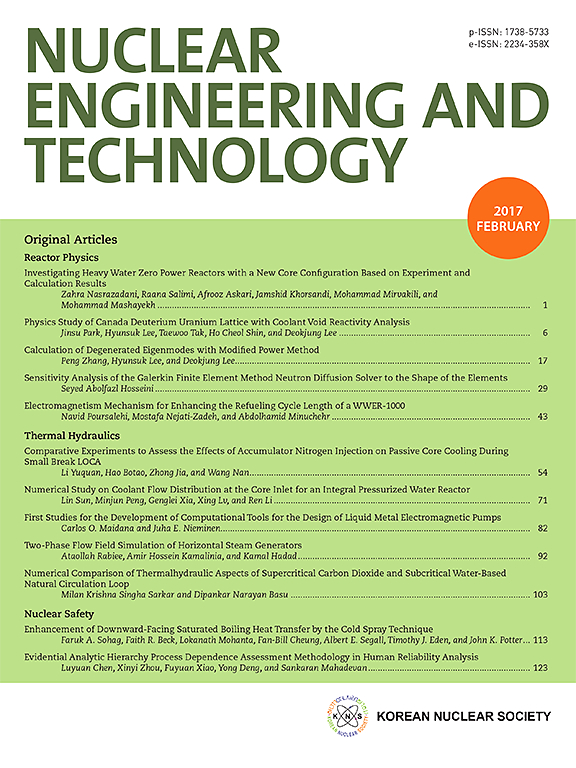
Nuclear Engineering and Technology (NET), an international journal of the Korean Nuclear Society (KNS), publishes peer-reviewed papers on original research, ideas and developments in all areas of the field of nuclear science and technology. NET bimonthly publishes original articles, reviews, and technical notes. The journal is listed in the Science Citation Index Expanded (SCIE) of Thomson Reuters.
NET covers all fields for peaceful utilization of nuclear energy and radiation as follows:
1) Reactor Physics
2) Thermal Hydraulics
3) Nuclear Safety
4) Nuclear I&C
5) Nuclear Physics, Fusion, and Laser Technology
6) Nuclear Fuel Cycle and Radioactive Waste Management
7) Nuclear Fuel and Reactor Materials
8) Radiation Application
9) Radiation Protection
10) Nuclear Structural Analysis and Plant Management & Maintenance
11) Nuclear Policy, Economics, and Human Resource Development
 求助内容:
求助内容: 应助结果提醒方式:

 京公网安备 11010802042870号


