
A CFD SSTk−ω−kθ−εθ four parameter heat transfer turbulence model for the 19-pin fuel assembly in LBE cooled reactors
IF 2.9
3区 工程技术
Q1 NUCLEAR SCIENCE & TECHNOLOGY
Nuclear Engineering and Technology
Pub Date : 2026-07-01
Epub Date: 2026-03-10
DOI:10.1016/j.net.2026.104253
引用次数: 0
Abstract
Liquid lead-bismuth eutectic (LBE) alloy exhibits excellent thermo-hydraulic properties and chemical inertness as a coolant for fast reactors. Unlike conventional fluids such as water and air, LBE has a lower Prandtl number (), and its local turbulent Prandtl number () is nonlinear. Therefore, the constant turbulent Prandtl number is difficult to satisfy complex turbulent heat transfer calculations. Thus, developing a high-precision two parameter turbulent heat transfer model for lead bismuth alloys has significant engineering value. This study systematically derives the four parameter turbulence heat transfer model and its boundary conditions under constant heat flux boundary. Based on the open source CFD software OpenFOAM, a four parameter heat transfer turbulence solver named LBEHMTFoam is developed to enhance the prediction accuracy of turbulent heat and mass transfer in liquid lead-bismuth alloys. The accuracy of the model is validated by comparing the simulation results of planar flow heat transfer with direct numerical simulation (DNS) data. Furthermore, heat and mass transfer simulations are conducted for LBE fuel assemblies and compared with empirical correlations. This study provides an effective tool for accurately predicting the thermo-hydraulic coupled corrosion behavior in LBE systems and holds significant reference value.
LBE冷却堆19针燃料组件的SSTk−ω−kθ−εθ四参数传热湍流模型
液态铅铋共晶(LBE)合金作为快堆冷却剂具有优良的热工性能和化学惰性。与水和空气等常规流体不同,LBE具有较低的普朗特数(Pr),其局部湍流普朗特数(Prt)是非线性的。因此,恒定的湍流普朗特数很难满足复杂的湍流换热计算。因此,建立高精度的kθ−εθ双参数铅铋合金湍流传热模型具有重要的工程价值。本文系统地推导了SSTk−ω−kθ−εθ四参数湍流换热模型及其在恒热流密度边界下的边界条件。基于开源CFD软件OpenFOAM,开发了四参数传热湍流求解器LBEHMTFoam,提高了液态铅铋合金湍流传热传质的预测精度。通过将平面流动换热模拟结果与直接数值模拟(DNS)数据进行比较,验证了模型的准确性。此外,对LBE燃料组件进行了传热传质模拟,并与经验相关性进行了比较。该研究为准确预测LBE体系热-液耦合腐蚀行为提供了有效工具,具有重要的参考价值。
本文章由计算机程序翻译,如有差异,请以英文原文为准。
求助全文
约1分钟内获得全文
求助全文
来源期刊
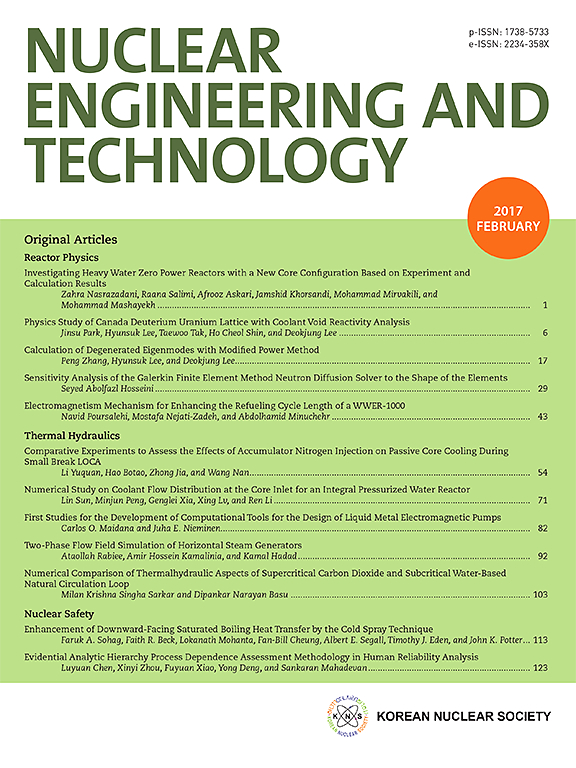
Nuclear Engineering and Technology
工程技术-核科学技术
CiteScore
4.80
自引率
7.40%
发文量
431
审稿时长
3.5 months
期刊介绍:
Nuclear Engineering and Technology (NET), an international journal of the Korean Nuclear Society (KNS), publishes peer-reviewed papers on original research, ideas and developments in all areas of the field of nuclear science and technology. NET bimonthly publishes original articles, reviews, and technical notes. The journal is listed in the Science Citation Index Expanded (SCIE) of Thomson Reuters.
NET covers all fields for peaceful utilization of nuclear energy and radiation as follows:
1) Reactor Physics
2) Thermal Hydraulics
3) Nuclear Safety
4) Nuclear I&C
5) Nuclear Physics, Fusion, and Laser Technology
6) Nuclear Fuel Cycle and Radioactive Waste Management
7) Nuclear Fuel and Reactor Materials
8) Radiation Application
9) Radiation Protection
10) Nuclear Structural Analysis and Plant Management & Maintenance
11) Nuclear Policy, Economics, and Human Resource Development
 求助内容:
求助内容: 应助结果提醒方式:

 京公网安备 11010802042870号


