
Imidazolium lipid-based nanoparticles enable effective mRNA delivery and cellular immune response
IF 24.1
1区 材料科学
Q1 MATERIALS SCIENCE, MULTIDISCIPLINARY
引用次数: 0
Abstract
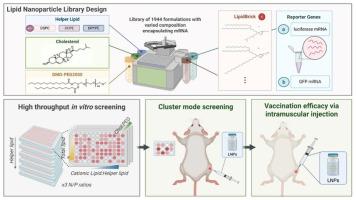
Imidazolium LipidBrick® cationic lipid nanoparticles (LNPs) provide a pH-independent alternative to conventional ionizable systems for nucleic acid delivery. Through a high-throughput screen of 1,944 formulations spanning eight imidazolium cores, three helper lipids, and varying PEG densities, we found that more than half of the library outperformed the clinical ionizable benchmark ALC-0315 in multiple representative mammalian cell types. Top-performing candidates showed robust cellular uptake, efficient endosomal escape, and strong transgene expression both in vitro and following intramuscular administration. A lead formulation (C3 LNP), incorporating an imidazolium lipid core bearing a hydroxyethyl substituent, with 30 mol% DOPE, achieved comparable intramuscular luciferase expression and antibody titers to ALC-0315, while eliciting ∼ 3-fold stronger ovalbumin-specific IFN-γ+ T-cell responses and maintaining low cytotoxicity. Machine-learning analysis of the dataset further distilled transferable design rules to inform future formulation strategies. Collectively, these findings establish cationic LipidBrick® LNPs as a versatile platform for mRNA delivery, offering a generalizable framework for the high-throughput discovery of ionization-independent systems that effectively prime adaptive immune responses.
咪唑类脂质纳米颗粒能够有效的mRNA传递和细胞免疫反应
咪唑LipidBrick®阳离子脂质纳米颗粒(LNPs)提供了一种不依赖ph值的替代方案,可用于核酸递送的传统电离系统。通过对1,944种配方的高通量筛选,包括八种咪唑核心,三种辅助脂质和不同的PEG密度,我们发现超过一半的库在多种代表性哺乳动物细胞类型中优于临床电离基准ALC-0315。表现最好的候选药物在体外和肌内给药后都表现出强大的细胞摄取,有效的内体逃逸和强大的转基因表达。一种先导配方(C3 LNP),包含含有羟乙基取代基的咪唑脂质核心,含有30 mol%的DOPE,实现了与ALC-0315相当的肌内荧光素酶表达和抗体滴度,同时引发约3倍强的卵清蛋白特异性IFN-γ+ t细胞反应并保持低细胞毒性。对数据集的机器学习分析进一步提炼出可转移的设计规则,为未来的制定策略提供信息。总的来说,这些发现建立了阳离子LipidBrick®LNPs作为mRNA传递的通用平台,为高通量发现有效启动适应性免疫应答的非电离系统提供了一个可推广的框架。
本文章由计算机程序翻译,如有差异,请以英文原文为准。
求助全文
约1分钟内获得全文
求助全文
来源期刊
Materials Today
工程技术-材料科学:综合
CiteScore
36.30
自引率
1.20%
发文量
237
审稿时长
23 days
期刊介绍:
Materials Today is the leading journal in the Materials Today family, focusing on the latest and most impactful work in the materials science community. With a reputation for excellence in news and reviews, the journal has now expanded its coverage to include original research and aims to be at the forefront of the field.
We welcome comprehensive articles, short communications, and review articles from established leaders in the rapidly evolving fields of materials science and related disciplines. We strive to provide authors with rigorous peer review, fast publication, and maximum exposure for their work. While we only accept the most significant manuscripts, our speedy evaluation process ensures that there are no unnecessary publication delays.
 求助内容:
求助内容: 应助结果提醒方式:

 京公网安备 11010802042870号


