
Inverse temperature-dependent toughness and exceptional cryogenic damage tolerance in a plain bcc steel
IF 24.1
1区 材料科学
Q1 MATERIALS SCIENCE, MULTIDISCIPLINARY
引用次数: 0
Abstract
Steels with the body-centered cubic (bcc) structure suffer low-temperature brittleness due to an inherent ductile-to-brittle transition that inhibits plastic deformation. Strategies to improve the cryogenic toughness generally involve stabilizing a face-centered cubic (fcc) phase to prevent this transition; however, this involves alloying with high concentrations of nickel, cobalt, and chromium, which are expensive and unsustainable due to their high environmental impact, energy-intensive extraction processes, and limited global reserves. Here, we engineered a low-carbon, micro-alloyed steel to possess a dual-phase, ultrafine-grained ferrite/martensite lamellar microstructure. This structure confers an unusual inverse-temperature dependence of impact toughness across a broad temperature range (383 K to 77 K) and exceptional resistance to fracture under both impact and quasi-static loading conditions at cryogenic temperatures (77 K). These properties are achieved through a combination of extrinsic toughening from delamination and crack bridging, as well as intrinsic toughening by interface dislocation-mediated plastic deformation within ferrite and activation of multiscale substructure sliding in martensite. This microstructural design strategy offers a pathway to engineer plain bcc steels with exceptional cryogenic damage tolerance without the addition of expensive and critical elements.
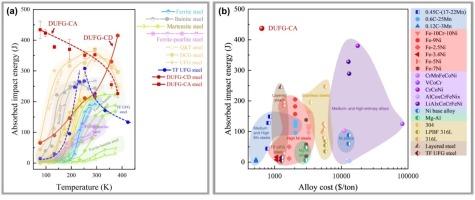
在普通bcc钢的逆温度依赖韧性和特殊的低温损伤容忍度
具有体心立方(bcc)结构的钢由于固有的延脆转变抑制了塑性变形而遭受低温脆性。提高低温韧性的策略通常包括稳定面心立方相(fcc)以防止这种转变;然而,这涉及到使用高浓度的镍、钴和铬合金,由于它们对环境的高影响、能源密集型的提取过程和有限的全球储量,这些合金价格昂贵且不可持续。在这里,我们设计了一种低碳、微合金钢,使其具有双相、超细晶铁素体/马氏体片层组织。这种结构在很宽的温度范围内(383 K至77 K)具有不同寻常的反温度依赖性,并且在低温(77 K)的冲击和准静态加载条件下具有优异的抗断裂性。这些性能是通过脱层和裂纹桥接的外在增韧,以及铁素体内部界面位错介导的塑性变形和马氏体中多尺度亚结构滑动激活的内在增韧来实现的。这种微观结构设计策略为设计具有特殊低温损伤容忍度的普通bcc钢提供了一条途径,而无需添加昂贵和关键的元素。
本文章由计算机程序翻译,如有差异,请以英文原文为准。
求助全文
约1分钟内获得全文
求助全文
来源期刊
Materials Today
工程技术-材料科学:综合
CiteScore
36.30
自引率
1.20%
发文量
237
审稿时长
23 days
期刊介绍:
Materials Today is the leading journal in the Materials Today family, focusing on the latest and most impactful work in the materials science community. With a reputation for excellence in news and reviews, the journal has now expanded its coverage to include original research and aims to be at the forefront of the field.
We welcome comprehensive articles, short communications, and review articles from established leaders in the rapidly evolving fields of materials science and related disciplines. We strive to provide authors with rigorous peer review, fast publication, and maximum exposure for their work. While we only accept the most significant manuscripts, our speedy evaluation process ensures that there are no unnecessary publication delays.
 求助内容:
求助内容: 应助结果提醒方式:

 京公网安备 11010802042870号


