
Ultrafine CoCrCuFeNi high entropy alloy thin films with high strength, plastic deformability and thermal stability achieved via grain engineering and nanoclustering
IF 24.1
1区 材料科学
Q1 MATERIALS SCIENCE, MULTIDISCIPLINARY
引用次数: 0
Abstract
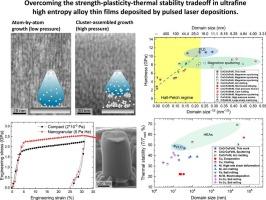
The design of high-performance structural materials is always pursuing the combination of mutually exclusive properties such as mechanical strength, plasticity and thermal stability. Although high entropy alloys thin films (HEAs-TF) show promising mechanical and thermal properties, the development of novel nanostructures with unique nanoscale features is needed to overcome the strength-plasticity-thermal stability trade-off, going beyond a conventional compositional control. Here, we present a new synthesis route to fabricate ultra-strong, highly plastic, and thermally stable HEAs-TF leveraging the unique capabilities of pulsed laser deposition (PLD). We demonstrate our approach by focusing on CoCrCuFeNi, a model FCC HEA of the original Cantor family. Specifically, we synthetize ultrafine grain structures with controllable size (down to 12 nm) which can be further tailored by post-thermal annealing treatments, resulting in high hardness (11 GPa) and yield strength (2.0 GPa) due to Hall-Petch strengthening, outperforming similar HEAs-TF while maintaining high plasticity (no fracture at 30% strain). Moreover, these ultrafine HEAs-TF shows enhanced thermal stability, grain growth starting at T = 49% of Tm (melting temperature), while maintaining high hardness (9.1 GPa) after annealing for 1 h at 460°C. The PLD-deposited ultrafine HEAs-TF lead to mutual thermodynamic and mechanical stabilization, opening up a new approach for stable, strong and ductile materials.
通过晶粒工程和纳米聚类技术,获得了具有高强度、塑性变形和热稳定性的超细CoCrCuFeNi高熵合金薄膜
高性能结构材料的设计始终追求机械强度、塑性和热稳定性等互斥性能的组合。虽然高熵合金薄膜(HEAs-TF)具有良好的机械和热性能,但需要开发具有独特纳米尺度特征的新型纳米结构来克服强度-塑性-热稳定性之间的权衡,而不仅仅是传统的成分控制。在这里,我们提出了一种新的合成路线,利用脉冲激光沉积(PLD)的独特能力来制造超强,高塑性和热稳定的HEAs-TF。我们通过关注CoCrCuFeNi来展示我们的方法,CoCrCuFeNi是原始康托家族的FCC HEA模型。具体而言,我们合成了可控制尺寸(低至12 nm)的超细晶粒结构,可以通过热后退火处理进一步定制,从而获得高硬度(11 GPa)和屈服强度(2.0 GPa),由于Hall-Petch强化,优于类似的HEAs-TF,同时保持高塑性(在30%应变下不断裂)。此外,这些超细HEAs-TF表现出增强的热稳定性,晶粒生长开始于T = 49%的Tm(熔化温度),在460℃下退火1 h后仍保持较高的硬度(9.1 GPa)。pld沉积的超细HEAs-TF导致了相互的热力学和机械稳定,为稳定,强和延展性材料开辟了新的途径。
本文章由计算机程序翻译,如有差异,请以英文原文为准。
求助全文
约1分钟内获得全文
求助全文
来源期刊
Materials Today
工程技术-材料科学:综合
CiteScore
36.30
自引率
1.20%
发文量
237
审稿时长
23 days
期刊介绍:
Materials Today is the leading journal in the Materials Today family, focusing on the latest and most impactful work in the materials science community. With a reputation for excellence in news and reviews, the journal has now expanded its coverage to include original research and aims to be at the forefront of the field.
We welcome comprehensive articles, short communications, and review articles from established leaders in the rapidly evolving fields of materials science and related disciplines. We strive to provide authors with rigorous peer review, fast publication, and maximum exposure for their work. While we only accept the most significant manuscripts, our speedy evaluation process ensures that there are no unnecessary publication delays.
 求助内容:
求助内容: 应助结果提醒方式:

 京公网安备 11010802042870号


