
Influence of wettability design on moist air condensation: Superhydrophobic, unidirectional wettability gradient and patterned surfaces
IF 6.2
2区 工程技术
Q1 MECHANICS
International Communications in Heat and Mass Transfer
Pub Date : 2026-06-01
Epub Date: 2026-03-12
DOI:10.1016/j.icheatmasstransfer.2026.111017
引用次数: 0
Abstract
In this study, three engineered aluminum surfaces with distinct wettability characteristics, namely plain superhydrophobic, unidirectional wettability gradient, and patterned wettability, were fabricated and systematically evaluated for moist-air condensation under controlled conditions. The plain superhydrophobic surface was created by chemical etching and hot water treatment, then functionalized with 1H,1H,2H,2H-perfluorooctyl trichlorosilane. The wettability gradient surface was produced using a gradual substrate elevation method comprising chemical etching, hot water treatment, and trichlorosilane coating. A combination of chemical etching, hot-water treatment, masking, coating, and plasma etching produced the patterned surface. Surfaces were characterized using atomic force microscopy (AFM) for roughness, SEM for morphology, and FT-IR for chemistry. Wetting behaviour was assessed by measuring the equilibrium contact angle and hysteresis of a water droplet. Moist air condensation experiments were conducted at defined subcooling and relative humidity levels, and all quantitative results are reported as mean values with uncertainty based on the standard deviation. Surface performance was evaluated under orientation-matched, regime-specific conditions to isolate intrinsic wettability effects from gravitational drainage. The unidirectional wettability gradient surface exhibited a 36% higher condensation rate than a comparable superhydrophobic surface in the horizontal pendant (downward facing) configuration, whereas the patterned vertical surface had a 51% higher condensation rate than the plain vertical superhydrophobic surface under identical gravity assisted conditions. Results reveal that condensation depends on surface energy gradients and gravity. Wettability affects droplet transport differently in capillary and gravity regimes. Higher subcooling and humidity increase the rate of condensate collection. The work provides a framework for designing wettability to optimize droplet transport and water collection.
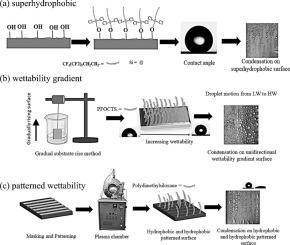
润湿性设计对湿空气凝结的影响:超疏水、单向润湿性梯度和图案表面
在本研究中,制备了三种具有不同润湿性特征的工程铝表面,即普通超疏水性,单向润湿性梯度和图案润湿性,并在受控条件下系统地评估了湿-空气冷凝。通过化学刻蚀和热水处理制备了平面超疏水表面,并用1H,1H,2H,2H-全氟辛基三氯硅烷进行了功能化。采用由化学蚀刻、热水处理和三氯硅烷涂层组成的渐变基材提升法产生润湿性梯度表面。化学蚀刻、热水处理、遮盖、涂层和等离子蚀刻的组合产生了图案表面。表面采用原子力显微镜(AFM)进行粗糙度表征,SEM进行形貌表征,FT-IR进行化学表征。通过测量水滴的平衡接触角和滞后来评估润湿行为。湿空气冷凝实验在规定的过冷度和相对湿度水平下进行,所有定量结果均以平均值报告,具有基于标准偏差的不确定性。在定向匹配的特定条件下评估了表面性能,以隔离重力排水对固有润湿性的影响。在相同的重力辅助条件下,单向润湿性梯度表面的凝结率比水平垂向(向下)结构下的同类超疏水表面高36%,而图案垂直表面的凝结率比普通垂直超疏水表面高51%。结果表明,凝结与表面能梯度和重力有关。在毛细管和重力条件下,润湿性对液滴运输的影响不同。较高的过冷度和湿度会增加冷凝水的收集速度。这项工作为设计润湿性以优化液滴传输和水收集提供了一个框架。
本文章由计算机程序翻译,如有差异,请以英文原文为准。
求助全文
约1分钟内获得全文
求助全文
来源期刊
CiteScore
11.00
自引率
10.00%
发文量
648
审稿时长
32 days
期刊介绍:
International Communications in Heat and Mass Transfer serves as a world forum for the rapid dissemination of new ideas, new measurement techniques, preliminary findings of ongoing investigations, discussions, and criticisms in the field of heat and mass transfer. Two types of manuscript will be considered for publication: communications (short reports of new work or discussions of work which has already been published) and summaries (abstracts of reports, theses or manuscripts which are too long for publication in full). Together with its companion publication, International Journal of Heat and Mass Transfer, with which it shares the same Board of Editors, this journal is read by research workers and engineers throughout the world.
 求助内容:
求助内容: 应助结果提醒方式:

 京公网安备 11010802042870号


