
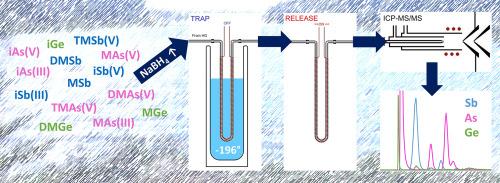
Simultaneous ultratrace analysis of antimony, arsenic and germanium species by hydride generation–cryotrapping–ICP-MS/MS: Focus on antimony in freshwaters
IF 3.8
2区 化学
Q1 SPECTROSCOPY
Spectrochimica Acta Part B: Atomic Spectroscopy
Pub Date : 2026-06-01
Epub Date: 2026-03-05
DOI:10.1016/j.sab.2026.107501
引用次数: 0
Abstract
A method is presented for the ultratrace analysis of antimony (Sb) species in natural water samples, performed simultaneously with the analysis of arsenic (As) and germanium (Ge) species. Compromise conditions enable efficient generation of volatile inorganic and methyl-substituted hydrides, which are cryotrapped, separated in a semi-automated system and detected by inductively coupled plasma mass spectrometry with triple quadrupole (ICP-MS/MS). Selective hydride generation (HG) from a TRIS buffer at pH 6, with or without L-cysteine for prereduction, distinguishes between trivalent and pentavalent Sb and As species. Limits of detection are in the low ng L−1 for inorganic As and Sb, low tenths of ng L−1 for methylated As species and a few hundredths of ng L−1 for methylated Sb and Ge species, making the method suitable for natural waters. Speciation of Sb, As and Ge in SLRS-6 and AQUA-1 reference materials is presented. Main analytical challenges and key considerations are discussed, supported by a one-year monitoring of Sb, As and Ge species at (sub)ng L−1 concentrations in Czech drinking water reservoirs. Limitations in quantifying methylated Sb species due to the absence of analytical standards are addressed. Conservation by HNO3 preserves speciation well, but the selectivity of trivalent iAs and iSb determination in the presence of pentavalent species is affected. EDTA is effective in maintaining the oxidation state of Sb and As species; however, inorganic Ge must be analyzed within days due to the slow formation of stable EDTA complexes, which are inaccessible for HG.
氢化物发生-低温捕集- icp -MS/MS同时超痕量分析淡水中锑、砷和锗
提出了一种天然水样中锑(Sb)与砷(As)、锗(Ge)同时超痕量分析的方法。妥协的条件使挥发性无机氢化物和甲基取代氢化物的高效生成成为可能,这些氢化物被冷冻,在半自动系统中分离,并通过电感耦合等离子体质谱与三重四极杆(ICP-MS/MS)检测。在pH为6的TRIS缓冲液中选择性氢化物生成(HG),有或没有l -半胱氨酸进行预还原,可区分三价和五价Sb和As。无机As和Sb的检出限在低ng L−1,甲基化As的检出限在低ng L−1的十分之一,甲基化Sb和Ge的检出限在几百分之一ng L−1,使该方法适用于天然水体。介绍了SLRS-6和AQUA-1标准物质中Sb、As和Ge的形态。通过对捷克饮用水水库中(亚)ng L−1浓度的Sb、As和Ge物种进行为期一年的监测,讨论了主要的分析挑战和关键考虑因素。由于缺乏分析标准,在定量甲基化Sb物种的限制被解决。HNO3保存能很好地保存物种形成,但在存在五价物种时,三价iAs和iSb测定的选择性受到影响。EDTA能有效维持Sb和As的氧化态;然而,无机Ge必须在几天内分析,因为稳定的EDTA络合物形成缓慢,HG无法获得。
本文章由计算机程序翻译,如有差异,请以英文原文为准。
求助全文
约1分钟内获得全文
求助全文
来源期刊
CiteScore
6.10
自引率
12.10%
发文量
173
审稿时长
81 days
期刊介绍:
Spectrochimica Acta Part B: Atomic Spectroscopy, is intended for the rapid publication of both original work and reviews in the following fields:
Atomic Emission (AES), Atomic Absorption (AAS) and Atomic Fluorescence (AFS) spectroscopy;
Mass Spectrometry (MS) for inorganic analysis covering Spark Source (SS-MS), Inductively Coupled Plasma (ICP-MS), Glow Discharge (GD-MS), and Secondary Ion Mass Spectrometry (SIMS).
Laser induced atomic spectroscopy for inorganic analysis, including non-linear optical laser spectroscopy, covering Laser Enhanced Ionization (LEI), Laser Induced Fluorescence (LIF), Resonance Ionization Spectroscopy (RIS) and Resonance Ionization Mass Spectrometry (RIMS); Laser Induced Breakdown Spectroscopy (LIBS); Cavity Ringdown Spectroscopy (CRDS), Laser Ablation Inductively Coupled Plasma Atomic Emission Spectroscopy (LA-ICP-AES) and Laser Ablation Inductively Coupled Plasma Mass Spectrometry (LA-ICP-MS).
X-ray spectrometry, X-ray Optics and Microanalysis, including X-ray fluorescence spectrometry (XRF) and related techniques, in particular Total-reflection X-ray Fluorescence Spectrometry (TXRF), and Synchrotron Radiation-excited Total reflection XRF (SR-TXRF).
Manuscripts dealing with (i) fundamentals, (ii) methodology development, (iii)instrumentation, and (iv) applications, can be submitted for publication.
 求助内容:
求助内容: 应助结果提醒方式:

 京公网安备 11010802042870号


