
Choosing a matrix effects correction method to quantify Cu, Zn, As and Pb in industrially contaminated soils by wavelength dispersive X-ray fluorescence spectrometry
IF 3.8
2区 化学
Q1 SPECTROSCOPY
Spectrochimica Acta Part B: Atomic Spectroscopy
Pub Date : 2026-06-01
Epub Date: 2026-02-26
DOI:10.1016/j.sab.2026.107497
引用次数: 0
Abstract
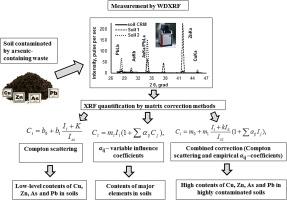
When quantifying the toxic elements Cu, Zn, As and Pb with X-ray fluorescence analysis in the soils contaminated by arsenic-containing industrial waste, there was a need to find some suitable methods for correcting of matrix effects caused by significant variations in the concentrations of the determined and interfering elements. The authors applied the XRF methods for calculating the elemental contents: external standard, Compton scattering correction, and α-correction with variable influence coefficients. The XRF results were validated with the atomic absorption spectrometry, the inductively coupled plasma mass spectrometry and the total reflection X-ray fluorescence spectrometry. This study showed that the Compton scattering correction is suitable for calculating the low-level contents of Cu, Zn, As and Pb in the contaminated soils, when the chemical compositions of soils are close to those of the calibration CRMs. If the contents of the determined and interfering elements in the contaminated soils varied significantly none of the above XRF methods provides the correct XRF results. The errors characterizing the difference between results of XRF and comparison methods (RSD) reached 20–90% rel. To compensate significant inter-element influences in such soils, the authors proposed the equation containing the Compton scattering component and empirical αij- influence coefficients. As a result, the RSD values were significantly reduced, amounting to: Cu 1.1–7, Zn 3–12, As 1.6–9 and Pb 2–9.5% rel. The maximum contents of target elements in highly contaminated soils were as follows, μg/g: Cu 6036, Zn 13,550, As 10,880 and Pb 4976. Thus, the combined correction approach ensured the WDXRF determination of the high contents of target elements in the studied soils.
选择矩阵效应校正法测定工业污染土壤中Cu、Zn、As和Pb的波长色散x射线荧光光谱法
在用x射线荧光法定量测定含砷工业废弃物污染土壤中的有毒元素Cu、Zn、As和Pb时,需要寻找合适的方法来校正被测元素和干扰元素浓度的显著变化所引起的基质效应。采用外标法、康普顿散射校正法和变影响系数α-校正法计算元素含量。用原子吸收光谱法、电感耦合等离子体质谱法和全反射x射线荧光光谱法对XRF结果进行了验证。研究表明,当污染土壤的化学成分与标定标准相接近时,康普顿散射校正法适用于计算污染土壤中Cu、Zn、As和Pb的低水平含量。如果污染土壤中被测定元素和干扰元素的含量变化显著,上述XRF方法均不能提供正确的XRF结果。XRF结果与对比方法(RSD)之间的误差达到20-90%。为了补偿此类土壤中显著的元素间影响,作者提出了包含康普顿散射分量和经验αij-影响系数的方程。结果表明,高污染土壤的RSD值显著降低,分别为:Cu 1.1 ~ 7、Zn 3 ~ 12、As 1.6 ~ 9、Pb 2 ~ 9.5%。高污染土壤中目标元素的最大含量为:Cu 6036、Zn 13550、As 10880、Pb 4976。因此,联合校正方法保证了WDXRF测定所研究土壤中目标元素的高含量。
本文章由计算机程序翻译,如有差异,请以英文原文为准。
求助全文
约1分钟内获得全文
求助全文
来源期刊
CiteScore
6.10
自引率
12.10%
发文量
173
审稿时长
81 days
期刊介绍:
Spectrochimica Acta Part B: Atomic Spectroscopy, is intended for the rapid publication of both original work and reviews in the following fields:
Atomic Emission (AES), Atomic Absorption (AAS) and Atomic Fluorescence (AFS) spectroscopy;
Mass Spectrometry (MS) for inorganic analysis covering Spark Source (SS-MS), Inductively Coupled Plasma (ICP-MS), Glow Discharge (GD-MS), and Secondary Ion Mass Spectrometry (SIMS).
Laser induced atomic spectroscopy for inorganic analysis, including non-linear optical laser spectroscopy, covering Laser Enhanced Ionization (LEI), Laser Induced Fluorescence (LIF), Resonance Ionization Spectroscopy (RIS) and Resonance Ionization Mass Spectrometry (RIMS); Laser Induced Breakdown Spectroscopy (LIBS); Cavity Ringdown Spectroscopy (CRDS), Laser Ablation Inductively Coupled Plasma Atomic Emission Spectroscopy (LA-ICP-AES) and Laser Ablation Inductively Coupled Plasma Mass Spectrometry (LA-ICP-MS).
X-ray spectrometry, X-ray Optics and Microanalysis, including X-ray fluorescence spectrometry (XRF) and related techniques, in particular Total-reflection X-ray Fluorescence Spectrometry (TXRF), and Synchrotron Radiation-excited Total reflection XRF (SR-TXRF).
Manuscripts dealing with (i) fundamentals, (ii) methodology development, (iii)instrumentation, and (iv) applications, can be submitted for publication.
 求助内容:
求助内容: 应助结果提醒方式:

 京公网安备 11010802042870号


