
Reactive and flexible graft polyesters with polydimethylsiloxane side chains as versatile tougheners for epoxies
IF 5.1
3区 工程技术
Q1 CHEMISTRY, APPLIED
Reactive & Functional Polymers
Pub Date : 2026-06-01
Epub Date: 2026-03-03
DOI:10.1016/j.reactfunctpolym.2026.106719
引用次数: 0
Abstract
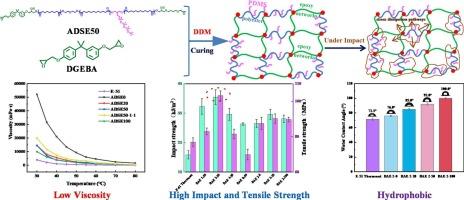
A kind of epoxy-functionalized flexible graft polyesters containing pendant polydimethylsiloxane short chains (ADSE) as novel tougheners for epoxies were developed. The polyesters with varying compositions were synthesized using dodecanedioic acid and azelaic acid as diacids, diethylene glycol and a Y-shaped mono-terminal bis‑carbon hydroxyl polydimethylsiloxane (PDMS) as diols, and two epoxy compounds as capping agents. Chemical structure and crystallization property of ADSE were well characterized by 1H NMR, FTIR, GPC and DSC. Viscosity testing revealed a higher content of PDMS resulted in a lower viscosity of ADSE. Polyester containing 50% of PDMS in diols (ADSE50) showed best toughening and strengthening performance for epoxies. The epoxy thermosets containing 2% of ADSE50 exhibited the maximum impact strength of 40.42 kJ/m2 and tensile strength of 103.25 MPa, which increase of 94.14% and 34.21% compared with that of neat epoxy. The introduction of ADSE50 also increased the glass transition temperature (Tg), initial thermal decomposition temperature, hydrophobicity and maintain high transparency of epoxy thermosets. The polyester of ADSE 50 was demonstrated to be a versatile toughener, capable of fabricating high-performance epoxy thermosets.
具有聚二甲基硅氧烷侧链的反应性和柔性接枝聚酯作为环氧树脂的通用增韧剂
研制了一种新型环氧树脂增韧剂——聚二甲基硅氧烷短链柔性接枝聚酯(ADSE)。以十二烷二酸和壬二酸为二酸,二甘醇和y型单端双碳羟基聚二甲基硅氧烷(PDMS)为二醇,两种环氧化合物为封盖剂,合成了不同组成的聚酯。通过1H NMR、FTIR、GPC和DSC表征了ADSE的化学结构和结晶性能。粘度测试表明,PDMS含量越高,ADSE的粘度越低。聚二醇中PDMS含量为50%的聚酯(ADSE50)对环氧树脂的增韧强化性能最好。含2% ADSE50的环氧热固性树脂的最大冲击强度为40.42 kJ/m2,抗拉强度为103.25 MPa,分别比纯环氧树脂提高了94.14%和34.21%。ADSE50的引入还提高了环氧热固性树脂的玻璃化转变温度(Tg)、初始热分解温度、疏水性和保持高透明度。ADSE 50的聚酯被证明是一种多功能增韧剂,能够制造高性能环氧热固性材料。
本文章由计算机程序翻译,如有差异,请以英文原文为准。
求助全文
约1分钟内获得全文
求助全文
来源期刊
Reactive & Functional Polymers
工程技术-高分子科学
CiteScore
8.90
自引率
5.90%
发文量
259
审稿时长
27 days
期刊介绍:
Reactive & Functional Polymers provides a forum to disseminate original ideas, concepts and developments in the science and technology of polymers with functional groups, which impart specific chemical reactivity or physical, chemical, structural, biological, and pharmacological functionality. The scope covers organic polymers, acting for instance as reagents, catalysts, templates, ion-exchangers, selective sorbents, chelating or antimicrobial agents, drug carriers, sensors, membranes, and hydrogels. This also includes reactive cross-linkable prepolymers and high-performance thermosetting polymers, natural or degradable polymers, conducting polymers, and porous polymers.
Original research articles must contain thorough molecular and material characterization data on synthesis of the above polymers in combination with their applications. Applications include but are not limited to catalysis, water or effluent treatment, separations and recovery, electronics and information storage, energy conversion, encapsulation, or adhesion.
 求助内容:
求助内容: 应助结果提醒方式:

 京公网安备 11010802042870号


