
Low-diameter/defect carbon nanotubes formed on nickel foam derived from nickel-cobalt Prussian blue analogs for high-performance supercapacitor
IF 8.4
2区 工程技术
Q1 CHEMISTRY, PHYSICAL
Journal of Power Sources
Pub Date : 2026-05-15
Epub Date: 2026-03-05
DOI:10.1016/j.jpowsour.2026.239773
引用次数: 0
Abstract
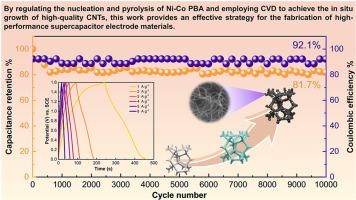
Carbon nanotubes (CNTs) with high specific surface area, low internal resistance, high structural stability, and abundant active sites are ideal electrode materials. In this work, regulating nickel-cobalt Prussian blue analogs (Ni-Co PBA) nucleation on nickel foam (NF) guides CNTs morphological evolution, achieving in-situ growth of low-diameter/defect CNTs on NF. Ni-Co PBA is anchored on NF through deposition and chemical bonding mechanisms. Chemical vapor deposition (CVD) is employed to synthesize CNTs on the NF surface. The framework structure of Ni-Co PBA not only effectively prevents transition metal ion agglomeration, but pyrolytic Ni-Co nanoparticles also catalyze this growth. Selenization converts the nanoparticles encapsulated within CNTs into metal selenides, yielding the product [email protected]. The fabricated [email protected] electrode exhibits a specific capacitance of 1592.3 F g−1 at current density of 1 A g−1. The assembled [email protected]//AC achieves a maximum energy density of 48.6 Wh kg−1 at power density of 800 W kg−1; it also maintains 81.7% of initial specific capacitance after 10,000 cycles at a current density of 10 A g−1. Importantly, this work provides inspiration for the preparation of low-diameter/defect CNTs and their application in high-performance supercapacitor energy storage.
高性能超级电容器用镍钴普鲁士蓝类似物在镍泡沫上形成的低直径/缺陷碳纳米管
碳纳米管具有高比表面积、低内阻、高结构稳定性和丰富的活性位点等优点,是理想的电极材料。在本研究中,通过调节镍钴普鲁士蓝类似物(Ni-Co PBA)在泡沫镍(NF)上的成核,引导碳纳米管的形态演变,实现了低直径/缺陷碳纳米管在泡沫镍(NF)上的原位生长。镍钴PBA通过沉积和化学键机制锚定在NF上。采用化学气相沉积(CVD)技术在NF表面合成CNTs。Ni-Co PBA的框架结构不仅有效地阻止了过渡金属离子的团聚,而且热解Ni-Co纳米颗粒也催化了这种生长。硒化作用将包裹在碳纳米管内的纳米颗粒转化为金属硒化物,生成产物[email protected]。制备的[email protected]电极在电流密度为1 a g−1时的比电容为1592.3 F g−1。组装的[email protected]//交流电在功率密度为800 W kg - 1时,最大能量密度为48.6 Wh kg - 1;在10 a g−1的电流密度下,在10,000次循环后,它还保持81.7%的初始比电容。重要的是,这项工作为低直径/缺陷碳纳米管的制备及其在高性能超级电容器储能中的应用提供了灵感。
本文章由计算机程序翻译,如有差异,请以英文原文为准。
求助全文
约1分钟内获得全文
求助全文
来源期刊
Journal of Power Sources
工程技术-电化学
CiteScore
16.40
自引率
6.50%
发文量
1249
审稿时长
36 days
期刊介绍:
The Journal of Power Sources is a publication catering to researchers and technologists interested in various aspects of the science, technology, and applications of electrochemical power sources. It covers original research and reviews on primary and secondary batteries, fuel cells, supercapacitors, and photo-electrochemical cells.
Topics considered include the research, development and applications of nanomaterials and novel componentry for these devices. Examples of applications of these electrochemical power sources include:
• Portable electronics
• Electric and Hybrid Electric Vehicles
• Uninterruptible Power Supply (UPS) systems
• Storage of renewable energy
• Satellites and deep space probes
• Boats and ships, drones and aircrafts
• Wearable energy storage systems
 求助内容:
求助内容: 应助结果提醒方式:

 京公网安备 11010802042870号


