
Facile hydrothermal synthesis of rod-like nanostructure NiO/CuO for highly selective low-temperature H2S sensing

IF 3.4 4区 化学 Q2 CHEMISTRY, MULTIDISCIPLINARY
Journal of the Indian Chemical Society Pub Date : 2026-05-01 Epub Date: 2026-03-10 DOI:10.1016/j.jics.2026.102537
Vedshree Lothe , Manjusha Kulkarni , Ashok Borhade , Dipak Tope
{"title":"Facile hydrothermal synthesis of rod-like nanostructure NiO/CuO for highly selective low-temperature H2S sensing","authors":"Vedshree Lothe ,&nbsp;Manjusha Kulkarni ,&nbsp;Ashok Borhade ,&nbsp;Dipak Tope","doi":"10.1016/j.jics.2026.102537","DOIUrl":null,"url":null,"abstract":"<div><div>In the present study, NiO/CuO nanostructures were synthesized using a cost-effective, straightforward hydrothermal method at a molar Ratio of 1:1, followed by calcination. The structural, morphological, and optical properties were analyzed using XRD, FTIR, UV-Vis, FE-SEM, EDX-mapping, and HR-TEM-SAED. XRD analysis confirmed the successful synthesis of the core-shell nanostructures, with the XRD spectrum showing diffraction peaks of cubic NiO and the monoclinic phase of CuO. The morphology of the nanostructures, as determined by HR-TEM, was confirmed to be rod-like, with diameters ranging from 6 to 10 nm, and showed well-resolved lattice fringes of both NiO and CuO. The UV-Vis spectrum of the nanostructures exhibited a broad absorption band, enabling their use in photocatalysis across a wide range of light. Moreover, the synthesized NiO/CuO nanomaterials were evaluated for potential gas-detection applications, and their gas-sensing properties were compared with those of NiO and CuO. The nanostructures sensor exhibited high selectivity to H<sub>2</sub>S, with a response of over 90% at an optimal operating temperature of 90 °C. This excellent performance with rapid response and recovery behaviour is due to the synergistic effect of the NiO/CuO nanostructures. This phenomenon enhances charge separation and transport, thereby improving the material's sensitivity and selectivity. The results indicate that the NiO/CuO nanostructures are very promising for potential gas-sensing applications.</div></div>","PeriodicalId":17276,"journal":{"name":"Journal of the Indian Chemical Society","volume":"103 5","pages":"Article 102537"},"PeriodicalIF":3.4000,"publicationDate":"2026-05-01","publicationTypes":"Journal Article","fieldsOfStudy":null,"isOpenAccess":false,"openAccessPdf":"","citationCount":"0","resultStr":null,"platform":"Semanticscholar","paperid":null,"PeriodicalName":"Journal of the Indian Chemical Society","FirstCategoryId":"92","ListUrlMain":"https://www.sciencedirect.com/science/article/pii/S0019452226001408","RegionNum":4,"RegionCategory":"化学","ArticlePicture":[],"TitleCN":null,"AbstractTextCN":null,"PMCID":null,"EPubDate":"2026/3/10 0:00:00","PubModel":"Epub","JCR":"Q2","JCRName":"CHEMISTRY, MULTIDISCIPLINARY","Score":null,"Total":0}
引用次数: 0

Abstract

In the present study, NiO/CuO nanostructures were synthesized using a cost-effective, straightforward hydrothermal method at a molar Ratio of 1:1, followed by calcination. The structural, morphological, and optical properties were analyzed using XRD, FTIR, UV-Vis, FE-SEM, EDX-mapping, and HR-TEM-SAED. XRD analysis confirmed the successful synthesis of the core-shell nanostructures, with the XRD spectrum showing diffraction peaks of cubic NiO and the monoclinic phase of CuO. The morphology of the nanostructures, as determined by HR-TEM, was confirmed to be rod-like, with diameters ranging from 6 to 10 nm, and showed well-resolved lattice fringes of both NiO and CuO. The UV-Vis spectrum of the nanostructures exhibited a broad absorption band, enabling their use in photocatalysis across a wide range of light. Moreover, the synthesized NiO/CuO nanomaterials were evaluated for potential gas-detection applications, and their gas-sensing properties were compared with those of NiO and CuO. The nanostructures sensor exhibited high selectivity to H2S, with a response of over 90% at an optimal operating temperature of 90 °C. This excellent performance with rapid response and recovery behaviour is due to the synergistic effect of the NiO/CuO nanostructures. This phenomenon enhances charge separation and transport, thereby improving the material's sensitivity and selectivity. The results indicate that the NiO/CuO nanostructures are very promising for potential gas-sensing applications.
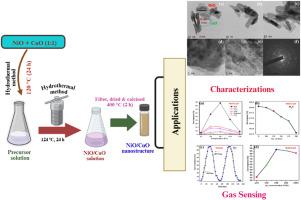
Abstract Image

用于高选择性低温H2S传感的棒状纳米结构NiO/CuO的水热合成
在本研究中,采用一种经济、简单的水热方法,以1:1的摩尔比合成了NiO/CuO纳米结构,然后进行了煅烧。采用XRD、FTIR、UV-Vis、FE-SEM、EDX-mapping和HR-TEM-SAED对其结构、形貌和光学性质进行了分析。XRD分析证实了核壳纳米结构的成功合成,XRD谱图显示出立方NiO和CuO单斜相的衍射峰。通过红外透射电镜(HR-TEM)检测,纳米结构为棒状,直径在6 ~ 10 nm之间,并显示出NiO和CuO的晶格条纹。纳米结构的紫外-可见光谱表现出较宽的吸收带,使其能够在宽范围的光催化中使用。此外,还对合成的NiO/CuO纳米材料的气敏性能进行了评价,并与NiO和CuO的气敏性能进行了比较。该传感器对H2S具有较高的选择性,在90°C的最佳工作温度下,响应率超过90%。这种具有快速响应和恢复行为的优异性能是由于NiO/CuO纳米结构的协同作用。这种现象增强了电荷的分离和输运,从而提高了材料的灵敏度和选择性。结果表明,NiO/CuO纳米结构具有潜在的气敏应用前景。
本文章由计算机程序翻译,如有差异,请以英文原文为准。
求助全文
约1分钟内获得全文 求助全文
来源期刊
CiteScore
3.50
自引率
7.70%
发文量
492
审稿时长
3-8 weeks
期刊介绍: The Journal of the Indian Chemical Society publishes original, fundamental, theorical, experimental research work of highest quality in all areas of chemistry, biochemistry, medicinal chemistry, electrochemistry, agrochemistry, chemical engineering and technology, food chemistry, environmental chemistry, etc.

×
引用
GB/T 7714-2015
复制
MLA
复制
APA
复制
导出至
BibTeX EndNote RefMan NoteFirst NoteExpress
×
提示
您的信息不完整,为了账户安全,请先补充。
现在去补充
×
提示
您因"违规操作"
具体请查看互助需知
我知道了
×
提示
确定
请完成安全验证×
copy
已复制链接
快去分享给好友吧!
我知道了
右上角分享
点击右上角分享
0
联系我们:info@booksci.cn Book学术提供免费学术资源搜索服务,方便国内外学者检索中英文文献。致力于提供最便捷和优质的服务体验。 Copyright © 2023 布克学术 All rights reserved.
京ICP备2023020795号-1
ghs 京公网安备 11010802042870号
Book学术文献互助
Book学术文献互助群
群 号:604180095
Book学术官方微信
小红书


