
Doping and electronic properties of Au5-xMx (M=Ag or Cu; x = 0 to 5) nanoclusters

IF 3.4 4区 化学 Q2 CHEMISTRY, MULTIDISCIPLINARY
Journal of the Indian Chemical Society Pub Date : 2026-05-01 Epub Date: 2026-03-06 DOI:10.1016/j.jics.2026.102525
Jyoti Yadav, Sangeeta Saini
{"title":"Doping and electronic properties of Au5-xMx (M=Ag or Cu; x = 0 to 5) nanoclusters","authors":"Jyoti Yadav,&nbsp;Sangeeta Saini","doi":"10.1016/j.jics.2026.102525","DOIUrl":null,"url":null,"abstract":"<div><div>A density functional theory (DFT)-based study has been performed to investigate the effect of substitutional silver (Ag) and copper (Cu) doping on the structural, electronic, magnetic, and reactivity properties of Au<sub>5</sub> nanoclusters. Multiple initial geometries of bimetallic Au<sub>5-x</sub>M<sub>x</sub> (M = Ag, Cu; x = 1–4) are optimized, and the most stable ground-state structure for each composition is selected for further studies. The impact of dopant concentration on binding energy per atom, vertical ionization potential (VIP), vertical electron affinity (VEA), chemical hardness, frontier molecular orbital gap, dipole moment, Fukui functions, nuclear independent chemical shift (NICS), density of states (DOS), IR frequencies and spin densities is systematically examined. The study found Ag doping leads to a gradual reduction in binding energy and chemical hardness, indicating increased softness and moderate reactivity. In contrast, Cu incorporation enhances s–d hybridization, strengthens metal–metal interactions, and increases stability. Fukui function results show reasonable agreement with electrostatic potential (ESP) maps in predicting nature of reactive sites. NICS analysis reveals aromatic character in the order Au<sub>5</sub> &gt; Cu<sub>5</sub> &gt; Ag<sub>5</sub>. Mulliken spin populations indicate symmetry-dependent spin delocalization. DOS analysis further highlights composition-dependent changes in SOMO character. The study highlights substitutional doping as an effective strategy for tuning the stability, electronic structure, and reactivity of small gold-based bimetallic nanoclusters.</div></div>","PeriodicalId":17276,"journal":{"name":"Journal of the Indian Chemical Society","volume":"103 5","pages":"Article 102525"},"PeriodicalIF":3.4000,"publicationDate":"2026-05-01","publicationTypes":"Journal Article","fieldsOfStudy":null,"isOpenAccess":false,"openAccessPdf":"","citationCount":"0","resultStr":null,"platform":"Semanticscholar","paperid":null,"PeriodicalName":"Journal of the Indian Chemical Society","FirstCategoryId":"92","ListUrlMain":"https://www.sciencedirect.com/science/article/pii/S0019452226001287","RegionNum":4,"RegionCategory":"化学","ArticlePicture":[],"TitleCN":null,"AbstractTextCN":null,"PMCID":null,"EPubDate":"2026/3/6 0:00:00","PubModel":"Epub","JCR":"Q2","JCRName":"CHEMISTRY, MULTIDISCIPLINARY","Score":null,"Total":0}
引用次数: 0

Abstract

A density functional theory (DFT)-based study has been performed to investigate the effect of substitutional silver (Ag) and copper (Cu) doping on the structural, electronic, magnetic, and reactivity properties of Au5 nanoclusters. Multiple initial geometries of bimetallic Au5-xMx (M = Ag, Cu; x = 1–4) are optimized, and the most stable ground-state structure for each composition is selected for further studies. The impact of dopant concentration on binding energy per atom, vertical ionization potential (VIP), vertical electron affinity (VEA), chemical hardness, frontier molecular orbital gap, dipole moment, Fukui functions, nuclear independent chemical shift (NICS), density of states (DOS), IR frequencies and spin densities is systematically examined. The study found Ag doping leads to a gradual reduction in binding energy and chemical hardness, indicating increased softness and moderate reactivity. In contrast, Cu incorporation enhances s–d hybridization, strengthens metal–metal interactions, and increases stability. Fukui function results show reasonable agreement with electrostatic potential (ESP) maps in predicting nature of reactive sites. NICS analysis reveals aromatic character in the order Au5 > Cu5 > Ag5. Mulliken spin populations indicate symmetry-dependent spin delocalization. DOS analysis further highlights composition-dependent changes in SOMO character. The study highlights substitutional doping as an effective strategy for tuning the stability, electronic structure, and reactivity of small gold-based bimetallic nanoclusters.
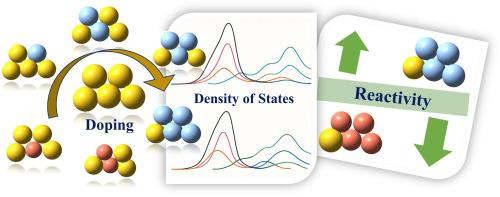
Abstract Image

Au5-xMx (M=Ag或Cu; x = 0 ~ 5)纳米团簇的掺杂及电子性质
基于密度泛函理论(DFT)研究了取代银(Ag)和铜(Cu)掺杂对Au5纳米团簇结构、电子、磁性和反应性的影响。对双金属Au5-xMx (M = Ag, Cu; x = 1-4)的多种初始几何形状进行了优化,选择了每种成分最稳定的基态结构进行进一步研究。系统考察了掺杂剂浓度对单原子结合能、垂直电离势(VIP)、垂直电子亲和势(VEA)、化学硬度、前沿分子轨道间隙、偶极矩、福井函数、核无关化学位移(NICS)、态密度(DOS)、红外频率和自旋密度的影响。研究发现,Ag掺杂导致材料的结合能和化学硬度逐渐降低,表明材料的柔软度增加,反应性适中。相反,Cu的掺入增强了s-d杂化,增强了金属-金属相互作用,提高了稳定性。福井函数结果与静电势图在预测反应位点性质方面具有较好的一致性。通过NICS分析,发现其芳香特征为Au5 >; Cu5 > Ag5。Mulliken自旋居表明对称性相关的自旋离域。DOS分析进一步强调了SOMO特征中与成分相关的变化。该研究强调了替代掺杂是调节小型金基双金属纳米团簇的稳定性、电子结构和反应性的有效策略。
本文章由计算机程序翻译,如有差异,请以英文原文为准。
求助全文
约1分钟内获得全文 求助全文
来源期刊
CiteScore
3.50
自引率
7.70%
发文量
492
审稿时长
3-8 weeks
期刊介绍: The Journal of the Indian Chemical Society publishes original, fundamental, theorical, experimental research work of highest quality in all areas of chemistry, biochemistry, medicinal chemistry, electrochemistry, agrochemistry, chemical engineering and technology, food chemistry, environmental chemistry, etc.

×
引用
GB/T 7714-2015
复制
MLA
复制
APA
复制
导出至
BibTeX EndNote RefMan NoteFirst NoteExpress
×
提示
您的信息不完整,为了账户安全,请先补充。
现在去补充
×
提示
您因"违规操作"
具体请查看互助需知
我知道了
×
提示
确定
请完成安全验证×
copy
已复制链接
快去分享给好友吧!
我知道了
右上角分享
点击右上角分享
0
联系我们:info@booksci.cn Book学术提供免费学术资源搜索服务,方便国内外学者检索中英文文献。致力于提供最便捷和优质的服务体验。 Copyright © 2023 布克学术 All rights reserved.
京ICP备2023020795号-1
ghs 京公网安备 11010802042870号
Book学术文献互助
Book学术文献互助群
群 号:604180095
Book学术官方微信
小红书


