
Sustainable design of multifunctional zinc oxide nanoparticles using Cleistocalyx operculatus for high-efficiency UV photocatalysis and potent antibacterial applications

IF 3.4 4区 化学 Q2 CHEMISTRY, MULTIDISCIPLINARY
Journal of the Indian Chemical Society Pub Date : 2026-05-01 Epub Date: 2026-03-09 DOI:10.1016/j.jics.2026.102536
Anh Van Thi Le , Linh Minh Ngo , Diep Ngoc Le , Mai Thi Le , Sura Nguyen , Thi Anh Le , Chien Mau Dang , Dung My Thi Dang
{"title":"Sustainable design of multifunctional zinc oxide nanoparticles using Cleistocalyx operculatus for high-efficiency UV photocatalysis and potent antibacterial applications","authors":"Anh Van Thi Le ,&nbsp;Linh Minh Ngo ,&nbsp;Diep Ngoc Le ,&nbsp;Mai Thi Le ,&nbsp;Sura Nguyen ,&nbsp;Thi Anh Le ,&nbsp;Chien Mau Dang ,&nbsp;Dung My Thi Dang","doi":"10.1016/j.jics.2026.102536","DOIUrl":null,"url":null,"abstract":"<div><div>A sustainable, comprehensive green synthesis route for zinc oxide nanoparticles (ZnO NPs) was developed using <em>Cleistocalyx operculatus</em> leaf extract as both a reducing and a capping agent. The extraction of bioactive compounds was systematically optimized via Response surface methodology (RSM), with extraction time, temperature, ethanol concentration, and leaf-to-solvent ratio as key parameters. Optimized conditions (76°C, 87 min, 85% v/v ethanol, and a 3:8 g mL<sup>−1</sup> ratio) were used to obtain a polyphenol-rich extract with high total phenolic content, antioxidant capacity, and reducing power. The resulting extract facilitated the synthesis of high-purity, spherical ZnO NPs exhibiting a hexagonal wurtzite structure. Physicochemical analyses confirmed high crystallinity (79–80%) and tunable crystallite sizes ranging from 8.8 to 16.3 nm. The precursor-to-extract ratio emerged as a critical parameter; higher extract volumes resulted in more uniform, well-dispersed particles with enhanced bio-derived surface functionalities. The synthesized ZnO NPs exhibited high photocatalytic efficiency, degrading 99.5% of methylene blue under UV irradiation within 150 min. Kinetic studies indicated the process followed a pseudo-first-order model (with a rate constant k = 1.84 × 10<sup>−2</sup> min<sup>−1</sup>). Scavenging experiments confirmed that photogenerated hydroxyl radicals (•OH) were the primary active species responsible for degradation. The catalyst maintained near-complete efficiency over five reuse cycles, demonstrating robust stability. Furthermore, the NPs showed potent, dose-dependent antibacterial activity against <em>Escherichia coli</em> (MBC/MIC = 0.625/0.313 mg mL<sup>−1</sup>) and <em>Staphylococcus aureus</em> (MBC/MIC = 2.50/0.625 mg mL<sup>−1</sup>). This efficacy is attributed to the synergistic action of Reactive oxygen species (ROS) generation, membrane disruption, and Zn<sup>2+</sup> ion release. The results validate <em>C. operculatus</em>–assisted ZnO NPs as efficient and multifunctional candidates for advanced environmental cleanup and antimicrobial applications, highlighting the broad utility of polyphenol-mediated green synthesis for designing metal oxide nanomaterials.</div></div>","PeriodicalId":17276,"journal":{"name":"Journal of the Indian Chemical Society","volume":"103 5","pages":"Article 102536"},"PeriodicalIF":3.4000,"publicationDate":"2026-05-01","publicationTypes":"Journal Article","fieldsOfStudy":null,"isOpenAccess":false,"openAccessPdf":"","citationCount":"0","resultStr":null,"platform":"Semanticscholar","paperid":null,"PeriodicalName":"Journal of the Indian Chemical Society","FirstCategoryId":"92","ListUrlMain":"https://www.sciencedirect.com/science/article/pii/S0019452226001391","RegionNum":4,"RegionCategory":"化学","ArticlePicture":[],"TitleCN":null,"AbstractTextCN":null,"PMCID":null,"EPubDate":"2026/3/9 0:00:00","PubModel":"Epub","JCR":"Q2","JCRName":"CHEMISTRY, MULTIDISCIPLINARY","Score":null,"Total":0}
引用次数: 0

Abstract

A sustainable, comprehensive green synthesis route for zinc oxide nanoparticles (ZnO NPs) was developed using Cleistocalyx operculatus leaf extract as both a reducing and a capping agent. The extraction of bioactive compounds was systematically optimized via Response surface methodology (RSM), with extraction time, temperature, ethanol concentration, and leaf-to-solvent ratio as key parameters. Optimized conditions (76°C, 87 min, 85% v/v ethanol, and a 3:8 g mL−1 ratio) were used to obtain a polyphenol-rich extract with high total phenolic content, antioxidant capacity, and reducing power. The resulting extract facilitated the synthesis of high-purity, spherical ZnO NPs exhibiting a hexagonal wurtzite structure. Physicochemical analyses confirmed high crystallinity (79–80%) and tunable crystallite sizes ranging from 8.8 to 16.3 nm. The precursor-to-extract ratio emerged as a critical parameter; higher extract volumes resulted in more uniform, well-dispersed particles with enhanced bio-derived surface functionalities. The synthesized ZnO NPs exhibited high photocatalytic efficiency, degrading 99.5% of methylene blue under UV irradiation within 150 min. Kinetic studies indicated the process followed a pseudo-first-order model (with a rate constant k = 1.84 × 10−2 min−1). Scavenging experiments confirmed that photogenerated hydroxyl radicals (•OH) were the primary active species responsible for degradation. The catalyst maintained near-complete efficiency over five reuse cycles, demonstrating robust stability. Furthermore, the NPs showed potent, dose-dependent antibacterial activity against Escherichia coli (MBC/MIC = 0.625/0.313 mg mL−1) and Staphylococcus aureus (MBC/MIC = 2.50/0.625 mg mL−1). This efficacy is attributed to the synergistic action of Reactive oxygen species (ROS) generation, membrane disruption, and Zn2+ ion release. The results validate C. operculatus–assisted ZnO NPs as efficient and multifunctional candidates for advanced environmental cleanup and antimicrobial applications, highlighting the broad utility of polyphenol-mediated green synthesis for designing metal oxide nanomaterials.
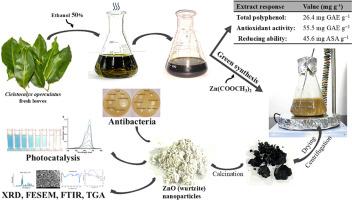
Abstract Image

多功能氧化锌纳米颗粒的可持续设计,用于高效紫外光催化和有效的抗菌应用
以闭锁叶提取物为还原剂和封盖剂,建立了一种可持续、全面的绿色合成氧化锌纳米颗粒(ZnO NPs)的途径。以提取时间、提取温度、乙醇浓度、叶液比为主要参数,采用响应面法(RSM)对提取工艺进行了系统优化。优化条件(76°C, 87 min, 85% v/v乙醇,3:8 g mL−1比)可获得高总酚含量,抗氧化能力和还原能力的富含多酚的提取物。所得萃取物有助于合成具有六方纤锌矿结构的高纯度球形ZnO NPs。理化分析证实其结晶度高(79-80%),晶粒尺寸可调,范围为8.8 - 16.3 nm。前驱物萃取比成为一个关键参数;更高的萃取量导致更均匀,分散良好的颗粒与增强的生物衍生的表面功能。合成的ZnO纳米粒子具有较高的光催化效率,在紫外线照射150 min内可降解99.5%的亚甲基蓝。动力学研究表明,该过程符合准一阶模型(速率常数k = 1.84 × 10⁻² min−1)。清除实验证实,光产生的羟基自由基(•OH)是负责降解的主要活性物质。该催化剂在5个重复使用周期中保持了近乎完全的效率,显示出强大的稳定性。此外,NPs对大肠杆菌(MBC/MIC = 0.625/0.313 mg mL−1)和金黄色葡萄球菌(MBC/MIC = 2.50/0.625 mg mL−1)的抑菌活性呈剂量依赖性。这种功效归因于活性氧(ROS)的产生、膜破坏和Zn2+离子释放的协同作用。这些结果验证了C. operculatas辅助ZnO NPs作为先进环境净化和抗菌应用的高效和多功能候选者,突出了多酚介导的绿色合成在设计金属氧化物纳米材料中的广泛应用。
本文章由计算机程序翻译,如有差异,请以英文原文为准。
求助全文
约1分钟内获得全文 求助全文
来源期刊
CiteScore
3.50
自引率
7.70%
发文量
492
审稿时长
3-8 weeks
期刊介绍: The Journal of the Indian Chemical Society publishes original, fundamental, theorical, experimental research work of highest quality in all areas of chemistry, biochemistry, medicinal chemistry, electrochemistry, agrochemistry, chemical engineering and technology, food chemistry, environmental chemistry, etc.

×
引用
GB/T 7714-2015
复制
MLA
复制
APA
复制
导出至
BibTeX EndNote RefMan NoteFirst NoteExpress
×
提示
您的信息不完整,为了账户安全,请先补充。
现在去补充
×
提示
您因"违规操作"
具体请查看互助需知
我知道了
×
提示
确定
请完成安全验证×
copy
已复制链接
快去分享给好友吧!
我知道了
右上角分享
点击右上角分享
0
联系我们:info@booksci.cn Book学术提供免费学术资源搜索服务,方便国内外学者检索中英文文献。致力于提供最便捷和优质的服务体验。 Copyright © 2023 布克学术 All rights reserved.
京ICP备2023020795号-1
ghs 京公网安备 11010802042870号
Book学术文献互助
Book学术文献互助群
群 号:604180095
Book学术官方微信
小红书


