
A new high-efficiency nickel-based catalyst doped with rare earth metals for hydrogen production by ammonia decomposition
IF 3.4
4区 化学
Q2 CHEMISTRY, MULTIDISCIPLINARY
Journal of the Indian Chemical Society
Pub Date : 2026-05-01
Epub Date: 2026-02-26
DOI:10.1016/j.jics.2026.102518
引用次数: 0
Abstract
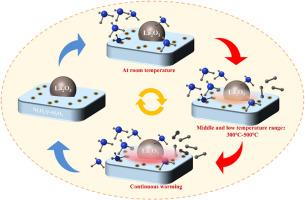
The development of efficient and low-cost catalysts for hydrogen production via ammonia decomposition is crucial for the hydrogen economy. This work systematically investigates the promotional effects and underlying mechanisms of rare earth metals (La, Ce, Y) on Ni/γ-Al2O3 catalysts. A series of 8%Ni–M/γ-Al2O3 (M = La, Ce, Y) catalysts were synthesized via ultrasound-assisted impregnation. Comprehensive characterization (XRD, BET, SEM, XPS, EDS, NH3-TPD) reveals that La doping optimally enhances Ni dispersion, increases surface oxygen vacancies concentration, and strengthens metal-support interaction. These synergistic modifications lead to superior catalytic performance. The 8%Ni–3%La2O3/γ-Al2O3 catalyst achieves ammonia conversion rates of 39.2%, 65.0%, 89.2%, and 98.8% at 500, 550, 600, and 700 °C, respectively, under a GHSV of 6000 mL g−1 h−1. This represents an activity enhancement of ∼11%, ∼20%, and ∼8% at 500, 550, and 700 °C, respectively, compared to the undoped catalyst. Most importantly, La doping significantly reduces the apparent activation energy to 66.8 kJ mol−1, providing direct kinetic evidence for the facilitated reaction pathway. The promotional mechanism is attributed to La-induced oxygen vacancies which favor NH3 activation and the improved Ni dispersion which provides more active sites. This study elucidates the structure-activity relationship in rare earth promoted Ni catalysts and offers a strategic guideline for designing high-performance, non-noble metal catalysts for sustainable hydrogen production.
一种新型掺稀土高效镍基氨分解制氢催化剂
开发高效、低成本的氨分解制氢催化剂对氢经济至关重要。本文系统地研究了稀土金属(La, Ce, Y)对Ni/γ-Al2O3催化剂的促进作用及其机制。采用超声辅助浸渍法制备了一系列8%Ni-M /γ-Al2O3 (M = La, Ce, Y)催化剂。综合表征(XRD, BET, SEM, XPS, EDS, NH3-TPD)表明,La的掺杂最优地增强了Ni的分散性,增加了表面氧空位浓度,增强了金属-载体相互作用。这些协同改性导致了优异的催化性能。8%Ni-3%La2O3 /γ-Al2O3催化剂在温度为500、550、600和700℃,GHSV为6000 mL g−1 h−1时,氨转化率分别为39.2%、65.0%、89.2%和98.8%。与未掺杂的催化剂相比,在500、550和700℃时,活性分别提高了~ 11%、~ 20%和~ 8%。最重要的是,La掺杂显著降低了表观活化能至66.8 kJ mol−1,为促进反应途径提供了直接的动力学证据。la诱导的氧空位有利于NH3的活化,而Ni的分散性得到了改善,从而提供了更多的活性位点。本研究阐明了稀土促进镍催化剂的构效关系,为设计高性能非贵金属可持续制氢催化剂提供了战略指导。
本文章由计算机程序翻译,如有差异,请以英文原文为准。
求助全文
约1分钟内获得全文
求助全文
来源期刊
CiteScore
3.50
自引率
7.70%
发文量
492
审稿时长
3-8 weeks
期刊介绍:
The Journal of the Indian Chemical Society publishes original, fundamental, theorical, experimental research work of highest quality in all areas of chemistry, biochemistry, medicinal chemistry, electrochemistry, agrochemistry, chemical engineering and technology, food chemistry, environmental chemistry, etc.
 求助内容:
求助内容: 应助结果提醒方式:

 京公网安备 11010802042870号


