
Deep-blue solid-state emission from Ternaphthalene: Photophysical tuning via multi-chromophore architectures
IF 4.7
3区 化学
Q2 CHEMISTRY, PHYSICAL
Journal of Photochemistry and Photobiology A-chemistry
Pub Date : 2026-09-01
Epub Date: 2026-03-06
DOI:10.1016/j.jphotochem.2026.117156
引用次数: 0
Abstract
We report the synthesis and photophysical characterization of a series of “all-naphthalene” multi-chromophore systems, ternaphthalenes (TNps), designed for efficient deep-blue solid-state emission. Unlike planar polycyclic aromatic hydrocarbons that suffer from aggregation-caused quenching (ACQ), the twisted molecular architecture of TNps effectively inhibits π-π stacking interactions. Consequently, several TNps exhibit crystallization-induced emission enhancement (CIEE) or retain high quantum yields (up to 0.94) in the solid state. Kinetic analysis revealed that this efficiency stems from the significant suppression of non-radiative rates (knr) due to the restricted intramolecular rotation in the rigid crystal lattice. Furthermore, a decisive topological effect on the radiative rate (kf) was demonstrated. The 1,4-, 1,5- and 2,6-linked isomers display allowed transitions with large oscillator strengths (f) and fast radiative rate (kf = ca. 5 × 10⁸ s−1), whereas the 2,7-linked isomers exhibit forbidden-like character with prolonged lifetimes. A distinct linear correlation between the experimental and calculated values empirically supports the applicability of the Strickler-Berg relationship in both solution and solid states. These findings demonstrate that controlling the chromophore connectivity is a powerful strategy to tune excited-state dynamics for developing high-performance deep-blue organic emitters.
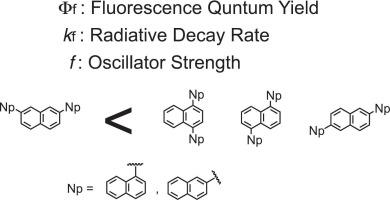
ter萘的深蓝色固态发射:通过多发色团结构的光物理调谐
我们报道了一系列“全萘”多发色团体系ternaphthales (TNps)的合成和光物理特性,该体系设计用于高效的深蓝色固态发射。与平面型多环芳烃的聚集猝灭(ACQ)不同,TNps的扭曲分子结构有效抑制π-π堆积相互作用。因此,一些TNps表现出结晶诱导发射增强(CIEE)或在固体状态下保持高量子产率(高达0.94)。动力学分析表明,这种效率源于刚性晶格中受限制的分子内旋转对非辐射速率(knr)的显著抑制。此外,还证明了拓扑结构对辐射率(kf)的决定性影响。1,4-, 1,5-和2,6-链异构体显示出具有大振荡强度(f)和快速辐射速率(kf =约5 × 10⁸ s−1)的跃迁,而2,7-链异构体表现出具有长寿命的类似于禁止的特性。实验值和计算值之间明显的线性相关性在经验上支持了Strickler-Berg关系在溶液和固体状态中的适用性。这些发现表明,控制发色团连接是调节激发态动力学以开发高性能深蓝色有机发射器的有力策略。
本文章由计算机程序翻译,如有差异,请以英文原文为准。
求助全文
约1分钟内获得全文
求助全文
来源期刊
CiteScore
7.90
自引率
7.00%
发文量
580
审稿时长
48 days
期刊介绍:
JPPA publishes the results of fundamental studies on all aspects of chemical phenomena induced by interactions between light and molecules/matter of all kinds.
All systems capable of being described at the molecular or integrated multimolecular level are appropriate for the journal. This includes all molecular chemical species as well as biomolecular, supramolecular, polymer and other macromolecular systems, as well as solid state photochemistry. In addition, the journal publishes studies of semiconductor and other photoactive organic and inorganic materials, photocatalysis (organic, inorganic, supramolecular and superconductor).
The scope includes condensed and gas phase photochemistry, as well as synchrotron radiation chemistry. A broad range of processes and techniques in photochemistry are covered such as light induced energy, electron and proton transfer; nonlinear photochemical behavior; mechanistic investigation of photochemical reactions and identification of the products of photochemical reactions; quantum yield determinations and measurements of rate constants for primary and secondary photochemical processes; steady-state and time-resolved emission, ultrafast spectroscopic methods, single molecule spectroscopy, time resolved X-ray diffraction, luminescence microscopy, and scattering spectroscopy applied to photochemistry. Papers in emerging and applied areas such as luminescent sensors, electroluminescence, solar energy conversion, atmospheric photochemistry, environmental remediation, and related photocatalytic chemistry are also welcome.
 求助内容:
求助内容: 应助结果提醒方式:

 京公网安备 11010802042870号


