
A bio-inspired interface modification strategy for suppressing insulation degradation of aramid fiber/epoxy composites
IF 9.9
1区 材料科学
Q1 MATERIALS SCIENCE, COMPOSITES
Composites Science and Technology
Pub Date : 2026-05-26
Epub Date: 2026-03-06
DOI:10.1016/j.compscitech.2026.111590
引用次数: 0
Abstract
Designing effective interfaces for aramid fiber/epoxy (AF/EP) composites in electrical insulation applications is particularly challenging, given that interfacial failure is prone to occur at the AF/EP interface due to charge accumulation and inherent modulus mismatch. Inspired by mussel byssus and nacre, a bionic interface modification strategy is developed in this study, which integrates polydopamine coating and nanosilica (SiO2) onto the fiber surface through a hierarchical assembly approach. The results show that the interfacial shear strength and interlaminar shear strength of the composites are improved by 126.46% and 47.86% respectively, due to the synergistic effects of enhanced interface bonding strength, mechanical interlocking and successful construction of gradient modulus transition layer. Furthermore, more charge traps and energy scattering centers are introduced by SiO2. Consequently, interfacial insulation degradation process under high voltage is significantly suppressed in the channel length, cumulative damage area, and breakdown time. Compared to the unmodified AF/EP composites, the modified composites demonstrate exceptional dielectric properties with DC conductivity decreased by 83.38%, dielectric loss reduced by 10.36% and breakdown strength enhanced by 29.43%. This interface functionalization strategy provides novel insights into the performance improvement of AF/EP composites for high-end power equipment subjected to combined electrical and mechanical stresses.
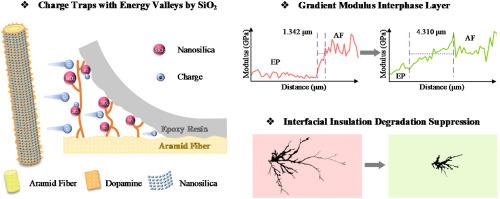
抑制芳纶/环氧复合材料绝缘降解的仿生界面改性策略
由于电荷积累和固有模量不匹配,在AF/EP界面上容易发生界面失效,因此在电绝缘应用中为芳纶纤维/环氧树脂(AF/EP)复合材料设计有效的界面尤其具有挑战性。受贻贝足丝和珍珠层的启发,本研究开发了一种仿生界面修饰策略,该策略通过分层组装方法将聚多巴胺涂层和纳米二氧化硅(SiO2)集成到纤维表面。结果表明:复合材料的界面剪切强度和层间剪切强度分别提高了126.46%和47.86%,这是界面结合强度增强、机械联锁和梯度模量过渡层成功构建的协同作用所致。此外,SiO2还引入了更多的电荷陷阱和能量散射中心。因此,高压下的界面绝缘退化过程在通道长度、累积损伤面积和击穿时间中受到显著抑制。与未改性的AF/EP复合材料相比,改性后的复合材料具有优异的介电性能,直流电导率降低83.38%,介电损耗降低10.36%,击穿强度提高29.43%。这种界面功能化策略为提高AF/EP复合材料的性能提供了新的见解,该复合材料可用于承受电气和机械联合应力的高端电力设备。
本文章由计算机程序翻译,如有差异,请以英文原文为准。
求助全文
约1分钟内获得全文
求助全文
来源期刊
Composites Science and Technology
工程技术-材料科学:复合
CiteScore
16.20
自引率
9.90%
发文量
611
审稿时长
33 days
期刊介绍:
Composites Science and Technology publishes refereed original articles on the fundamental and applied science of engineering composites. The focus of this journal is on polymeric matrix composites with reinforcements/fillers ranging from nano- to macro-scale. CSTE encourages manuscripts reporting unique, innovative contributions to the physics, chemistry, materials science and applied mechanics aspects of advanced composites.
Besides traditional fiber reinforced composites, novel composites with significant potential for engineering applications are encouraged.
 求助内容:
求助内容: 应助结果提醒方式:

 京公网安备 11010802042870号


