
Operando Infrared Thermography and Quantitative Insights into Lithium Plating Dynamics on Electrodes during Fast Charging
IF 8.4
2区 工程技术
Q1 CHEMISTRY, PHYSICAL
Journal of Power Sources
Pub Date : 2026-05-15
Epub Date: 2026-03-02
DOI:10.1016/j.jpowsour.2026.239676
引用次数: 0
Abstract
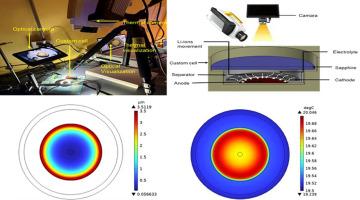
Lithium-ion batteries (LIBs) are critical to enabling electric vehicles and grid storage due to their high energy density and longevity. However, the development of extreme fast-charging (XFC) protocols is challenged by non-uniform thermal behavior that promotes lithium plating—a key degradation mechanism compromising safety and cycle life. This work presents an integrated approach combining operando infrared (IR) thermography and validated physics-based modeling to quantify spatial temperature gradients and their influence on lithium plating in custom-designed graphite | Li half-cells during high-rate charging. Geometry-driven current localization causes thermal hotspots and localized Li plating via electro-thermal coupling. This study provides mechanistic insight into how geometry-driven current localization couples with temperature gradients to bias where plating nucleates and grows in an operando half-cell. While the absolute plating severity in commercial full cells can differ, the framework identifies electro-thermal localization mechanisms that are relevant for understanding and designing cell hardware and charge protocols to reduce plating risk. The combined experimental-modeling framework advances understanding of plating heterogeneity and provides a pathway for optimizing cell design and charging protocols to enable safe, high-power LIB operation.
快速充电过程中电极上锂电镀动力学的红外热成像和定量研究
锂离子电池(LIBs)由于其高能量密度和寿命,对电动汽车和电网存储至关重要。然而,极端快速充电(XFC)协议的发展受到了热行为不均匀的挑战,这种热行为会促进锂电镀,这是影响安全性和循环寿命的关键降解机制。本研究提出了一种综合方法,结合红外热成像和基于物理验证的建模,量化空间温度梯度及其对高倍率充电时定制设计的石墨| Li半电池镀锂的影响。几何驱动的电流局域化通过电热耦合产生热热点和局域化镀锂。这项研究为几何驱动的电流定位如何与温度梯度耦合到电镀成核和生长的偏置提供了机制见解。虽然商业全电池的绝对电镀严重程度可能有所不同,但该框架确定了与理解和设计电池硬件和充电协议相关的电热定位机制,以降低电镀风险。该组合实验建模框架促进了对镀层非均匀性的理解,并为优化电池设计和充电协议提供了途径,从而实现安全、高功率的LIB操作。
本文章由计算机程序翻译,如有差异,请以英文原文为准。
求助全文
约1分钟内获得全文
求助全文
来源期刊
Journal of Power Sources
工程技术-电化学
CiteScore
16.40
自引率
6.50%
发文量
1249
审稿时长
36 days
期刊介绍:
The Journal of Power Sources is a publication catering to researchers and technologists interested in various aspects of the science, technology, and applications of electrochemical power sources. It covers original research and reviews on primary and secondary batteries, fuel cells, supercapacitors, and photo-electrochemical cells.
Topics considered include the research, development and applications of nanomaterials and novel componentry for these devices. Examples of applications of these electrochemical power sources include:
• Portable electronics
• Electric and Hybrid Electric Vehicles
• Uninterruptible Power Supply (UPS) systems
• Storage of renewable energy
• Satellites and deep space probes
• Boats and ships, drones and aircrafts
• Wearable energy storage systems
 求助内容:
求助内容: 应助结果提醒方式:

 京公网安备 11010802042870号


