
Metal-free synthesis of benzimidazoles via pyridinium-catalyzed silane activation under atmospheric CO₂
IF 4.2
Q2 CHEMISTRY, MULTIDISCIPLINARY
引用次数: 0
Abstract
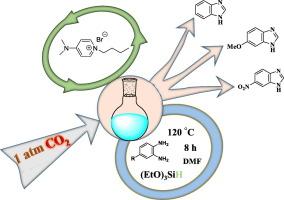
The conversion of CO₂ into valuable nitrogen-containing heterocycles represents an attractive and sustainable strategy in green chemistry. In this work, an efficient metal-free catalytic system was developed for synthesizing benzimidazoles under mild conditions. This system utilizes the ionic liquid 1-butyl-4-(dimethylamino)pyridinium bromide ([C4DMAP]Br) in combination with triethoxysilane as a hydride donor. The ionic liquid provides a synergistic Brønsted acidic and nucleophilic environment that effectively activates both o-phenylenediamine and the CO₂-derived intermediates, facilitating the hydride-transfer pathway. Under optimal conditions (atmospheric CO₂ pressure, 120 °C, 0.12 mmol of IL and 8 h) the reaction produced the target benzimidazoles in an excellent yield of 93%. Substrate scope studies confirmed the applicability of this system to a variety of substituted o-phenylenediamines. Notably, the catalyst could be readily recovered and reused for several consecutive cycles without significant loss of activity, demonstrating its good stability and operational practicality. Overall, this work provides a promising and sustainable approach for the fixation of CO₂ into valuable benzimidazole derivatives, contributing to the development of green, recyclable catalytic systems.
吡啶催化硅烷活化在大气CO₂条件下无金属合成苯并咪唑
将CO₂转化为有价值的含氮杂环是绿色化学中一种具有吸引力和可持续性的策略。本文研究了一种在温和条件下合成苯并咪唑的高效无金属催化体系。该体系利用离子液体1-丁基-4-(二甲氨基)溴化吡啶([C4DMAP]Br)与三乙氧基硅烷结合作为氢化物供体。离子液体提供了一个协同的Brønsted酸性和亲核环境,可以有效地激活邻苯二胺和CO₂衍生的中间体,促进氢化物转移途径。在最佳条件下(常压CO₂,120℃,0.12 mmol IL, 8 h),以93%的优异收率生成目标苯并咪唑。底物范围研究证实了该体系对多种取代邻苯二胺的适用性。值得注意的是,该催化剂可以很容易地回收并重复使用几个连续循环,而没有明显的活性损失,表明其具有良好的稳定性和操作实用性。总的来说,这项工作为将CO₂固定为有价值的苯并咪唑衍生物提供了一种有前途的可持续方法,有助于开发绿色,可回收的催化体系。
本文章由计算机程序翻译,如有差异,请以英文原文为准。
求助全文
约1分钟内获得全文
求助全文

 求助内容:
求助内容: 应助结果提醒方式:

 京公网安备 11010802042870号


