
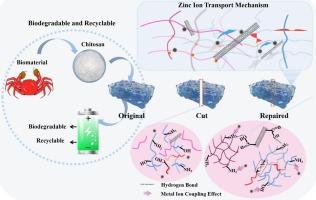
A biomass hydrogel electrolyte with a 3D dynamic interpenetrating network structure exhibting enhanced self-healing and electrochemical performances
IF 5.1
3区 工程技术
Q1 CHEMISTRY, APPLIED
Reactive & Functional Polymers
Pub Date : 2026-06-01
Epub Date: 2026-03-08
DOI:10.1016/j.reactfunctpolym.2026.106721
引用次数: 0
Abstract
A self-healing hydrogel electrolyte was fabricated by integrating CNTs-COOH as a three-dimensional conductive scaffold, demonstrating synergistic properties of enhanced electrochemical performance and biodegradability. This well-designed strategy for introducing CNTs-COOH can not only improve the mechanical properties and self-healing performance of the hydrogel electrolyte, but also booste its electrical conductivity. The results showed that when CNTs-COOH content was 0.1 wt%, the tensile strength of the CPZC-0.1C gel reached 63.93 kPa, up from 17.78 kPa, while the stress self-healing efficiency achieved 98.49%. More critically, the battery assembled with CPZC-0.1C delivered an ionic conductivity of 2.63 × 10⁻³ S cm−1, retained ∼73% of its initial capacity after 2000 cycles at 2 A g−1, with a Coulombic efficiency close to 91%, exhibited satisfactory long-term cycling stability, good rate capability and excellent Coulomb efficiency. Even after three cut/self-healing events within 200 cycles, the battery still maintained ∼60% of its capacity, evidencing outstanding multi-cycle self-healing stability. The electrochemical performance of the healed battery is virtually identical to that of the pristine battery. Moreover, CPZC-0.1C gel electrolytes are environmentally safe and ambietly degradable, making them sustainable candidates for eco-friendly batteries with promising application prospects.
一种具有三维动态互穿网络结构的生物质水凝胶电解质,具有增强的自愈和电化学性能
将碳纳米管- cooh作为三维导电支架,制备了一种自修复的水凝胶电解质,显示出增强电化学性能和生物降解性的协同特性。这种精心设计的引入碳纳米管- cooh的策略不仅可以改善水凝胶电解质的力学性能和自愈性能,还可以提高其导电性。结果表明,当CNTs-COOH含量为0.1 wt%时,CPZC-0.1C凝胶的抗拉强度由17.78 kPa提高到63.93 kPa,应力自愈效率达到98.49%。更重要的是,CPZC-0.1C组装的电池离子电导率为2.63 × 10⁻³ S cm−1,在2 A g−1下循环2000次后仍保持初始容量的约73%,库仑效率接近91%,具有令人满意的长期循环稳定性,具有良好的倍率能力和出色的库仑效率。即使在200个周期内发生三次切割/自愈事件后,电池仍然保持其容量的约60%,证明了出色的多周期自愈稳定性。修复后的电池的电化学性能几乎与原始电池相同。此外,CPZC-0.1C凝胶电解质具有环境安全性和可降解性,是具有良好应用前景的环保电池的可持续候选材料。
本文章由计算机程序翻译,如有差异,请以英文原文为准。
求助全文
约1分钟内获得全文
求助全文
来源期刊
Reactive & Functional Polymers
工程技术-高分子科学
CiteScore
8.90
自引率
5.90%
发文量
259
审稿时长
27 days
期刊介绍:
Reactive & Functional Polymers provides a forum to disseminate original ideas, concepts and developments in the science and technology of polymers with functional groups, which impart specific chemical reactivity or physical, chemical, structural, biological, and pharmacological functionality. The scope covers organic polymers, acting for instance as reagents, catalysts, templates, ion-exchangers, selective sorbents, chelating or antimicrobial agents, drug carriers, sensors, membranes, and hydrogels. This also includes reactive cross-linkable prepolymers and high-performance thermosetting polymers, natural or degradable polymers, conducting polymers, and porous polymers.
Original research articles must contain thorough molecular and material characterization data on synthesis of the above polymers in combination with their applications. Applications include but are not limited to catalysis, water or effluent treatment, separations and recovery, electronics and information storage, energy conversion, encapsulation, or adhesion.
 求助内容:
求助内容: 应助结果提醒方式:

 京公网安备 11010802042870号


