
A review of perovskite catalysts for automotive exhaust soot conversion: Structure, activity and design strategies
IF 5.8
Q2 CHEMISTRY, MULTIDISCIPLINARY
引用次数: 0
Abstract
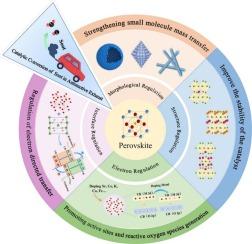
The soot particles in automobile exhaust are one of the main pollutants causing atmospheric pollution and posing health hazards to humans, and their efficient catalytic conversion is crucial for meeting increasingly stringent emission regulations. This review comprehensively summarizes recent advances in catalytic soot particles conversion, with a special focus on catalyst design, reaction mechanisms, and practical conversion processes. First, the unique advantages of perovskite catalysts are analyzed in detail, encompassing compositional tunability (A/B-site doping), modulation of electronic properties, structural design, and synthesis methodologies. Second, the reaction mechanisms of catalytic soot particles oxidation are thoroughly investigated research, specifically including: the formation and migration mechanisms of reactive oxygen species (O₂−, O−, O2−), physicochemical interactions at the soot-catalyst contact interface, and reaction pathways and kinetics. This review specifically dissects the key roles of lattice oxygen activity, oxygen vacancy concentration, and surface properties in perovskite catalysts in the reaction mechanisms. Ultimately, the forward-looking perspectives are provided regarding rational design principles, mechanistic research advancement, and prospects for scalable implementation of high-performance soot catalysts, particularly perovskite-based systems. This work aims to establish theoretical frameworks and practical guidelines for developing efficient, durable, and cost-effective catalytic soot particles conversion technologies, thereby advancing the eco-friendly evolution of automotive exhaust aftertreatment systems.
汽车尾气烟尘转化用钙钛矿催化剂的研究进展:结构、活性和设计策略
汽车尾气中的烟尘颗粒是造成大气污染和危害人类健康的主要污染物之一,其高效催化转化对满足日益严格的排放法规至关重要。本文综述了近年来催化烟尘颗粒转化的研究进展,重点介绍了催化烟尘颗粒转化的催化剂设计、反应机理和实际转化过程。首先,详细分析了钙钛矿催化剂的独特优势,包括成分可调性(A/ b位掺杂)、电子性质的调制、结构设计和合成方法。其次,深入研究了催化烟灰颗粒氧化的反应机理,具体包括:活性氧(O₂−,O−,O2−)的形成和迁移机制,烟灰-催化剂接触界面的物理化学相互作用,反应途径和动力学。本文重点剖析了钙钛矿催化剂中晶格氧活度、氧空位浓度和表面性质在反应机理中的关键作用。最后,对合理的设计原则、机理研究进展以及高性能煤烟催化剂(特别是钙钛矿基催化剂)的可扩展应用前景进行了前瞻性展望。本研究旨在为开发高效、耐用、经济的催化烟尘颗粒转化技术建立理论框架和实践指南,从而推动汽车尾气后处理系统的生态友好化发展。
本文章由计算机程序翻译,如有差异,请以英文原文为准。
求助全文
约1分钟内获得全文
求助全文

 求助内容:
求助内容: 应助结果提醒方式:

 京公网安备 11010802042870号


