
Valorization of eggshell waste into CaO adsorbents for efficient crystal violet dye removal: kinetics, isotherms, thermodynamic and activation energy studies
IF 4.2
Q2 CHEMISTRY, MULTIDISCIPLINARY
引用次数: 0
Abstract
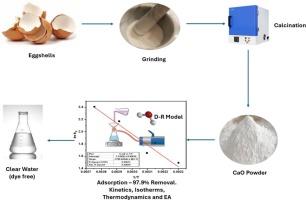
Water pollution from persistent cationic dyes, such as Crystal Violet (CV), poses serious environmental challenges, highlighting the need for sustainable and cost-effective treatment methods. This study aimed to develop an eco-friendly adsorbent from waste eggshells by synthesizing high-purity calcium oxide (CaO) and evaluating its performance for CV removal. The material was characterized using XRF, XRD, and FTIR, confirming CaO as the dominant phase with surface hydration to Ca(OH)₂. Adsorption experiments were optimized using Response Surface Methodology (RSM) with a Central Composite Design, revealing that the initial dye concentration was the most influential factor. Under optimal conditions (pH 3, 6.1 g CaO, 90 min, 60 ppm CV), eggshell-derived CaO achieved 97.9% CV removal at. Adsorption followed the Dubinin–Radushkevich isotherm (R2 = 0.9839) and the pseudo-second-order kinetic model (R2 = 0.999), indicating physisorption-driven adsorption. Thermodynamic analysis showed the process to be spontaneous, exothermic (ΔH = −2.27 kJ/mol), and energetically favourable. Importantly, the activation energy (Ea = 14.85 kJ/mol) was determined, providing critical insight into the energy barrier and temperature dependence of adsorption, a parameter rarely reported in literature. This study reinforces and ascertains the potential of eggshell-derived CaO as a low-cost, sustainable adsorbent and fills a key knowledge gap in mechanistic understanding and industrial applicability.
蛋壳废料转化为CaO吸附剂以高效去除结晶紫染料:动力学、等温线、热力学和活化能研究
结晶紫(CV)等持久性阳离子染料造成的水污染构成了严重的环境挑战,突出了对可持续和具有成本效益的处理方法的需求。本研究旨在利用废蛋壳合成高纯氧化钙(CaO),开发一种环保型吸附剂,并对其去除CV的性能进行评价。采用XRF、XRD和FTIR对材料进行了表征,证实CaO为主要相,表面与Ca(OH) 2水化。采用响应面法(RSM)和中心复合设计对吸附实验进行优化,发现初始染料浓度是影响吸附效果的主要因素。在最佳条件下(pH 3, 6.1 g CaO, 90 min, 60 ppm CV),蛋壳提取的CaO去除率达到97.9%。吸附遵循Dubinin-Radushkevich等温线(R2 = 0.9839)和拟二级动力学模型(R2 = 0.999),表明吸附是物理吸附驱动的。热力学分析表明,该过程是自发的,放热的(ΔH = - 2.27 kJ/mol),并且能量有利。重要的是,测定了活化能(Ea = 14.85 kJ/mol),提供了对吸附的能量势垒和温度依赖性的关键见解,这是文献中很少报道的参数。本研究强化并确定了蛋壳提取的氧化钙作为低成本、可持续吸附剂的潜力,填补了在机理理解和工业应用方面的关键知识空白。
本文章由计算机程序翻译,如有差异,请以英文原文为准。
求助全文
约1分钟内获得全文
求助全文

 求助内容:
求助内容: 应助结果提醒方式:

 京公网安备 11010802042870号


