
Clay surface modification with cationic surfactant and their thermal, morphological and crystal structure analysis
IF 4.2
Q2 CHEMISTRY, MULTIDISCIPLINARY
引用次数: 0
Abstract
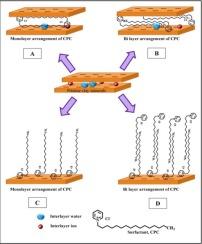
The current work used ion exchange techniques to investigate the interactions of the cationic surfactant cetylpyridinium chloride (CPC) with naturally occurring clays like vermiculite (Vt), bentonite (Bent), and montmorillonite (Mmt). Characterization techniques such as X-ray diffraction (XRD), Fourier transform infra-red (FT-IR) spectroscopy, scanning electron microscopy (SEM), transmission electron microscopy (TEM), and zeta sizer are used to confirm that the surfactant either intercalates in the interlayer region of clay minerals or interacts onto the surface due to electrostatic interaction during interaction. The end products of CPC interaction are referred to as organo clays. The intercalation of surfactant in the interlayer of clay minerals by substituting their interlayer ions was further supported by the XRD pattern in the cases of Montmorillonite and Bentonite, which showed an increase in basal spacing. The existence of two additional vibrational bands, asymmetric and symmetric stretching of the CPC's methylene group, indicated surface interaction between the surfactant and clay minerals in the FT-IR spectra. Following alteration, there was no discernible change in the morphology of the clay minerals. According to TEM pictures, the particle size of the organo clays was between 4 and 50 nm. The surface interaction of CPC with clay minerals was further validated by the notable shift in surface charge data obtained from the zeta sizer.
阳离子表面活性剂对粘土表面的改性及其热、形貌和晶体结构分析
目前的工作使用离子交换技术来研究阳离子表面活性剂十六烷基吡啶氯化(CPC)与天然粘土(如蛭石(Vt)、膨润土(Bent)和蒙脱土(Mmt))的相互作用。利用x射线衍射(XRD)、傅里叶变换红外(FT-IR)光谱、扫描电子显微镜(SEM)、透射电子显微镜(TEM)和zeta浆料等表征技术证实了表面活性剂在粘土矿物的层间区插入或在相互作用过程中由于静电相互作用而与表面相互作用。CPC相互作用的最终产物称为有机粘土。在蒙脱土和膨润土的情况下,表面活性剂通过取代粘土矿物层间离子在粘土矿物层间的插层作用得到了XRD图的进一步支持,显示出基间距的增加。在FT-IR光谱中,存在两个额外的振动带,即CPC的亚甲基的不对称和对称拉伸,表明表面活性剂与粘土矿物之间存在表面相互作用。在蚀变之后,粘土矿物的形态没有明显的变化。TEM图显示,有机粘土的粒径在4 ~ 50 nm之间。从zeta分级机获得的表面电荷数据的显著变化进一步证实了CPC与粘土矿物的表面相互作用。
本文章由计算机程序翻译,如有差异,请以英文原文为准。
求助全文
约1分钟内获得全文
求助全文

 求助内容:
求助内容: 应助结果提醒方式:

 京公网安备 11010802042870号


