
Integrated biomarker analysis in type 2 diabetes: soluble CD36, glycine, homocysteine, miR-375, and miR-126

IF 4.2 Q2 CHEMISTRY, MULTIDISCIPLINARY
Results in Chemistry Pub Date : 2026-05-05 Epub Date: 2026-02-26 DOI:10.1016/j.rechem.2026.103179
Roza Talaat Yaseen , Sardar Nouri Ahmad
{"title":"Integrated biomarker analysis in type 2 diabetes: soluble CD36, glycine, homocysteine, miR-375, and miR-126","authors":"Roza Talaat Yaseen ,&nbsp;Sardar Nouri Ahmad","doi":"10.1016/j.rechem.2026.103179","DOIUrl":null,"url":null,"abstract":"<div><div>Type 2 diabetes mellitus (T2DM) is a chronic metabolic disorder characterized by persistent hyperglycemia resulting from insulin resistance and progressive pancreatic β-cell dysfunction, and is associated with an increased risk of microvascular and macrovascular complications. The early detection and prognosis of these complications remain difficult to diagnose and, therefore, require reliable biomarkers. Thus, this study aimed at assessing the diagnostic and prognostic values of sCD36, miR-375, miR-126, glycine, and homocysteine in T2DM patients, and their associations with metabolic and vascular dysfunction. Despite extensive studies, there is still a great need for the discovery of early biomarkers of diabetic complications. This may be important in improving risk stratification and personalized treatment. These biomarkers could perhaps help further in early diagnosis, monitoring of disease progression, and guiding therapeutic interventions, thereby improving patient outcomes. A prospective observational study (July–October 2024) included 180 participants (90 T2DM patients, 90 controls). Biomarkers were assayed in blood samples by ELISA and quantitative PCR (qPCR). Correlation matrices, regression, and comparative tests were used for relationships studies with HbA1c, BMI, lipid profile, and complications such as nephropathy, neuropathy, and retinopathy. T2DM patients showed significantly elevated sCD36 (∼600 ng/mL), homocysteine (∼70 μmol/L), and miR-375 (3.81-fold increase), while glycine and miR-126 were decreased. sCD36 was highly associated with homocysteine (<em>r</em> = 0.71), indicating vascular oxidative stress. Glycine was inversely correlated with sCD36 and miR-375. miR-126 was downregulated and inversely related to HbA1c, cholesterol, and creatinine, indicating its involvement in metabolic impairment. These biomarkers, taken together, offer a comprehensive insight into pathophysiology, disease progression, and complications in T2DM. Their use would be very promising for early detection, risk stratification, and tailored therapy and justifies their inclusion in regular diabetic checkups for better patient management.</div></div>","PeriodicalId":420,"journal":{"name":"Results in Chemistry","volume":"24 ","pages":"Article 103179"},"PeriodicalIF":4.2000,"publicationDate":"2026-05-05","publicationTypes":"Journal Article","fieldsOfStudy":null,"isOpenAccess":false,"openAccessPdf":"","citationCount":"0","resultStr":null,"platform":"Semanticscholar","paperid":null,"PeriodicalName":"Results in Chemistry","FirstCategoryId":"1085","ListUrlMain":"https://www.sciencedirect.com/science/article/pii/S2211715626001529","RegionNum":0,"RegionCategory":null,"ArticlePicture":[],"TitleCN":null,"AbstractTextCN":null,"PMCID":null,"EPubDate":"2026/2/26 0:00:00","PubModel":"Epub","JCR":"Q2","JCRName":"CHEMISTRY, MULTIDISCIPLINARY","Score":null,"Total":0}
引用次数: 0

Abstract

Type 2 diabetes mellitus (T2DM) is a chronic metabolic disorder characterized by persistent hyperglycemia resulting from insulin resistance and progressive pancreatic β-cell dysfunction, and is associated with an increased risk of microvascular and macrovascular complications. The early detection and prognosis of these complications remain difficult to diagnose and, therefore, require reliable biomarkers. Thus, this study aimed at assessing the diagnostic and prognostic values of sCD36, miR-375, miR-126, glycine, and homocysteine in T2DM patients, and their associations with metabolic and vascular dysfunction. Despite extensive studies, there is still a great need for the discovery of early biomarkers of diabetic complications. This may be important in improving risk stratification and personalized treatment. These biomarkers could perhaps help further in early diagnosis, monitoring of disease progression, and guiding therapeutic interventions, thereby improving patient outcomes. A prospective observational study (July–October 2024) included 180 participants (90 T2DM patients, 90 controls). Biomarkers were assayed in blood samples by ELISA and quantitative PCR (qPCR). Correlation matrices, regression, and comparative tests were used for relationships studies with HbA1c, BMI, lipid profile, and complications such as nephropathy, neuropathy, and retinopathy. T2DM patients showed significantly elevated sCD36 (∼600 ng/mL), homocysteine (∼70 μmol/L), and miR-375 (3.81-fold increase), while glycine and miR-126 were decreased. sCD36 was highly associated with homocysteine (r = 0.71), indicating vascular oxidative stress. Glycine was inversely correlated with sCD36 and miR-375. miR-126 was downregulated and inversely related to HbA1c, cholesterol, and creatinine, indicating its involvement in metabolic impairment. These biomarkers, taken together, offer a comprehensive insight into pathophysiology, disease progression, and complications in T2DM. Their use would be very promising for early detection, risk stratification, and tailored therapy and justifies their inclusion in regular diabetic checkups for better patient management.
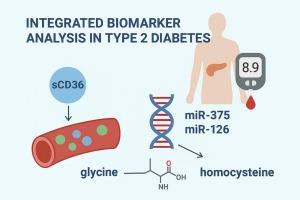
Abstract Image

2型糖尿病的综合生物标志物分析:可溶性CD36、甘氨酸、同型半胱氨酸、miR-375和miR-126
2型糖尿病(T2DM)是一种慢性代谢紊乱,以胰岛素抵抗和胰腺β细胞进行性功能障碍引起的持续高血糖为特征,并与微血管和大血管并发症的风险增加有关。这些并发症的早期发现和预后仍然难以诊断,因此需要可靠的生物标志物。因此,本研究旨在评估sCD36、miR-375、miR-126、甘氨酸和同型半胱氨酸在T2DM患者中的诊断和预后价值,以及它们与代谢和血管功能障碍的关系。尽管进行了广泛的研究,但仍需要发现糖尿病并发症的早期生物标志物。这可能对改善风险分层和个性化治疗很重要。这些生物标志物可能有助于进一步早期诊断,监测疾病进展,指导治疗干预,从而改善患者的预后。一项前瞻性观察性研究(2024年7月至10月)包括180名参与者(90名T2DM患者,90名对照组)。采用酶联免疫吸附法(ELISA)和定量PCR (qPCR)检测血液中生物标志物。相关矩阵、回归和比较试验用于研究与HbA1c、BMI、血脂和并发症(如肾病、神经病变和视网膜病变)的关系。T2DM患者sCD36 (~ 600 ng/mL)、同型半胱氨酸(~ 70 μmol/L)和miR-375(3.81倍升高)显著升高,甘氨酸和miR-126降低。sCD36与同型半胱氨酸高度相关(r = 0.71),提示血管氧化应激。甘氨酸与sCD36和miR-375呈负相关。miR-126下调,与HbA1c、胆固醇和肌酐呈负相关,表明其参与代谢损伤。这些生物标志物结合在一起,为T2DM的病理生理学、疾病进展和并发症提供了全面的见解。它们在早期发现、风险分层和量身定制治疗方面的应用非常有希望,并证明将它们纳入定期糖尿病检查以更好地管理患者是合理的。
本文章由计算机程序翻译,如有差异,请以英文原文为准。
求助全文
约1分钟内获得全文 求助全文
来源期刊
Results in Chemistry
Results in Chemistry Chemistry-Chemistry (all)
CiteScore
2.70
自引率
8.70%
发文量
380
审稿时长
56 days
×
引用
GB/T 7714-2015
复制
MLA
复制
APA
复制
导出至
BibTeX EndNote RefMan NoteFirst NoteExpress
×
提示
您的信息不完整,为了账户安全,请先补充。
现在去补充
×
提示
您因"违规操作"
具体请查看互助需知
我知道了
×
提示
确定
请完成安全验证×
copy
已复制链接
快去分享给好友吧!
我知道了
右上角分享
点击右上角分享
0
联系我们:info@booksci.cn Book学术提供免费学术资源搜索服务,方便国内外学者检索中英文文献。致力于提供最便捷和优质的服务体验。 Copyright © 2023 布克学术 All rights reserved.
京ICP备2023020795号-1
ghs 京公网安备 11010802042870号
Book学术文献互助
Book学术文献互助群
群 号:604180095
Book学术官方微信
小红书



