
Folding of a single layer in an effectively anisotropic host: the role of viscosity stratification and confinement on growth rates and fold patterns
IF 3
2区 地球科学
Q2 GEOSCIENCES, MULTIDISCIPLINARY
Journal of Structural Geology
Pub Date : 2026-05-01
Epub Date: 2026-01-31
DOI:10.1016/j.jsg.2026.105635
引用次数: 0
Abstract
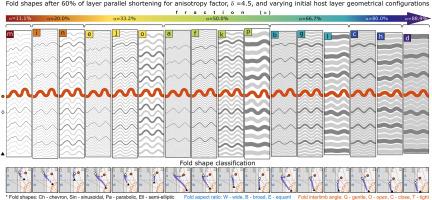
We investigate how multilayer stack geometry and viscosity stratification influences fold shapes, focusing on the case of a competent layer embedded within a layered host subject to 60% layer-parallel shortening. First, we compare the growth rate spectra calculated with an upscaled anisotropic model and a fully discrete multilayer model. We derive a novel analytical expression for growth rates of a single layer embedded in a confined anisotropic medium. The growth rates computed for the layered host case inherently split depending on whether the low- or high viscosity host layer is in contact with the main layer. For fine host layering, their average converges to the growth rates calculated for the equivalent anisotropic host. Further, using a series of two-dimensional finite element numerical simulations, we vary the internal structure of host layering and analyse the resulting fold patterns. To isolate the influence of geometric configuration, we adjust host layer viscosities to maintain a fixed effective host anisotropy factor across the simulations. To quantify fold shapes in deforming multilayer sequences, we propose a new method that is based on reconstructing an average fold shape for each folded layer. Using the fold classification diagram of Srivastava and Lisle (2004), we obtain a robust characterization of the simulated fold geometries and analyse shape variations within each model and across studied multilayer configurations. Our results demonstrate that even for the same effective anisotropy factor, variations in host layer thicknesses produce a wide spectrum of fold shapes, emphasising the important role of host layer geometry in controlling fold development.
有效各向异性宿主中单层的折叠:粘度分层和约束对生长速率和折叠模式的作用
我们研究了多层叠层几何形状和粘度分层如何影响褶皱形状,重点研究了在层状主体中嵌入的胜任层的情况,该层与层平行缩短了60%。首先,我们比较了用各向异性模型和完全离散多层模型计算的生长速率谱。我们导出了一个新的解析表达式,用于计算嵌入在受限各向异性介质中的单层的生长速率。为分层宿主情况计算的增长率固有地分裂取决于低粘度或高粘度宿主层是否与主层接触。对于精细寄主分层,它们的平均值收敛于等效各向异性寄主计算的增长率。此外,利用一系列二维有限元数值模拟,我们改变了宿主分层的内部结构,并分析了由此产生的褶皱模式。为了隔离几何结构的影响,我们调整了宿主层粘度,以在模拟中保持固定的有效宿主各向异性因子。为了量化变形多层序列中的褶皱形状,我们提出了一种基于重建每个褶皱层的平均褶皱形状的新方法。利用Srivastava和Lisle(2004)的褶皱分类图,我们获得了模拟褶皱几何形状的稳健特征,并分析了每个模型内和所研究的多层结构之间的形状变化。我们的研究结果表明,即使对于相同的有效各向异性因子,宿主层厚度的变化也会产生广泛的褶皱形状,强调了宿主层几何形状在控制褶皱发育中的重要作用。
本文章由计算机程序翻译,如有差异,请以英文原文为准。
求助全文
约1分钟内获得全文
求助全文
来源期刊
Journal of Structural Geology
地学-地球科学综合
CiteScore
6.00
自引率
19.40%
发文量
192
审稿时长
15.7 weeks
期刊介绍:
The Journal of Structural Geology publishes process-oriented investigations about structural geology using appropriate combinations of analog and digital field data, seismic reflection data, satellite-derived data, geometric analysis, kinematic analysis, laboratory experiments, computer visualizations, and analogue or numerical modelling on all scales. Contributions are encouraged to draw perspectives from rheology, rock mechanics, geophysics,metamorphism, sedimentology, petroleum geology, economic geology, geodynamics, planetary geology, tectonics and neotectonics to provide a more powerful understanding of deformation processes and systems. Given the visual nature of the discipline, supplementary materials that portray the data and analysis in 3-D or quasi 3-D manners, including the use of videos, and/or graphical abstracts can significantly strengthen the impact of contributions.
 求助内容:
求助内容: 应助结果提醒方式:

 京公网安备 11010802042870号


