
Ionic liquid-functionalized graphene oxide-reinforced-poly(carbazole) nanocomposite anionic membranes for high-performance water electrolysis
IF 9.9
1区 工程技术
Q1 ENGINEERING, CHEMICAL
引用次数: 0
Abstract
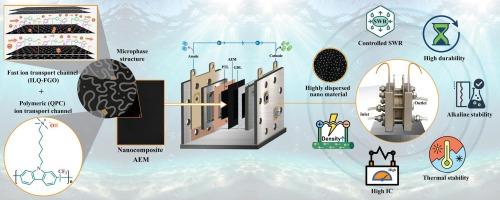
Anion exchange membrane water electrolysis (AEMWE) promises low-cost green hydrogen production but is limited by the anion exchange membranes (AEMs) that must couple high hydroxide (OH−) ion conductivity (IC) with mechanical robustness and alkaline durability. Rigid ether-free poly(carbazole) (PC) backbones help stability, yet transport-swelling trade-offs still cap performance. This study reported ionic liquid-functionalized graphene oxide (ILQ-FGO)-reinforced quaternized poly(carbazole) (QPC) nanocomposite AEMs that integrate a chemically resilient backbone with a cationic two-dimensional (2D) nano-filler to build percolated ion pathways while suppressing excessive swelling. All the AEMs demonstrated a balanced performance of dimensional, mechanical, and electrochemical stability. The optimized QPC-ILQ-FGO-1.5 AEM exhibited the highest IC of 279.3 mS cm−1 at 80 °C, which is approximately a two-fold increase compared to the pristine QPC membrane (156.2 mS cm−1). This membrane also exhibited an impressive single-cell performance, having a peak current density of 4.61 A cm−2 at 2.0 V in 1 M KOH at 60 °C. The mechanical testing suggested an increased tensile strength of 51.55 megapascal (MPa), while alkaline aging (1 M KOH, 60 °C, 504 h) shows ≥92% IC retention by this membrane. The long-term durability testing further validates the robustness of AEMs with a minimal voltage decay rate of 0.35 mV h−1 up to 240 h of stable water electrolysis operation. In summary, the weaving of cation-rich ILQ-FGO into a rigid QPC polymer matrix reconciles the classical transport-stability trade-off, enabling high IC, mechanical strength, and alkaline durability in a scalable platform for advancing high-performing AEMWE technologies.
离子液体功能化氧化石墨烯-聚咔唑纳米复合阴离子膜用于高性能水电解
阴离子交换膜电解(AEMWE)有望实现低成本的绿色制氢,但阴离子交换膜(AEMs)必须将高氢氧离子(OH -)电导率(IC)与机械稳健性和碱性耐久性相结合,因此受到限制。刚性无醚聚咔唑(PC)骨架有助于稳定性,但传输膨胀的权衡仍然限制性能。本研究报道了离子液体功能化氧化石墨烯(ILQ-FGO)增强季铵盐化聚咔唑(QPC)纳米复合材料AEMs,该AEMs将化学弹性骨架与阳离子二维(2D)纳米填料结合在一起,以建立渗透离子途径,同时抑制过度膨胀。所有AEMs均表现出尺寸、机械和电化学稳定性的平衡性能。优化后的QPC- ilq - fgo -1.5 AEM在80°C时的IC最高,为279.3 mS cm−1,比原始QPC膜(156.2 mS cm−1)提高了约两倍。该膜还表现出令人印象深刻的单电池性能,在2.0 V, 1 M KOH, 60°C下具有4.61 a cm−2的峰值电流密度。力学测试表明,该膜的抗拉强度提高了51.55兆帕斯卡(MPa),而碱性老化(1 M KOH, 60°C, 504 h)表明该膜的IC保留率≥92%。长期耐久性测试进一步验证了AEMs的稳健性,在240小时的稳定电解操作中,AEMs的电压衰减率最小,为0.35 mV h - 1。综上所述,将富含阳离子的ILQ-FGO编织成刚性QPC聚合物基质,调和了经典的传输稳定性权衡,在一个可扩展的平台上实现了高集成电路、机械强度和碱性耐久性,从而推进了高性能的AEMWE技术。
本文章由计算机程序翻译,如有差异,请以英文原文为准。
求助全文
约1分钟内获得全文
求助全文
来源期刊
Desalination
工程技术-工程:化工
CiteScore
14.60
自引率
20.20%
发文量
619
审稿时长
41 days
期刊介绍:
Desalination is a scholarly journal that focuses on the field of desalination materials, processes, and associated technologies. It encompasses a wide range of disciplines and aims to publish exceptional papers in this area.
The journal invites submissions that explicitly revolve around water desalting and its applications to various sources such as seawater, groundwater, and wastewater. It particularly encourages research on diverse desalination methods including thermal, membrane, sorption, and hybrid processes.
By providing a platform for innovative studies, Desalination aims to advance the understanding and development of desalination technologies, promoting sustainable solutions for water scarcity challenges.
 求助内容:
求助内容: 应助结果提醒方式:

 京公网安备 11010802042870号


