
Techno-economic assessment of the manufacturing of NMC811 cathode active material
IF 8.4
2区 工程技术
Q1 CHEMISTRY, PHYSICAL
Journal of Power Sources
Pub Date : 2026-05-15
Epub Date: 2026-03-09
DOI:10.1016/j.jpowsour.2026.239534
引用次数: 0
Abstract
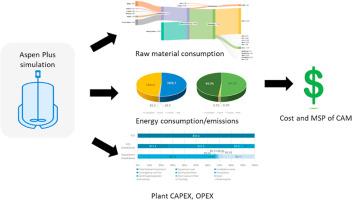
The manufacturing of cathode active materials (CAM) remains a focal point to improve the cost of Li-ion battery packs. A flexible process-level model has been developed and applied to determine key performance indicators of the manufacturing process of NMC811, via co-precipitation. The model predicts that nickel sulphate has the highest rate of consumption at 3.06 kg/kg CAM, followed by manganese sulphate at 0.41 kg/kg CAM, cobalt sulphate and lithium hydroxide at 0.25 kg/kg CAM, however, results carry a level of uncertainty associated with kinetic data used to model the precipitation reaction. The cost of CAM is determined to be $25.6 per kg CAM for the base case and can vary in the range $16.1–$48.4 per kg CAM, similarly, the minimum selling price of goods was determined at $32.3 per kg CAM and can fluctuate in the range $16.3 – $60.9 per kg CAM. The strength of the approach presented here lies in the capability of the model to incorporate detailed data regarding the chemistry of the system, allowing for further expansion of the model to conduct optimization studies.
NMC811正极活性材料制造的技术经济评价
阴极活性材料(CAM)的制造仍然是提高锂离子电池组成本的焦点。建立了一种柔性工艺级模型,并将其应用于共沉淀法确定NMC811制造工艺的关键性能指标。该模型预测,硫酸镍的消耗率最高,为3.06 kg/kg CAM,其次是硫酸锰,为0.41 kg/kg CAM,硫酸钴和氢氧化锂为0.25 kg/kg CAM,然而,与用于模拟沉淀反应的动力学数据相关的结果存在一定程度的不确定性。在基本情况下,CAM的成本确定为每公斤CAM 25.6美元,可在每公斤CAM 16.1美元至48.4美元的范围内波动,同样,货物的最低销售价格确定为每公斤CAM 32.3美元,可在每公斤CAM 16.3美元至60.9美元的范围内波动。这里提出的方法的优势在于模型能够包含有关系统化学的详细数据,从而允许进一步扩展模型以进行优化研究。
本文章由计算机程序翻译,如有差异,请以英文原文为准。
求助全文
约1分钟内获得全文
求助全文
来源期刊
Journal of Power Sources
工程技术-电化学
CiteScore
16.40
自引率
6.50%
发文量
1249
审稿时长
36 days
期刊介绍:
The Journal of Power Sources is a publication catering to researchers and technologists interested in various aspects of the science, technology, and applications of electrochemical power sources. It covers original research and reviews on primary and secondary batteries, fuel cells, supercapacitors, and photo-electrochemical cells.
Topics considered include the research, development and applications of nanomaterials and novel componentry for these devices. Examples of applications of these electrochemical power sources include:
• Portable electronics
• Electric and Hybrid Electric Vehicles
• Uninterruptible Power Supply (UPS) systems
• Storage of renewable energy
• Satellites and deep space probes
• Boats and ships, drones and aircrafts
• Wearable energy storage systems
 求助内容:
求助内容: 应助结果提醒方式:

 京公网安备 11010802042870号


