
Study on a two-stage desiccant wheel dehumidification deep mine cooling system driven by mine water source heat pump
IF 6.4
2区 工程技术
Q1 THERMODYNAMICS
Case Studies in Thermal Engineering
Pub Date : 2026-04-01
Epub Date: 2026-03-06
DOI:10.1016/j.csite.2026.107896
引用次数: 0
Abstract
Deep mining is the primary direction for future mine development. However, deep mining causes heat damage, which seriously affects work efficiency and worker health. To satisfy the requirements of thermal comfort, a two-stage desiccant wheel dehumidification deep mine cooling system driven by mine water source heat pump (TSDW-DMCS-MWSHP) is proposed. The system consists of a two-stage desiccant wheel, water source heat pump, air cooler, and air heater. A water source heat pump is used to realize the dual supply of cold and heat, which provides cold and heat sources for cooling the mine airflow and heating the regeneration air. A two-stage desiccant wheel is used to achieve deep dehumidification. A heat and mass transfer model of the system is established and simulated. The effects of the main operating parameters on energy, dehumidification, and exergy performances are systematically investigated. The results show that when the inlet temperature of the mine airflow is 32 °C and the relative humidity is 80 %, the system can achieve a temperature difference of 6 °C, a humidity ratio difference of 11.7 g/kg, and an enthalpy difference of 36.1 kJ/kg. When the two-stage desiccant wheel operates at a low regeneration temperature of 60 °C, the TCOP, DCOP, and exergy efficiency reach their peak values of 2.8, 0.9, and 68.9 %, respectively. Compared with the ground centralized refrigeration system, the supply air relative humidity of the TSDW-DMCS-MWSHP is reduced by 13.3 %, and the COP is increased by 16 %. The TSDW-DMCS-MWSHP offers a viable solution for mitigating mine heat damage and advancing the sustainable development in the mining industry.
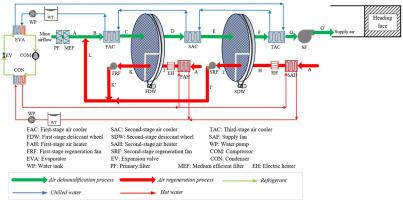
矿井水源热泵驱动的两级干燥剂轮除湿深部矿井冷却系统研究
深部开采是未来矿山发展的主要方向。然而,深部开采会造成热损伤,严重影响工作效率和工人身体健康。为满足矿井热舒适性的要求,提出了一种由矿井水源热泵驱动的两级干燥剂轮除湿矿井深部冷却系统。该系统由两级干燥剂轮、水源热泵、空气冷却器和空气加热器组成。采用水源热泵实现冷热双供,为矿井气流的冷却和再生风的加热提供冷热源。采用两级除湿轮,实现深度除湿。建立了系统的传热传质模型并进行了仿真。系统地研究了主要运行参数对能量、除湿和火用性能的影响。结果表明,当矿井气流入口温度为32℃,相对湿度为80%时,系统可实现温差6℃,湿比差11.7 g/kg,焓差36.1 kJ/kg。两级干燥剂轮在低再生温度60℃下运行时,TCOP、DCOP和火用效率分别达到峰值2.8、0.9和68.9%。与地面集中制冷系统相比,TSDW-DMCS-MWSHP送风相对湿度降低13.3%,COP提高16%。TSDW-DMCS-MWSHP为减轻矿山热损害,促进矿山可持续发展提供了可行的解决方案。
本文章由计算机程序翻译,如有差异,请以英文原文为准。
求助全文
约1分钟内获得全文
求助全文
来源期刊
Case Studies in Thermal Engineering
Chemical Engineering-Fluid Flow and Transfer Processes
CiteScore
8.60
自引率
11.80%
发文量
812
审稿时长
76 days
期刊介绍:
Case Studies in Thermal Engineering provides a forum for the rapid publication of short, structured Case Studies in Thermal Engineering and related Short Communications. It provides an essential compendium of case studies for researchers and practitioners in the field of thermal engineering and others who are interested in aspects of thermal engineering cases that could affect other engineering processes. The journal not only publishes new and novel case studies, but also provides a forum for the publication of high quality descriptions of classic thermal engineering problems. The scope of the journal includes case studies of thermal engineering problems in components, devices and systems using existing experimental and numerical techniques in the areas of mechanical, aerospace, chemical, medical, thermal management for electronics, heat exchangers, regeneration, solar thermal energy, thermal storage, building energy conservation, and power generation. Case studies of thermal problems in other areas will also be considered.
 求助内容:
求助内容: 应助结果提醒方式:

 京公网安备 11010802042870号


