
Low-cost rare-earth-oxide-derived Li3TmCl4Br2 halide electrolyte with superior ionic conductivity for all-solid-state batteries
IF 8.4
2区 工程技术
Q1 CHEMISTRY, PHYSICAL
Journal of Power Sources
Pub Date : 2026-05-15
Epub Date: 2026-03-06
DOI:10.1016/j.jpowsour.2026.239731
引用次数: 0
Abstract
Halide solid electrolytes (HSEs) are promising for all-solid-state batteries but are hindered by the high cost and hygroscopicity of rare-earth chloride precursors. This study addresses this challenge by developing a novel, cost-effective synthesis strategy. We utilize rare-earth oxides as starting materials and employ an ammonium salt-assisted liquid-phase method to synthesize Li3Tm/LuCl6-based solid electrolytes. Through systematic optimization and strategic Br− doping for partial Cl− substitution, we achieve a superior performer Li3TmCl4Br2. This material exhibits a high room-temperature ionic conductivity of 2.94 mS cm−1. Crucially, this oxide-based route reduces raw material costs by approximately 70%. Furthermore, we resolve the poor interfacial stability with Li metal by applying a Li6PS5Cl modification interlayer which enables stable Li stripping/plating for over 1400 h in symmetric cells. All-solid-state batteries using the modified electrolyte demonstrate excellent electrochemical performance. This work provides a rational design strategy and paves a practical path for the scalable production of high-performance and low-cost HSEs.
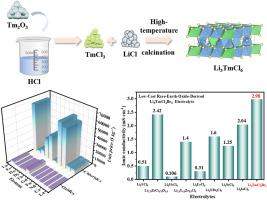
低成本稀土氧化物衍生的Li3TmCl4Br2卤化物电解质,具有优异的离子电导率,用于全固态电池
卤化物固体电解质(HSEs)在全固态电池中很有前途,但由于稀土氯化物前体的高成本和吸湿性而受到阻碍。本研究通过开发一种新颖的、具有成本效益的合成策略来解决这一挑战。以稀土氧化物为原料,采用铵盐辅助液相法合成了Li3Tm/ lucl6基固体电解质。通过系统优化和战略性的Br -掺杂部分Cl -取代,我们获得了性能优越的Li3TmCl4Br2。该材料具有2.94 mS cm−1的高室温离子电导率。至关重要的是,这种基于氧化物的路线将原材料成本降低了约70%。此外,我们通过应用Li6PS5Cl修饰中间层来解决与Li金属的界面稳定性差的问题,该中间层可以在对称电池中稳定剥离/镀Li超过1400小时。采用改性电解质的全固态电池表现出优异的电化学性能。这项工作提供了一个合理的设计策略,并为高性能和低成本的hse的可扩展生产铺平了一条实用的道路。
本文章由计算机程序翻译,如有差异,请以英文原文为准。
求助全文
约1分钟内获得全文
求助全文
来源期刊
Journal of Power Sources
工程技术-电化学
CiteScore
16.40
自引率
6.50%
发文量
1249
审稿时长
36 days
期刊介绍:
The Journal of Power Sources is a publication catering to researchers and technologists interested in various aspects of the science, technology, and applications of electrochemical power sources. It covers original research and reviews on primary and secondary batteries, fuel cells, supercapacitors, and photo-electrochemical cells.
Topics considered include the research, development and applications of nanomaterials and novel componentry for these devices. Examples of applications of these electrochemical power sources include:
• Portable electronics
• Electric and Hybrid Electric Vehicles
• Uninterruptible Power Supply (UPS) systems
• Storage of renewable energy
• Satellites and deep space probes
• Boats and ships, drones and aircrafts
• Wearable energy storage systems
 求助内容:
求助内容: 应助结果提醒方式:

 京公网安备 11010802042870号


