
Is the cloud absorption of solar radiation still underestimated notably by current model-based reanalyses?
IF 5.6
1区 地球科学
Q1 ENVIRONMENTAL SCIENCES
Advances in Climate Change Research
Pub Date : 2026-01-01
Epub Date: 2025-10-23
DOI:10.1016/j.accre.2025.10.003
引用次数: 0
Abstract
Cloud absorption of solar radiation strongly influences Earth’s radiation balance and climate change. Whether numerical models underestimate this absorption compared with observations has long been a highly debated issue in cloud–radiation research. Using state-of-the-art model-derived reanalyses, NCEP CFSv2, ECMWF ERA5, and NASA MERRA2, and the latest collocated satellite-surface observation in 2012–2023, we reinvestigate this controversial issue. The results demonstrate the observed cloud absorption of solar radiation still notably exceeds the modeled (regardless of model products), but their discrepancy has dropped a lot, particularly for NCEP CFSv2 and ECMWF ERA5. While a further investigation is needed, the reduced discrepancy may reflect the progress of shortwave radiation schemes in models, notably the integration of Rapid Radiative Transfer Model for General Circulation Models (RRTMG) and the Monte Carlo Independent Column Approximation (McICA). Additionally, it is noteworthy that there is not a perfect approach to obtaining the observed cloud absorption, and particularly the water vapor difference between clear and cloudy skies will often result in its unrealistic overestimation. If the impact from the water vapor difference is corrected, NCEP CFSv2, ECMWF ERA5, and NASA MERRA2 underestimate globally-mean cloud absorption by approximately 8.26, 14.50 and 16.51 W/m2, respectively.
当前基于模型的再分析是否仍然低估了云对太阳辐射的吸收?
云对太阳辐射的吸收强烈地影响着地球的辐射平衡和气候变化。与观测相比,数值模型是否低估了这种吸收一直是云辐射研究中一个备受争议的问题。利用最先进的模型衍生再分析,NCEP CFSv2、ECMWF ERA5和NASA MERRA2,以及2012-2023年最新的卫星地面观测数据,我们重新研究了这一有争议的问题。结果表明,观测到的云对太阳辐射的吸收仍然明显超过模型(与模型产品无关),但两者之间的差异已经下降了很多,特别是NCEP CFSv2和ECMWF ERA5。虽然需要进一步的研究,但差异的减小可能反映了模式中短波辐射方案的进展,特别是一般环流模式的快速辐射传输模式(RRTMG)和蒙特卡罗独立柱近似(McICA)的整合。此外,值得注意的是,没有一个完美的方法来获得观测到的云吸收,特别是晴天和多云天空之间的水蒸气差异往往会导致其不切实际的高估。如果对水汽差的影响进行校正,NCEP CFSv2、ECMWF ERA5和NASA MERRA2分别低估了全球平均云吸收量约8.26、14.50和16.51 W/m2。
本文章由计算机程序翻译,如有差异,请以英文原文为准。
求助全文
约1分钟内获得全文
求助全文
来源期刊
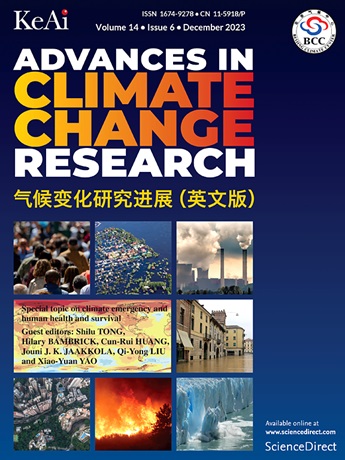
Advances in Climate Change Research
Earth and Planetary Sciences-Atmospheric Science
CiteScore
9.80
自引率
4.10%
发文量
424
审稿时长
107 days
期刊介绍:
Advances in Climate Change Research publishes scientific research and analyses on climate change and the interactions of climate change with society. This journal encompasses basic science and economic, social, and policy research, including studies on mitigation and adaptation to climate change.
Advances in Climate Change Research attempts to promote research in climate change and provide an impetus for the application of research achievements in numerous aspects, such as socioeconomic sustainable development, responses to the adaptation and mitigation of climate change, diplomatic negotiations of climate and environment policies, and the protection and exploitation of natural resources.
 求助内容:
 应助结果提醒方式:


 京公网安备 11010802042870号


