
Novel Directly Reusable Column Base Connection: Experimental Investigations on the Effects of Baseplate and Connector Thickness
IF 6.6
1区 工程技术
Q1 ENGINEERING, CIVIL
引用次数: 0
Abstract
The significance of reusable connections has surged recently due to increasing waste generation and the extraction of natural resources within the construction industry. The adoption of interlocking systems has become prominent in contemporary structural connections due to their ease of assembly. This paper examines the newly developed hold-down type reusable column base connection, which is based on a plate interlocking mechanism. Specifically, it investigates the effects of base plate thickness and connector thickness under monotonic lateral loading. The reusability of the newly developed connection is demonstrated through repeated loading tests, indicating that the column base connection can be dismantled and reused. The loading regimen includes two initial cycles up to the yield strength, followed by a final loading cycle leading to ultimate failure, thereby establishing the connection's reusability. The degree of semi-rigidity is assessed by comparing the connection's rotational stiffness to that of pinned and fixed connections. The experimental results in this study provided a technical base to understand the structural behaviour of the connection and, in turn, develop a theoretical approach to predict the initial elastic stiffness and yield point of the connection, the key parameters that ascertain its eligibility for reuse. The theoretically predicted values align closely with the experimental results obtained. Additionally, a design example is provided to enhance the readers’ understanding and demonstrate the practical applicability of the developed component model for the proposed interlocking-type column base connection.
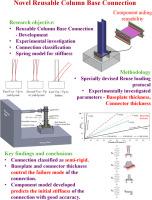
新型直接可重复使用柱基座连接:底板和连接件厚度影响的实验研究
最近,由于建筑行业中废物的产生和自然资源的开采,可重复使用连接的重要性激增。由于易于组装,采用联锁系统在当代结构连接中变得突出。本文研究了新开发的基于板联锁机构的压紧式可重复使用柱基座连接。具体而言,研究了单调侧向荷载作用下底板厚度和连接件厚度的影响。通过反复加载试验验证了新开发的连接的可重复使用性,表明柱基座连接可以拆除并重复使用。加载方案包括两个初始循环,直到屈服强度,然后是最终加载循环,导致最终破坏,从而建立连接的可重用性。通过比较连接的转动刚度与钉住连接和固定连接的转动刚度来评估半刚性程度。本研究的实验结果为理解连接的结构行为提供了技术基础,进而发展了一种理论方法来预测连接的初始弹性刚度和屈服点,这是确定其重复使用资格的关键参数。理论预测值与实验结果吻合较好。此外,还提供了一个设计实例,以加深读者的理解,并说明所开发的构件模型对所提出的联锁式柱基座连接的实用性。
本文章由计算机程序翻译,如有差异,请以英文原文为准。
求助全文
约1分钟内获得全文
求助全文
来源期刊
Thin-Walled Structures
工程技术-工程:土木
CiteScore
9.60
自引率
20.30%
发文量
801
审稿时长
66 days
期刊介绍:
Thin-walled structures comprises an important and growing proportion of engineering construction with areas of application becoming increasingly diverse, ranging from aircraft, bridges, ships and oil rigs to storage vessels, industrial buildings and warehouses.
Many factors, including cost and weight economy, new materials and processes and the growth of powerful methods of analysis have contributed to this growth, and led to the need for a journal which concentrates specifically on structures in which problems arise due to the thinness of the walls. This field includes cold– formed sections, plate and shell structures, reinforced plastics structures and aluminium structures, and is of importance in many branches of engineering.
The primary criterion for consideration of papers in Thin–Walled Structures is that they must be concerned with thin–walled structures or the basic problems inherent in thin–walled structures. Provided this criterion is satisfied no restriction is placed on the type of construction, material or field of application. Papers on theory, experiment, design, etc., are published and it is expected that many papers will contain aspects of all three.
 求助内容:
求助内容: 应助结果提醒方式:

 京公网安备 11010802042870号


