
Rational design of magnetron sputtering modification strategies to unlock the cycle reversibility and rate capability of LiMn0.8Fe0.2PO4 cathodes
IF 5.6
3区 材料科学
Q1 ELECTROCHEMISTRY
引用次数: 0
Abstract
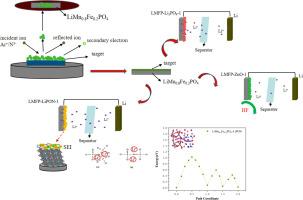
Compared to commercial LiFePO4 (LFP) cathode materials, manganese-based olivine material LiMn0.8Fe0.2PO4 (LMFP) has garnered greater attention due to its comprehensive enhancement of battery performance, particularly achieving significant breakthroughs in energy density. However, its rate performance and cycle life are limited by low charge conduction and Jahn-Teller distortion of Mn3+. To address these issues, this study employed radio-frequency magnetron sputtering to deposit LiPON, ZnO, and Li3PO4 films on LMFP electrodes for comparison. The results demonstrate that the cross-linked network structure formed by nitrogen bidentate and tridentate bonds in LiPON enhances ionic conductivity and interfacial stability. Increasing the LiPON coating layer to 2.4 nm resulted in optimal electrochemical performance of the LiMn0.8Fe0.2PO4 cathodes. The initial discharge capacity was 156.9 mAh g-1 at a rate of 0.1C. The capacities measured during multi-rate charge-discharge experiments at rates ranging from 0.1C to 5C were 147.8 mAh g-1, 141.2 mAh g-1, and 122.7 mAh g-1 at 1C, 2C, and 5C, respectively. There was very little capacity loss when the rate was brought back to 0.1C. Capacity retention rose from 88.0% to 95.7% after 100 cycles at 0.5C. LMFP-LiPON materials have better transition metal states close to the Fermi level and lower band gaps, according to density functional theory (DFT) simulations. In addition to increasing electronic conductivity, accelerating lithium-ion transport, and improving corrosion resistance, these changes significantly reduce the Li migration barrier. The approach offers a strong and adaptable lever for designing lithium-ion batteries of the future.
合理设计磁控溅射改性策略,解锁LiMn0.8Fe0.2PO4阴极的循环可逆性和速率能力
与商用LiFePO4 (LFP)正极材料相比,锰基橄榄石材料LiMn0.8Fe0.2PO4 (LMFP)因其对电池性能的全面提升,特别是在能量密度方面取得了重大突破而备受关注。然而,它的倍率性能和循环寿命受到低电荷传导和Mn3+的Jahn-Teller畸变的限制。为了解决这些问题,本研究采用射频磁控溅射在LMFP电极上沉积LiPON, ZnO和Li3PO4薄膜进行比较。结果表明,LiPON中氮双齿和三齿键形成的交联网络结构增强了离子电导率和界面稳定性。将LiPON涂层层数增加到2.4 nm, LiMn0.8Fe0.2PO4阴极的电化学性能达到最佳。初始放电容量为156.9 mAh g-1,放电速率为0.1C。在0.1C至5C的倍率充放电实验中,在1C、2C和5C的倍率下测得的容量分别为147.8 mAh g-1、141.2 mAh g-1和122.7 mAh g-1。当速率恢复到0.1C时,容量损失很小。在0.5℃下循环100次后,容量保留率从88.0%提高到95.7%。根据密度泛函理论(DFT)模拟,lmpp - lipon材料具有更好的接近费米能级的过渡金属态和更低的带隙。除了提高电子导电性、加速锂离子输运和提高耐腐蚀性外,这些变化还显著降低了锂离子的迁移势垒。这种方法为设计未来的锂离子电池提供了一个强大的、适应性强的杠杆。
本文章由计算机程序翻译,如有差异,请以英文原文为准。
求助全文
约1分钟内获得全文
求助全文
来源期刊
Electrochimica Acta
工程技术-电化学
CiteScore
11.30
自引率
6.10%
发文量
1634
审稿时长
41 days
期刊介绍:
Electrochimica Acta is an international journal. It is intended for the publication of both original work and reviews in the field of electrochemistry. Electrochemistry should be interpreted to mean any of the research fields covered by the Divisions of the International Society of Electrochemistry listed below, as well as emerging scientific domains covered by ISE New Topics Committee.
 求助内容:
求助内容: 应助结果提醒方式:

 京公网安备 11010802042870号


