
Neural bioprinting and regenerative neuroengineering: Integrating geometry, conductivity, and bioactivity towards translational repair
Q1 Computer Science
引用次数: 0
Abstract
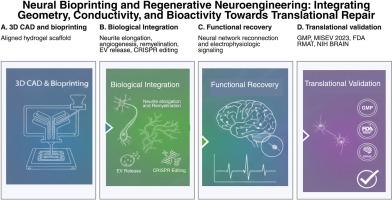
Neural regeneration remains one of the most formidable challenges in regenerative medicine, especially within the central nervous system (CNS) wherein the functional recovery is significantly constrained by inhibitory microenvironments, limited intrinsic plasticity, and poor structural guidance. However, recent advancements in the field of neural bioprinting has enabled remarkable control over scaffold architecture, electromechanical properties, and composition, paving way for fabricating engineered constructs that actively direct neural repair. This review consolidates emerging progress in the field of neural bioprinting through a systems-level framework that integrates biological constraints with design principles governing geometry, electromechanical compliance, and electrophysiological coupling. We analyze how microchannel architectures, compliant and composite bioinks, and electroactive materials can be harnessed to promote optimal axonal alignment, synaptic integration, and coordinated network activity. While our review primarily focuses on CNS repair, where clinical needs and translational are the highest, we have discussed the principles underlying peripheral nervous system (PNS) regeneration as biological design templates that inform scaffold-guided repair strategies. Beyond fabrication strategies, we have also highlighted how neural bioprinting facilitates the spatiotemporal integration of cellular and acellular biologics, transforming growth factors, extracellular vesicles, and gene-based interventions into architecture-dependent therapeutic components. Finally, this review also addresses translational considerations, including manufacturing reproducibility, quality control, and regulatory readiness, and positions neural bioprinting as a convergent platform for advancing the field of regenerative neuroengineering from experimental systems towards clinical translation. This review aims to advance a design-driven framework that integrates biological constraints, biomaterial behavior, and fabrication strategies to delineate actionable principles for translational neural bioprinting.
神经生物打印和再生神经工程:整合几何,电导率和生物活性的翻译修复
神经再生仍然是再生医学中最艰巨的挑战之一,特别是在中枢神经系统(CNS)中,其功能恢复受到抑制微环境,有限的内在可塑性和不良结构引导的显著限制。然而,神经生物打印领域的最新进展使得对支架结构、机电性能和组成的控制成为可能,为制造主动指导神经修复的工程结构铺平了道路。这篇综述通过一个系统级框架整合了生物约束与控制几何、机电顺应性和电生理耦合的设计原则,巩固了神经生物打印领域的新进展。我们分析了如何利用微通道架构、顺应性和复合生物墨水以及电活性材料来促进最佳轴突排列、突触整合和协调网络活动。虽然我们的综述主要集中在临床需求和翻译最高的中枢神经系统修复,但我们已经讨论了周围神经系统(PNS)再生的基本原则,作为指导支架引导修复策略的生物设计模板。除了制造策略,我们还强调了神经生物打印如何促进细胞和非细胞生物制剂的时空整合,将生长因子、细胞外囊泡和基于基因的干预转化为依赖于结构的治疗成分。最后,本综述还讨论了翻译方面的考虑,包括制造可重复性、质量控制和监管准备,并将神经生物打印定位为推动再生神经工程领域从实验系统向临床转化的融合平台。这篇综述旨在推进一个设计驱动的框架,该框架集成了生物学约束、生物材料行为和制造策略,以描述翻译神经生物打印的可操作原则。
本文章由计算机程序翻译,如有差异,请以英文原文为准。
求助全文
约1分钟内获得全文
求助全文
来源期刊

Bioprinting
Computer Science-Computer Science Applications
CiteScore
11.50
自引率
0.00%
发文量
72
审稿时长
68 days
期刊介绍:
Bioprinting is a broad-spectrum, multidisciplinary journal that covers all aspects of 3D fabrication technology involving biological tissues, organs and cells for medical and biotechnology applications. Topics covered include nanomaterials, biomaterials, scaffolds, 3D printing technology, imaging and CAD/CAM software and hardware, post-printing bioreactor maturation, cell and biological factor patterning, biofabrication, tissue engineering and other applications of 3D bioprinting technology. Bioprinting publishes research reports describing novel results with high clinical significance in all areas of 3D bioprinting research. Bioprinting issues contain a wide variety of review and analysis articles covering topics relevant to 3D bioprinting ranging from basic biological, material and technical advances to pre-clinical and clinical applications of 3D bioprinting.
 求助内容:
求助内容: 应助结果提醒方式:

 京公网安备 11010802042870号


