
Sketch-guided stylized landscape cinemagraph synthesis
IF 2.8
4区 计算机科学
Q2 COMPUTER SCIENCE, SOFTWARE ENGINEERING
引用次数: 0
Abstract
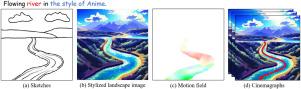
Designing stylized cinemagraphs is challenging due to the difficulty in customizing complex and expressive flow elements. To achieve intuitive and detailed control of the generated cinemagraphs, sketches provide a feasible solution to convey personalized design requirements beyond text inputs. In this paper, we propose Sketch2Cinemagraph, a sketch-guided framework that enables the conditional generation of stylized cinemagraphs from freehand sketches. Sketch2Cinemagraph adopts text prompts for initial landscape generation and provides sketch controls for both spatial and motion cues. The latent diffusion model first generates target stylized landscape images along with realistic versions. Then, a pre-trained object detection model obtains masks for the flow regions. We propose a latent motion diffusion model to estimate motion field in fluid regions of the generated landscape images. The input motion sketches serve as the conditions to control the generated motion fields in the masked fluid regions with the prompt. To synthesize cinemagraph frames, the pixels within fluid regions are warped to target locations at each timestep using a U-Net based frame generator. The results verified that Sketch2Cinemagraph can generate aesthetically appealing stylized cinemagraphs with continuous temporal flow from sketch inputs. We showcase the advantages of Sketch2Cinemagraph through qualitative and quantitative comparisons against the state-of-the-art approaches.
草图引导风格化景观电影合成
设计风格化的电影动画是具有挑战性的,因为很难定制复杂和富有表现力的流元素。为了实现对生成的电影图形的直观和详细的控制,草图提供了一种可行的解决方案,可以在文本输入之外传达个性化的设计要求。在本文中,我们提出了Sketch2Cinemagraph,这是一个草图引导框架,可以从手绘草图中有条件地生成风格化的电影图。Sketch2Cinemagraph采用文本提示进行初始景观生成,并为空间和运动线索提供素描控制。潜在扩散模型首先生成目标风格化的景观图像以及现实版本。然后,预训练的目标检测模型获得流区域的掩码。我们提出了一个潜在的运动扩散模型来估计生成的景观图像的流体区域的运动场。输入的运动草图作为条件,以提示符控制被屏蔽流体区域中生成的运动场。为了合成电影帧,使用基于U-Net的帧生成器在每个时间步将流体区域内的像素扭曲到目标位置。结果验证了Sketch2Cinemagraph可以从草图输入中生成具有连续时间流的美学吸引力的风格化电影。我们通过对最先进的方法进行定性和定量比较,展示了Sketch2Cinemagraph的优势。
本文章由计算机程序翻译,如有差异,请以英文原文为准。
求助全文
约1分钟内获得全文
求助全文
来源期刊
Computers & Graphics-Uk
工程技术-计算机:软件工程
CiteScore
5.30
自引率
12.00%
发文量
173
审稿时长
38 days
期刊介绍:
Computers & Graphics is dedicated to disseminate information on research and applications of computer graphics (CG) techniques. The journal encourages articles on:
1. Research and applications of interactive computer graphics. We are particularly interested in novel interaction techniques and applications of CG to problem domains.
2. State-of-the-art papers on late-breaking, cutting-edge research on CG.
3. Information on innovative uses of graphics principles and technologies.
4. Tutorial papers on both teaching CG principles and innovative uses of CG in education.
 求助内容:
求助内容: 应助结果提醒方式:

 京公网安备 11010802042870号


