
From design to user experience: The creation and assessment of ASANA, an immersive VR task for situation awareness and spatial ability
IF 2.8
4区 计算机科学
Q2 COMPUTER SCIENCE, SOFTWARE ENGINEERING
引用次数: 0
Abstract
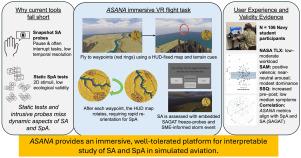
Accurate assessment of situation awareness (SA) and spatial ability (SpA) is critical in aviation, yet SA tools often interrupt tasks or offer limited temporal resolution, while SpA measures frequently rely on static 2D stimuli with low ecological validity. These limitations call for approaches that capture both abilities in realistic, dynamic contexts. Virtual reality (VR) offers this capability by enabling immersive 3D navigation while simultaneously recording performance and multimodal data. However, VR-based assessments must consider user-experience factors such as workload, affect, and simulator sickness, which can influence performance and the interpretability of assessment outcomes. Building on the preliminary study presented at IEEE VR’s Workshop on the eXtended Reality for Industrial and Occupational Supports, this paper describes the design of an immersive flight-navigation task that assesses SA and SpA, called Assessing Spatial Abilities in Naval Aviation (ASANA). We report user-experience outcomes from 106 U.S. Navy students, showing moderate workload, positive valence, near-neutral arousal, and slightly positive dominance. Simulator sickness increased from pre- to post-exposure, but post-exposure medians remained low, indicating generally mild symptoms. The correlation results showed that ASANA navigation efficiency aligned with established desktop-based SpA metrics. In addition, higher freeze-probe SA accuracy was associated with more efficient performance on an embedded, SME-informed in-scenario SA metric. Together, these findings support ASANA as a tolerable, interpretable VR platform for studying SpA and SA in ecologically-grounded context, and motivate future work that leverages synchronized multimodal sensing to model SA dynamics and SpA–SA interactions.
从设计到用户体验:ASANA的创建和评估,这是一个沉浸式VR任务,用于情境感知和空间能力
准确评估态势感知(SA)和空间能力(SpA)在航空领域至关重要,但态势感知工具经常会中断任务或提供有限的时间分辨率,而态势感知措施往往依赖于静态二维刺激,生态效度较低。这些限制需要在现实的动态环境中捕捉这两种能力的方法。虚拟现实(VR)通过实现身临其境的3D导航,同时记录性能和多模式数据,提供了这种功能。然而,基于vr的评估必须考虑用户体验因素,如工作量、影响和模拟器不适,这些因素会影响评估结果的性能和可解释性。在IEEE VR的工业和职业支持扩展现实研讨会上提出的初步研究的基础上,本文描述了评估SA和SpA的沉浸式飞行导航任务的设计,称为评估海军航空中的空间能力(ASANA)。我们报告了106名美国海军学生的用户体验结果,表现出适度的工作量、积极的效价、接近中性的唤醒和轻微的积极支配。从接触前到接触后,模拟器疾病有所增加,但接触后的中位数仍然很低,表明症状一般较轻。相关结果显示,ASANA导航效率与基于桌面的SpA指标一致。此外,更高的冷冻探针SA精度与嵌入的、sme通知的场景SA度量的更有效性能相关。总之,这些发现支持ASANA作为一个可容忍的、可解释的VR平台,用于研究生态基础背景下的SpA和SA,并激励未来利用同步多模态感知来模拟SA动态和SpA - SA相互作用的工作。
本文章由计算机程序翻译,如有差异,请以英文原文为准。
求助全文
约1分钟内获得全文
求助全文
来源期刊
Computers & Graphics-Uk
工程技术-计算机:软件工程
CiteScore
5.30
自引率
12.00%
发文量
173
审稿时长
38 days
期刊介绍:
Computers & Graphics is dedicated to disseminate information on research and applications of computer graphics (CG) techniques. The journal encourages articles on:
1. Research and applications of interactive computer graphics. We are particularly interested in novel interaction techniques and applications of CG to problem domains.
2. State-of-the-art papers on late-breaking, cutting-edge research on CG.
3. Information on innovative uses of graphics principles and technologies.
4. Tutorial papers on both teaching CG principles and innovative uses of CG in education.
 求助内容:
求助内容: 应助结果提醒方式:

 京公网安备 11010802042870号


